- Introduction
- Overview of Ryoan-ji
- History of Ryoan-ji
- 1. Muromachi Period (1450): Founded by Hosokawa Katsumoto—The Central Figure of the Onin War and His Zen Temple
- 2. Late Muromachi to Azuchi-Momoyama Period: The Birth and Mystery of the Rock Garden
- 3. Edo Period: Prosperity and Fire—Lost Halls
- 4. Meiji to Showa: From Anti-Buddhist Movement to World Heritage
- 5. Modern Era: New Discoveries in Rock Garden Research and Legacy for the Future
- Highlights and Recommended Spots
- 1. The Rock Garden (Hojo Garden)—The World’s Greatest Karesansui Masterpiece
- 2. Tsukubai (Stone Water Basin)—The Teaching of “I Learn Only to Be Contented”
- 3. Kyoyochi Pond—The Mandarin Duck Pond of Heian Aristocrats
- 4. Seigenin—A Luxurious Time with Yudofu and Gardens
- 5. Chokushimon Gate and Stone Steps—The Solemn Entrance to a Zen Temple
- Nearby Attractions
- Access
- Summary
- Frequently Asked Questions
Introduction
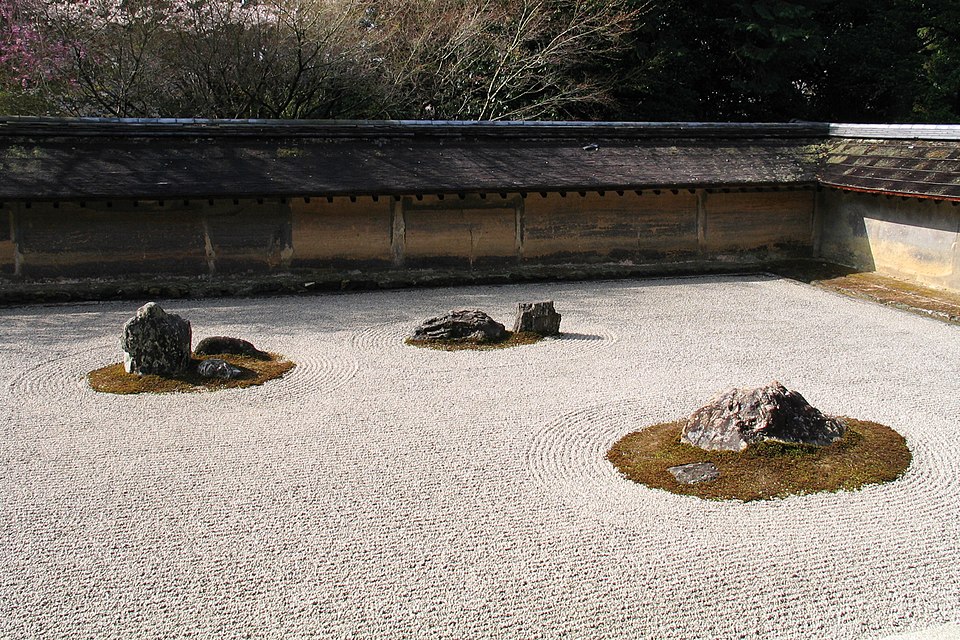
Ryoan-ji Temple stands quietly at the foot of Mount Kinugasa in Kyoto. When most people hear its name, they think of the world-famous rock garden with 15 stones arranged on white sand. In a confined space measuring approximately 25 meters wide and 10 meters deep, this karesansui garden expresses the universe using only stones and sand, completely devoid of any plants. As a symbol of Japanese aesthetic sensibility, it has captivated hearts for over 500 years.
The rock garden of Ryoan-ji has a mysterious characteristic: no matter which angle you view it from, you can never see all 15 stones at the same time. One or two stones are always hidden behind others. Some say this represents the Zen philosophy that “beauty exists in imperfection,” while others interpret it as the teaching that “humans cannot see everything in the world.” With the creator and intention both unknown, this enigmatic garden continues to pose eternal questions to all who gaze upon it.
In 1975, Queen Elizabeth II visited Ryoan-ji during her trip to Japan and praised the rock garden as “wonderful.” This sparked worldwide recognition of the garden as a “Rock Garden,” and in 1994, it was registered as a UNESCO World Heritage Site as part of the “Historic Monuments of Ancient Kyoto.” This article provides a comprehensive guide to Ryoan-ji, tracing its history from founding to the present day, unraveling the mysteries of the rock garden, and covering must-see highlights, nearby attractions, and access information.
Overview of Ryoan-ji
Ryoan-ji is a temple of the Myoshin-ji branch of the Rinzai school of Zen Buddhism, located in Ukyo-ku, Kyoto. Its mountain name is “Daiunzan.” It was founded by Hosokawa Katsumoto, a kanrei (deputy shogun) of the Muromachi shogunate, with Giten Gensho as the founding priest.
| Official Name | Daiunzan Ryoan-ji |
|---|---|
| Location | 13 Ryoanji Goryonoshita-cho, Ukyo-ku, Kyoto |
| Sect | Rinzai Zen, Myoshin-ji Branch |
| Principal Image | Shaka Nyorai (Shakyamuni Buddha) |
| Founding Priest | Giten Gensho |
| Founder | Hosokawa Katsumoto |
| Established | 1450 (Hotoku 2) |
| Visiting Hours | 8:00–17:00 (8:30–16:30 Dec–Feb) |
| Admission | Adults ¥600, High school ¥500, Elementary/Junior high ¥300 |
| Closed | Open year-round |
*Please check the official Ryoan-ji website for the latest hours and fees.
Ryoan-ji belongs to the Myoshin-ji branch of Rinzai Zen and is positioned as an external sub-temple of Myoshin-ji. The total grounds cover approximately 500,000 square meters (about 10.7 Tokyo Domes), with the vast Kyoyochi Pond at the center, showing different expressions with each season. Registered as a UNESCO World Heritage Site in 1994 as part of the “Historic Monuments of Ancient Kyoto,” it welcomes approximately 800,000 visitors annually.
Located along the Kinukake-no-Michi path, Ryoan-ji is about a 20-minute walk from Kinkaku-ji (Golden Pavilion) and about 10 minutes from Ninna-ji. The “Kinukake-no-Michi” is an approximately 3-kilometer walking path connecting three World Heritage Sites—Kinkaku-ji, Ryoan-ji, and Ninna-ji—and is one of Kyoto’s most popular sightseeing routes.
History of Ryoan-ji
1. Muromachi Period (1450): Founded by Hosokawa Katsumoto—The Central Figure of the Onin War and His Zen Temple
Hosokawa Katsumoto (1430–1473), the founder of Ryoan-ji, was a powerful shugo daimyo who served as kanrei (deputy shogun) of the Muromachi shogunate. The kanrei was the highest office assisting the shogun, and Katsumoto held this position three times. However, the greatest reason his name is etched in history is as the commander-in-chief of the Eastern Army in the Onin War (1467–1477), waging an approximately 11-year conflict against the Western Army led by Yamana Sozen across the streets of Kyoto.
In 1450, Katsumoto acquired the villa of the Tokudaiji family at the foot of Mount Kinugasa and established Ryoan-ji with Giten Gensho of Myoshin-ji as the founding priest. At the time, while Katsumoto wielded supreme power in the political world, he was also a cultured man deeply devoted to Zen. The name “Ryoan” means “where the dragon rests in peace”—perhaps this was a place where Katsumoto, living through turbulent times, sought tranquility of mind.
Ironically, the Onin War that Katsumoto himself triggered in 1467 burned Ryoan-ji to the ground. Katsumoto died of illness in 1473 at the age of 44, during the war. His son, Hosokawa Masamoto, rebuilt Ryoan-ji, and the current rock garden is believed to have been created during this reconstruction period (around 1499).
2. Late Muromachi to Azuchi-Momoyama Period: The Birth and Mystery of the Rock Garden
When and by whom the rock garden (Hojo Garden) of Ryoan-ji was created remains unknown to this day. The most widely accepted theory is that it was built around 1499 during the reconstruction by Hosokawa Masamoto, though some scholars suggest an earlier garden may have existed and was later modified.
The authorship is also debated. Theories include a member of the “sansui kawaramono” (landscape gardener guild) of the Muromachi period, a specific Zen monk, or the names “Kotaro” and “□jiro” carved on the backs of the stones. However, no definitive records exist, and this mystery of “unknown authorship” only deepens the garden’s allure. In the Zen world, “furyu monji” (not relying on words or letters) emphasizes direct enlightenment beyond language—and the rock garden, as if refusing verbal explanation, continues to speak in silence to its visitors.
During the Azuchi-Momoyama period, Ryoan-ji received the patronage of Toyotomi Hideyoshi, yet the rock garden maintained its austere beauty in stark contrast to the flamboyant Momoyama culture. At roughly the same time that Sen no Rikyu established the “wabi-sabi” aesthetic in the world of tea ceremony, Ryoan-ji’s rock garden was embodying the Zen beauty of stripping elements to their absolute minimum.
3. Edo Period: Prosperity and Fire—Lost Halls
During the Edo period, Ryoan-ji enjoyed a stable era under the protection of the shogunate and the imperial court. During the Kan’ei era (1624–1644), Emperor Go-Mizunoo is said to have made an imperial visit, deepening the temple’s ties with the imperial household. Numerous halls stood within the grounds, along with many sub-temples.
However, in 1797, a great fire struck Ryoan-ji, destroying many of the main buildings including the Hojo. This fire caused the most devastating damage in the temple’s history, reducing precious cultural properties and records to ashes. The current Hojo was relocated from the sub-temple Seigenin after this fire.
What is remarkable is that the rock garden survived the great fire completely unscathed. Composed solely of stones and sand, the garden had nothing to burn, and as if slipping through the flames, it has transmitted over 500 years of history directly to the present. The distinctive patterns visible on the upper portion of the earthen walls (aburadobe) are caused by rapeseed oil that has seeped out over centuries, providing a visual reminder of the weight of time.

4. Meiji to Showa: From Anti-Buddhist Movement to World Heritage
The anti-Buddhist movement following the Meiji Restoration also greatly impacted Ryoan-ji. The vast temple lands were confiscated, and a period of economic hardship ensued. However, it was precisely during this period that the artistic value of the rock garden began to be reassessed. During the Taisho era, art historians academically analyzed the garden’s composition, positioning it as a masterpiece of Japanese art.
The turning point that brought the rock garden to international fame was Queen Elizabeth II’s visit in 1975. Her praise of the garden as “wonderful” was reported by media worldwide, and it gained instant international recognition as a “Rock Garden.” From then on, the garden came to be discussed in the context of Western minimalism and modern art, and it is known to have inspired many artists including John Cage and David Bowie.
In 1994, Ryoan-ji was registered as a UNESCO World Heritage Site as part of the “Historic Monuments of Ancient Kyoto.” As a base for sharing Japanese Zen culture with the world, it has become one of Kyoto’s premier tourist destinations, welcoming approximately 800,000 visitors from home and abroad annually.
5. Modern Era: New Discoveries in Rock Garden Research and Legacy for the Future
Even in the 21st century, Ryoan-ji’s rock garden continues to yield new discoveries. A 2002 paper by a Kyoto University research team revealed that the arrangement of stones in the garden possesses the same fractal structure as “tree branching patterns.” The discovery that when viewing the garden from the Hojo veranda, the spaces between the stones unconsciously form the shape of “trees” suggests that the garden’s creator 500 years ago may have intuitively understood human visual cognition.
In recent years, restoration work on the Hojo has progressed, including restoration of sliding door paintings and seismic reinforcement of the building. The sand patterns (samon) of the rock garden are regularly redrawn by monks, and this task itself is considered part of Zen practice. The scene of a monk drawing patterns in the sand with a rake in the morning silence is part of daily life at Ryoan-ji—a continuation of 500 years of Zen practice.
Ryoan-ji will continue to pose questions to people around the world as “a temple with as many interpretations as there are viewers.” Why does such a simple garden of only stones and sand move people’s hearts so profoundly? The answer may be found when you yourself sit on the Hojo veranda and face the rock garden.
Highlights and Recommended Spots
Here are the must-see highlights at Ryoan-ji. Beyond the rock garden, the grounds offer numerous spots to enjoy throughout the seasons.
1. The Rock Garden (Hojo Garden)—The World’s Greatest Karesansui Masterpiece
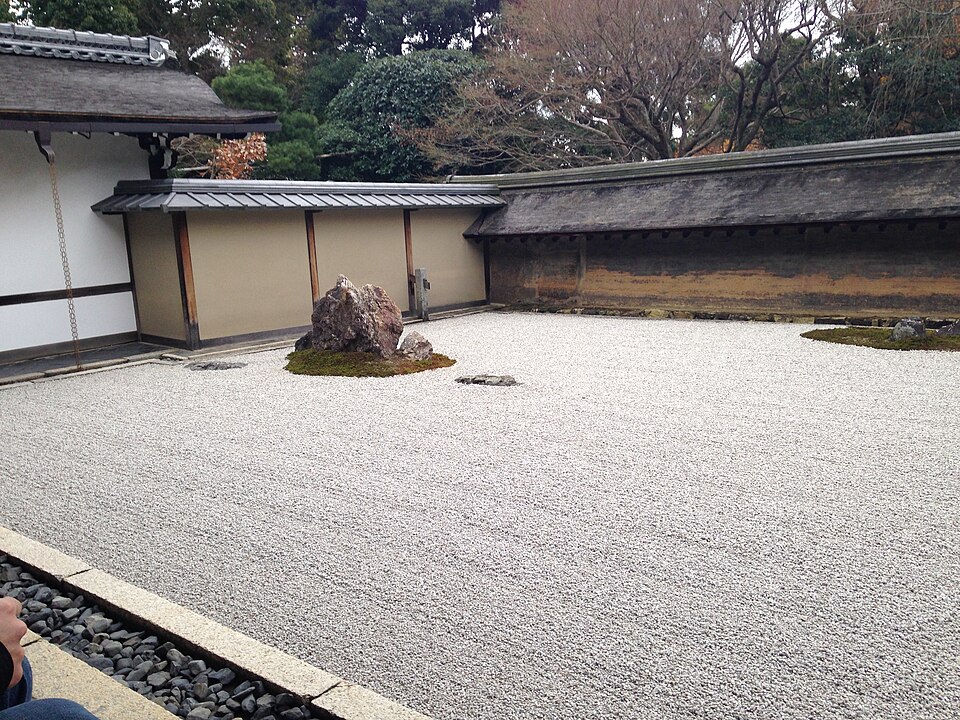
Ryoan-ji’s rock garden is a karesansui garden in a rectangular space approximately 25 meters wide by 10 meters deep, with 15 stones of varying sizes arranged in five groups (5, 2, 3, 2, 3). Wave patterns are drawn in the white sand, and only moss clings to the bases of the stones. This garden, completely devoid of plants, has been called “the ultimate minimalism.”
Its most distinctive feature is that from any position on the Hojo veranda, it is impossible to see all 15 stones simultaneously—one or two are always hidden behind others. Various interpretations of this design have been proposed: “the Zen teaching that perfection cannot be perceived by humans,” “the stones represent tigers crossing a river (toranoko watashi),” or “the stones represent islands floating in the sea.” But no one knows the true answer.
The best time to appreciate the rock garden is immediately after opening, between 8:00 and 9:00 AM. In the quiet of early morning with few tourists, you can sit on the Hojo veranda and quietly commune with the garden. Try moving gradually from right to left, observing how the view changes. You’ll be amazed at how the same garden gives completely different impressions depending on where you sit.
2. Tsukubai (Stone Water Basin)—The Teaching of “I Learn Only to Be Contented”
Located behind (north of) the Hojo, the tsukubai is a must-see when visiting Ryoan-ji. This stone water basin was used for purifying hands before entering the tea room. Its circular water hole is designed as the kanji character “口” (mouth/opening), with four characters—”五,” “隹,” “疋,” and “矢”—carved on the top, bottom, left, and right. By sharing the central “口” with each character, they can be read as “吾唯足知” (ware tada taru wo shiru).
“Ware tada taru wo shiru” means “I learn only to be contented”—expressing the Zen teaching of “chisoku” (contentment): knowing that what you already have is sufficient. Said to have been donated by Tokugawa Mitsukuni (of Mito Komon fame), this tsukubai is a masterpiece that expresses in just four characters a philosophy that resonates with the rock garden’s “beauty of subtraction.” The one currently on display is a replica, but its ingenious design never fails to impress viewers.
This tsukubai design is highly valued overseas, and miniature replicas are popular souvenirs. If the rock garden is “visual Zen,” then the tsukubai might be called “literary Zen.”
3. Kyoyochi Pond—The Mandarin Duck Pond of Heian Aristocrats
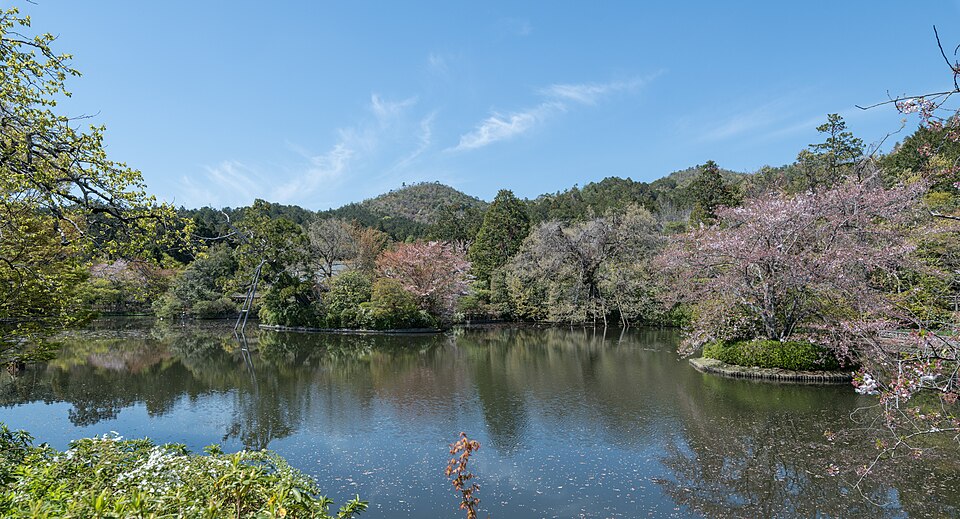
Kyoyochi Pond, which occupies the majority of Ryoan-ji’s grounds, has a history far older than the temple itself. During the Heian period, it was part of the garden of the Tokudaiji family villa “Tokudaiji-dono” and was known as “Oshidori-ike” (Mandarin Duck Pond). True to its name, it is said that many mandarin ducks once swam gracefully in this elegant pond.
The walking path around the vast pond of approximately 20,000 square meters shows different faces with each season. Spring brings cherry blossoms, early summer water lilies, autumn foliage, and winter snow scenery. The water lilies covering the pond surface from June to August are particularly beautiful, reminiscent of Monet’s “Water Lilies,” and have become a highlight of Ryoan-ji alongside the rock garden.
In the center of the pond sits Benten Island with a small Benten Hall. The walking path around Kyoyochi Pond takes about 20 minutes, but sitting on a bench and gazing at the water is also a wonderful way to spend time. Here you’ll find a generous natural beauty that contrasts with the tension of the rock garden.
4. Seigenin—A Luxurious Time with Yudofu and Gardens
Seigenin, one of Ryoan-ji’s sub-temples, is a spot worth visiting for a rest after your tour. Here you can enjoy Kyoto’s famous yudofu (hot tofu) as part of a shojin ryori (Buddhist vegetarian cuisine) set while admiring the expansive garden. Founded during the Muromachi period, this sub-temple has the distinction of its former Hojo having been relocated to serve as the current Ryoan-ji Hojo.
Seigenin’s garden is a pond garden incorporating part of Kyoyochi Pond, and during autumn, the red and yellow leaves reflected on the water surface create a beautiful scene. The yudofu enjoyed while viewing this garden features silky tofu made with Kyoto’s famous water paired with refined dashi broth—an absolute delight. The shojin ryori set requires no reservation and is charged separately from the admission ticket.
After immersing yourself in the Zen world of the rock garden, enjoying yudofu alongside the natural beauty of the garden—this luxurious experience is unique to Ryoan-ji. Why not savor the Zen teaching of “contentment” in this unhurried setting?
5. Chokushimon Gate and Stone Steps—The Solemn Entrance to a Zen Temple
The Chokushimon (Imperial Messenger Gate) at Ryoan-ji’s main entrance was once a gate through which only imperial messengers were permitted to pass. Regular visitors enter through a side gate, but standing before the Chokushimon and looking up, you can feel the solemn atmosphere of a Zen temple with your whole being.
Passing through the gate, a path with stone steps leads up to the Hojo. Beautiful moss grows on both sides of these steps, spreading a vivid green carpet, especially during the rainy season. The sensation of gradually leaving the mundane world behind as you climb each step feels like an introduction to Zen practice. The rock garden awaits at the top of these steps—this flow itself demonstrates the masterful “presentation” of Ryoan-ji.
In spring, the cherry trees around the steps bloom magnificently, and in autumn, fall foliage colors the stairway. This scenery, brimming with nature’s vitality yet different from the rock garden’s serene beauty, is another great attraction of Ryoan-ji.
Nearby Attractions
Kinkaku-ji (Rokuon-ji)—The Golden Pavilion World Heritage Site
About a 20-minute walk (or 5-minute bus ride) east of Ryoan-ji along the Kinukake-no-Michi path, Kinkaku-ji (official name: Rokuon-ji) is one of Kyoto’s most famous landmarks. The three-story golden pavilion “Shariden” covered in gold leaf, reflected in Kyokochi Pond, is an iconic Kyoto image known worldwide. Built by Ashikaga Yoshimitsu, the third shogun of the Muromachi shogunate, as his Kitayama Villa, it was registered as a World Heritage Site in 1994, the same year as Ryoan-ji.
If Ryoan-ji’s rock garden embodies the “beauty of subtraction,” Kinkaku-ji could be called the pinnacle of “beauty of addition.” Visiting both and comparing the splendor of gold leaf against the simplicity of the rock garden offers a deeper appreciation of the richness of Japanese aesthetic sensibility.
Ninna-ji—Omuro Cherry Blossoms and the Five-Story Pagoda
About a 10-minute walk west of Ryoan-ji along the Kinukake-no-Michi path, Ninna-ji is the head temple of the Omuro branch of Shingon Buddhism. Founded by Emperor Uda in 888, it is a prestigious temple where members of the imperial family served as head priests until the Meiji Restoration. Registered as a UNESCO World Heritage Site, the “Kinukake-no-Michi three-temple tour” of Kinkaku-ji, Ryoan-ji, and Ninna-ji is a popular Kyoto sightseeing course.
Ninna-ji’s greatest highlight is the approximately 200 “Omuro Zakura” (Omuro cherry trees) planted on the grounds. These unusual cherry trees are short in stature, blooming from the base, and are known as the latest-blooming cherries in Kyoto. Peak season is typically mid to late April, and the sight of low cherry trees in full bloom with the five-story pagoda in the background is a view unique to Ninna-ji.
Toji-in—The Family Temple of the Ashikaga Shoguns
About a 15-minute walk south of Ryoan-ji, Toji-in was built by Ashikaga Takauji, the first shogun of the Muromachi shogunate, and houses wooden statues of all 15 Ashikaga shoguns as the family temple. Ryoan-ji’s founder Hosokawa Katsumoto was also deeply connected to this temple through his role as kanrei of the Ashikaga shogunate, giving Toji-in close historical ties with Ryoan-ji.
Toji-in sees few tourists, making it a hidden gem where you can quietly enjoy the gardens. The East and West Gardens, attributed to Muso Soseki, feature both pond-strolling and dry landscape styles, offering beautiful scenery throughout the year. Here you can appreciate a soft, elegant garden beauty distinct from Ryoan-ji’s rock garden.
Access
By Train
- Keifuku Electric Railway (Randen): About 7-minute walk from Ryoanji Station (most recommended)
- From JR Kyoto Station: JR Sagano Line to Enmachi Station → City bus to Ryoanji-mae (about 40 minutes)
- Hankyu Railway: From Saiin Station, City Bus Route 205 for about 20 minutes
By Bus
- Kyoto City Bus Route 59, “Ryoanji-mae” stop, immediate access
- From JR Kyoto Station, City Bus Route 50 to “Ritsumeikan Daigaku-mae,” about 7-minute walk
- From Kinkaku-ji, City Bus Route 59 for about 5 minutes
By Car
- About 30 minutes from Kyoto-Minami IC on the Meishin Expressway
- Visitor parking available (first hour free for temple visitors)
- *Additional charges apply if your visit exceeds 1 hour
Recommended Access Route
The most recommended route is via Ryoanji Station on the Keifuku Electric Railway (Randen). The Randen is a streetcar connecting Arashiyama and Shijo-Omiya, and the retro-style cars running through Kyoto’s streets are themselves a sightseeing experience. From Ryoanji Station, it’s about a 7-minute walk through a residential area to the main gate. If visiting together with Kinkaku-ji or Arashiyama, walking the Kinukake-no-Michi path or taking a bus is convenient.

Summary
Ryoan-ji’s rock garden, which expresses the universe with only white sand and 15 stones, has been posing “questions” to people for over 500 years. Creator unknown, intention unknown—and precisely because of this, there are as many interpretations as there are viewers, and every visit brings new insights. This is why Ryoan-ji’s rock garden continues to fascinate people around the world.
After immersing yourself in the deep Zen world of the rock garden, touch the teaching of contentment at the “ware tada taru wo shiru” tsukubai and soothe your heart with the natural beauty of Kyoyochi Pond. A stroll along the “Kinukake-no-Michi” combined with Kinkaku-ji and Ninna-ji is the ultimate course for efficiently touring Kyoto’s World Heritage Sites. Please visit Ryoan-ji and listen to the Zen messages that the stones and sand speak.