Ishikawa Prefecture Gourmet Guide
Ishikawa Prefecture is a place where beautiful nature and rich culture merge, making it a region where you can enjoy many culinary delights. Kanazawa City, in particular, is known as a gourmet destination where you can savor local cuisine while immersing yourself in history and tradition. In this article, we introduce three carefully selected Ishikawa Prefecture dishes: “Jibuni,” “Noto Beef,” and “Kanazawa Oden.”
For each dish, we provide a detailed introduction to its appeal and history, along with recommended restaurants. When visiting Ishikawa Prefecture, be sure to try these exquisite gourmet offerings.
✔ In Short — Our Top Picks
- Jibuni — A representative Kaga-cuisine dish of Kanazawa: duck or chicken simmered in a thickened sweet-savory broth.
- Noto Beef — Premium Japanese Black Wagyu certified under standards set in 1995, prized for its fine, oleic-acid-rich fat.
- Kanazawa Oden — Kanazawa’s own oden, known for its clear broth and local ingredients such as kani-men and kuruma-fu.
Read on for the appeal, history, and access details of each spot.
Top 3 Gourmet Picks from Ishikawa Prefecture
Jibuni
The Appeal of Jibuni
Jibuni is a traditional local dish representing Kanazawa City in Ishikawa Prefecture, and is particularly well-known as a Kaga cuisine specialty. This dish is made with duck or chicken, seasonal vegetables, and a local specialty called “sudare-fu” (bamboo-screen wheat gluten), all simmered in a sweet and savory broth. The name is said to derive from the “jibu-jibu” simmering sound the ingredients make while cooking.
A key feature is that the meat is dusted with wheat flour or potato starch before simmering, which thickens the broth and seals in the umami of the ingredients. This thickness is especially effective at warming the body during cold seasons. Additionally, wasabi is served as a condiment, creating a perfect harmony between the tender duck meat and the refreshing spiciness of the wasabi.
History of Jibuni
Jibuni is a traditional local dish representing Kanazawa City in Ishikawa Prefecture, with origins dating back to the Edo period. There are various theories about the name’s origin: some say it comes from the “jibu-jibu” sound made during cooking, while others suggest it is an abbreviation of “jukubu,” meaning duck meat.
The dish is said to have developed as a samurai cuisine of the Kaga Domain, and it is traditionally believed that the chefs who served the Maeda family, lords of the domain, refined it over time. The early 18th-century cookbook “Ryori no Shiori,” written by a chef of the Maeda family, describes a dish called “mugidori,” in which duck or other meat is coated in wheat flour, simmered and served with wasabi, and this dish is considered similar to modern-day Jibuni.
Another theory suggests that the dish originated from a recipe brought back from Korea by Okabe Jibuemon, who served as a provisions officer under Toyotomi Hideyoshi. According to this theory, the dish he brought was adapted in the Kaga Domain and became established as Jibuni.
Where to Eat Jibuni!
- Restaurant Name: Shiroyamatei
- Appeal:
“Shiroyamatei” is one of the teahouses of Kenrokuen Garden, where you can casually enjoy Kaga cuisine before or after a stroll through the garden. Their most popular dish, “Jibuni,” is a must-try when visiting Kanazawa. In addition to the appeal of the Jibuni itself, they offer a variety of menu options.
For example, you can enjoy creative dishes that combine Jibuni with noodles, such as “Jibuni Udon,” “Jibuni Soba,” and “Jibuni Ramen.” They also offer unique arrangements like “Jibuni Don” (rice bowl) and “Jibuni with Sweet Shrimp,” all of which are absolutely delicious. - Access: Approximately 10 minutes by taxi from “Kanazawa Station”
- Hours: 10:00–17:00 in summer, 10:00–16:00 in winter; closed irregularly (as of September 2026)
- Address: 1-13 Kenrokumachi, Kanazawa City
- Google Maps: https://maps.app.goo.gl/aHz8Rsp29dmeKGks8
Noto Beef
The Appeal of Noto Beef
Noto Beef is a high-quality Japanese Black Wagyu raised in the beautiful natural environment and rustic landscape of Ishikawa Prefecture. Only beef that meets the certification standards set in 1995 (Heisei 7) by the “Noto Beef Brand Promotion Council,” made up of related organizations in Ishikawa Prefecture, is certified as “Noto Beef.” The rich natural environment of the Noto region and the dedicated husbandry techniques of producers greatly contribute to the raising of Noto Beef.
Its greatest feature is its finely marbled texture and premium fat. The fat is rich in oleic acid, which gives it a melt-in-your-mouth texture and rich flavor. In particular, beef certified as “Noto Beef Premium,” a designation created in December 2011 (Heisei 23), must be A5 rank with a BMS (Beef Marbling Standard) of 10 or higher, or BMS 8 or 9 with an oleic acid content of 55% or more.
Noto Beef maintains strict certification standards to ensure its high quality. Ishikawa Prefecture must be the final place of rearing and the place where the cattle were raised the longest, and the meat quality grade must be A3 or higher, or B3 or higher. Only Noto Beef that meets these criteria is permitted to bear the Noto Beef name.
History of Noto Beef
The roots of Noto Beef are traced back to three breeding bulls brought from the Tajima area of Hyogo Prefecture in 1892 (Meiji 25), and in 1924 (Taisho 13) eight cattle were introduced from Tottori Prefecture, mainly for farm work. From around 1934 (Showa 9), the production of first-generation crosses between the Hyogo line, which marbles easily, and the larger-bodied Tottori line was encouraged, and these cattle came to be valued as wagyu with ample body volume and superior quality.
In 1995 (Heisei 7), the “Noto Beef Brand Promotion Council,” made up of beef-related organizations in Ishikawa Prefecture, set certification standards, and from then on only beef meeting those standards was certified as “Noto Beef.” In 2007 (Heisei 19), Noto Beef was also registered as a regional collective trademark. Furthermore, at the 9th National Wagyu Competition in 2007, Noto Beef had the highest oleic acid content and excellent fat quality, earning it the special “Fat Quality Award.”
Where to Eat Noto Beef!
- Restaurant Name: Rokkakudo
- Appeal:
“Rokkakudo,” a long-established steakhouse founded in 1973 at the foot of Mt. Utatsu, is beloved by Kanazawa residents for many years. The restaurant offers a live cooking experience where the chef grills steak right before your eyes, allowing you to enjoy the meat with all five senses. Located within walking distance from the Higashi Chaya District, you can enjoy your meal in an atmosphere-rich setting.The recommended “Rokkakudo Course” is a luxurious course of appetizers, soup, seasonal teppanyaki seafood, salad and more, served with carefully selected steak (100g at lunch, 120g at dinner), with meat options such as “Black Wagyu Filet or Loin.” If you want to taste Noto Beef, we recommend choosing “Noto Beef Premium Loin.” The steak, lightly seared to lock in the juices, can be enjoyed with simple salt and pepper or with condiments for a change of flavor (course contents and prices are subject to change).
- Hours: 11:00–15:00 (until 15:30 on weekends and holidays), 17:00–22:00; open every day (as of September 2026)
- Address: 3-4-42 Kannonmachi, Kanazawa City, Ishikawa Prefecture (as of September 2026)
- Access: About a 10-minute walk from the “Hashibacho” bus stop
- Google Maps: https://maps.app.goo.gl/KkkLGa3nKZPB6DJHA
Kanazawa Oden
The Appeal of Kanazawa Oden
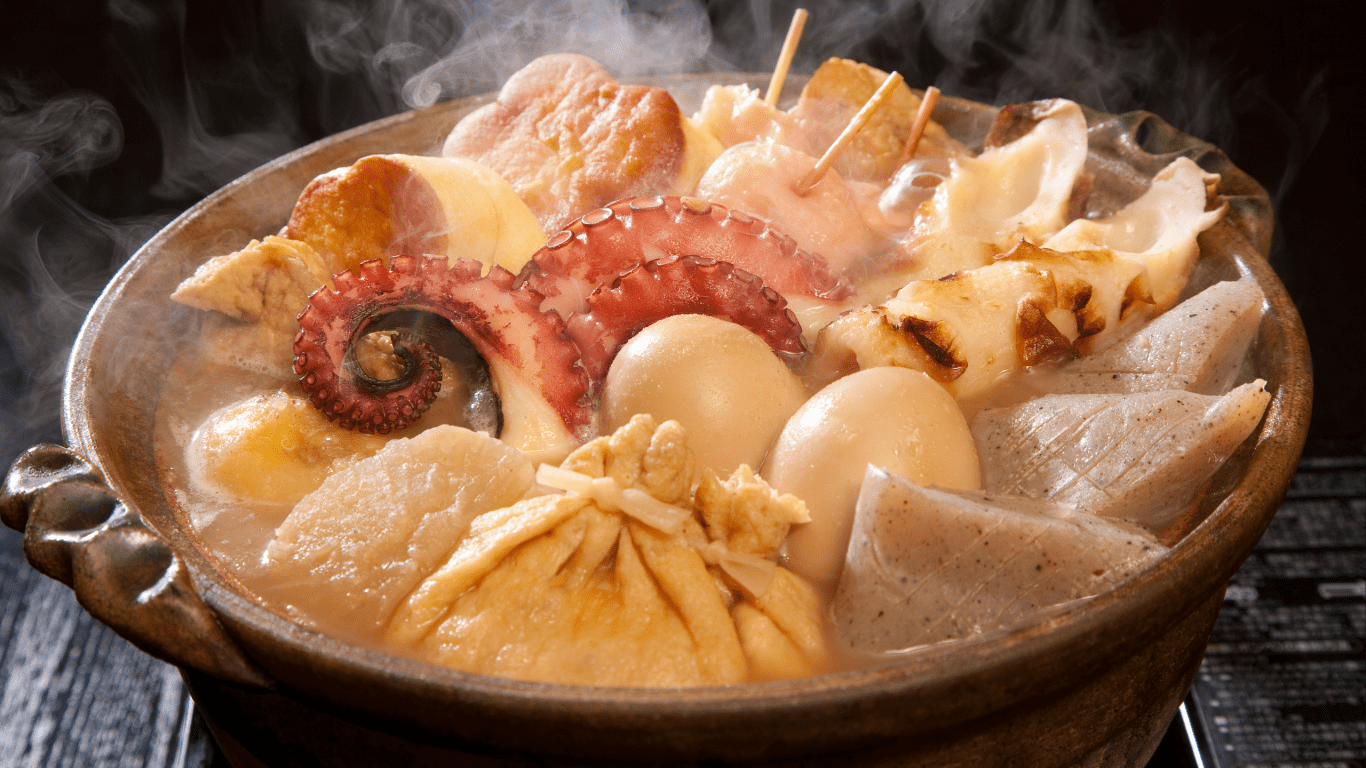
Kanazawa Oden is a traditional local dish representing Kanazawa City in Ishikawa Prefecture, cherished by locals and tourists alike as a heartwarming dish that eases the cold of winter. The greatest features of this oden are its elegant broth and diverse ingredients. The broth is characterized by a clear soup based on kelp and bonito flakes, with a deeper flavor than Kansai-style oden. Local Ono soy sauce is often used, giving the broth a distinctive flavor.
Local specialty ingredients are widely used. For example, “kani-men” (crab shell), a winter tradition, is a luxurious item made by stuffing a female Kobako crab shell with crab meat and miso, and is one of the most iconic ingredients of Kanazawa Oden. Other staple ingredients include bai-gai (sea snails), fukashi (white fish paste), kuruma-fu (wheel-shaped wheat gluten), and Gensuke daikon radish. These ingredients harmonize perfectly with the broth, creating a rich and flavorful experience.
History of Kanazawa Oden
There are various theories about the origins of Kanazawa Oden, but it is said that oden culture from other regions reached Kanazawa between the Meiji and Taisho eras and developed its own style by blending with local ingredients and broths.
Some long-established oden restaurants still in business today were founded in the early Showa era, and these shops continue to preserve the flavor of Kanazawa Oden. In 2010 (Heisei 22), oden restaurants in the city jointly formed the “Kanazawa Oden Tashinami-kai” association to promote the appeal of Kanazawa Oden nationwide.
When the NHK program “Tameshite Gatten” compared the number of oden restaurants per capita using the fiscal 2009 Town Page directory, Ishikawa Prefecture came out on top nationwide, and this made Kanazawa Oden known throughout Japan. Since then, it has been featured in various media and has become a popular gourmet choice for tourists visiting Kanazawa.
Where to Eat Kanazawa Oden!
- Restaurant Name: Oden Izakaya Miyuki
- Appeal:
“Miyuki,” located on a back street in Kanazawa, is a popular restaurant that draws discerning customers every night. Despite its back-street location, it is always bustling, thanks to its high-quality cuisine and pleasant lively atmosphere.One of the appeals of “Miyuki” is its elegant broth made from a chicken stock base. This broth, which also incorporates bonito and dried sardines, has a unique flavor while maintaining a robust taste. The oden, thoroughly infused with this broth, uses only carefully selected ingredients, and one bite is all it takes to be convinced of its deliciousness. Additionally, signature dishes like “Miyuki-age” (fried specialties) and “Tororo Teppanyaki” (grated yam on a hot plate) are also popular, attracting many fans.
- Access: 917m from Nomachi Station
- Address: 1-10-3 Katamachi, Kanazawa City, Ishikawa Prefecture
- Google Maps: https://maps.app.goo.gl/kLKt78788SecPNP68