Introduction
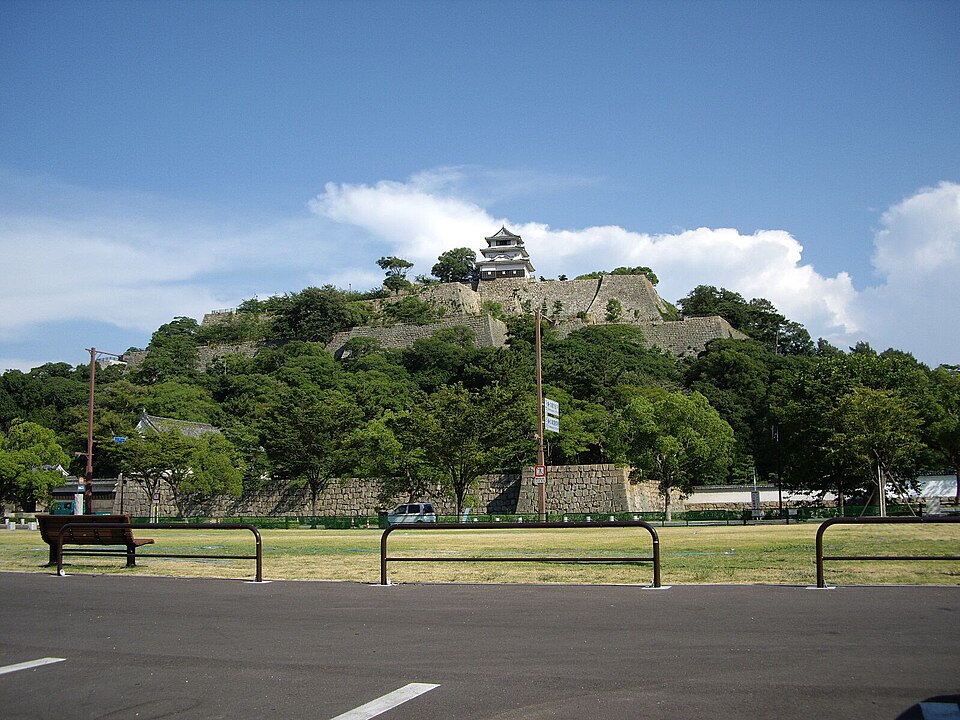
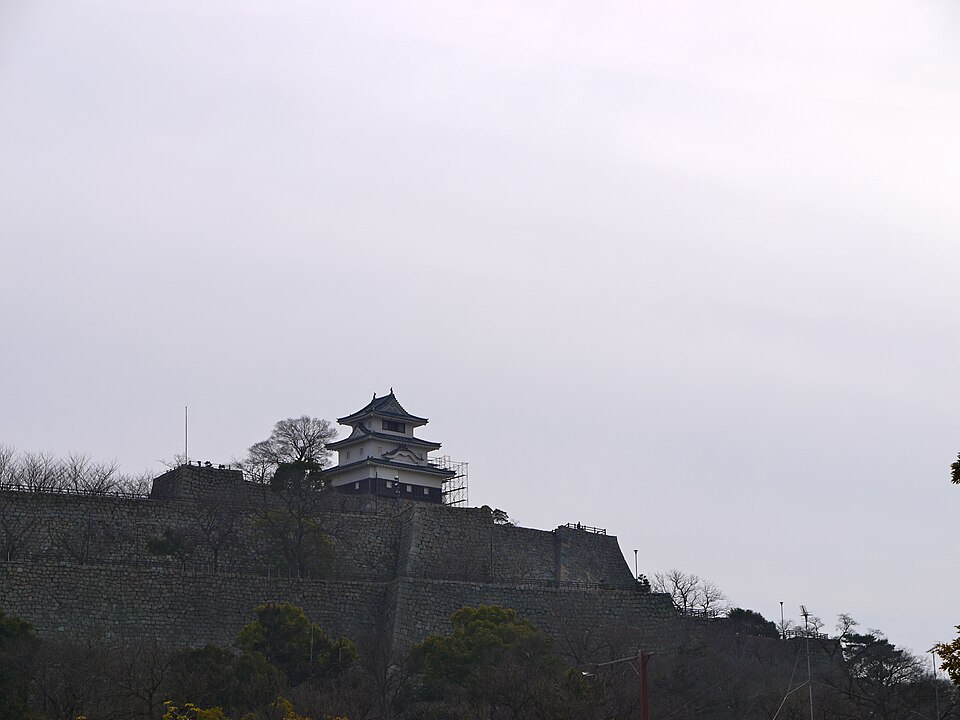
Marugame Castle is a hilltop castle (hirayamajiro) built on Kameyama, a hill about 66 m above sea level in Marugame City, Kagawa Prefecture. Marugame City describes its ramparts as “the tallest stone walls in Japan”: stacked in four tiers—the honmaru, ninomaru, sannomaru, and obikuruwa—the walls reach a combined height of about 60 m. The castle tower on the hilltop was completed in 1660 (Manji 3). It is one of only 12 original wooden castle towers surviving in Japan, and the oldest of the surviving wooden towers in Shikoku.
This article follows the official chronology to trace the castle’s history from its construction to the collapse and restoration of its stone walls, and covers the places worth seeing inside the grounds, nearby sights, and access and parking. The castle is about a 15-minute walk from JR Marugame Station, and the walk from the Ōte Gate up to the tower takes about 20 minutes one way.
Overview of Marugame Castle
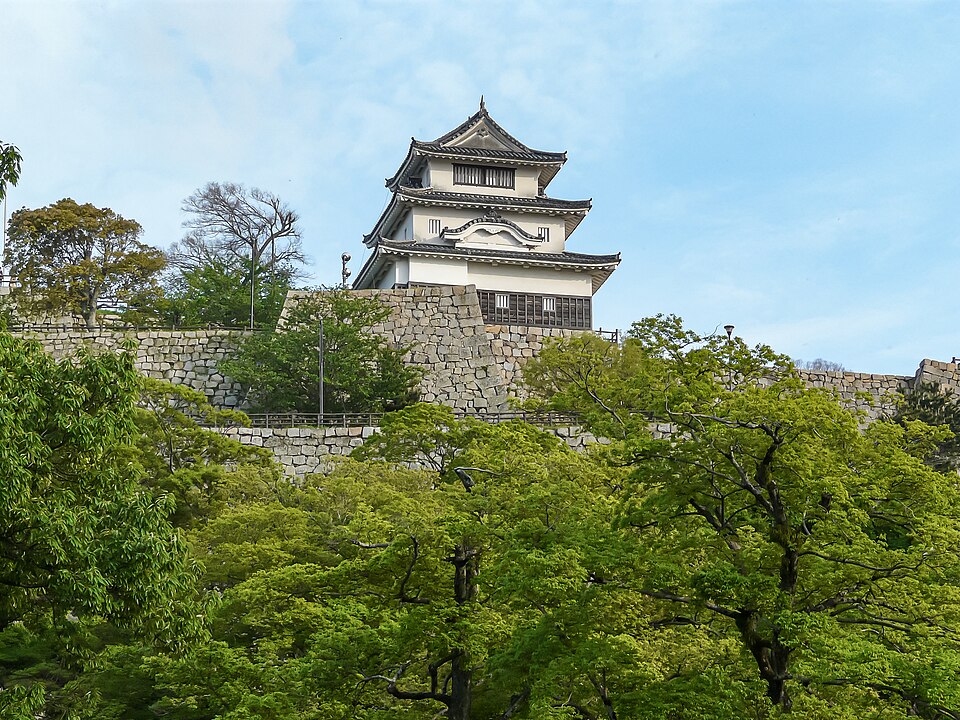
Marugame Castle is also known as Kameyama Castle. It consists of the honmaru, ninomaru, sannomaru, obikuruwa, and sange-kuruwa enclosures. The castle area measures about 540 m east to west and about 460 m north to south, and the roughly 200,000 m² inside the inner moat is designated as a National Historic Site. It has also been selected as one of Japan’s 100 Fine Castles.
The main stone walls are built in the uchikomi-hagi style, in which split stones are shaped before being stacked. At the corners they trace the “fan-shaped slope” (ōgi no kōbai): gentle at the base and rising closer to vertical toward the top. The stone wall on the north side of the sannomaru is more than 20 m high in a single face, making it the tallest wall in the castle.
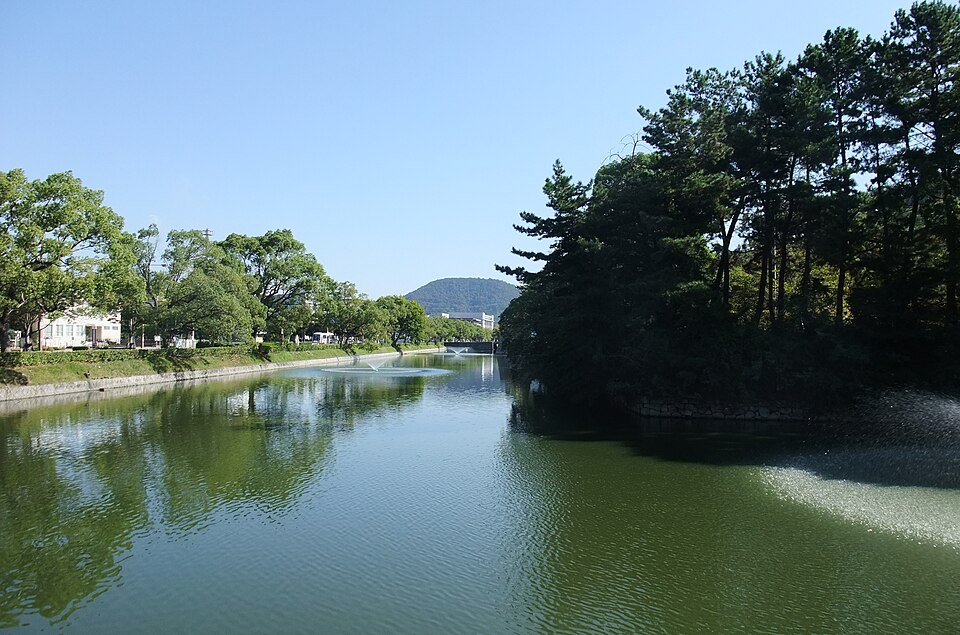
The tower has three roofs and three floors and is about 15 m tall, small among the surviving towers, but because it stands on top of the stone walls it looks taller than it really is when seen from the town below.
| Official Name | Marugame Castle (also known as Kameyama Castle) |
|---|---|
| Location | Ichibanchō, Marugame City, Kagawa Prefecture |
| Castle Type | Hirayamajiro (hilltop castle; renkaku-style layout) |
| Year Built | 1597 (Keichō 2) |
| Tower Construction Year | 1660 (Manji 3) |
| Tower Style | Three-roof, three-floor layered tower type; independent style |
| Stone Wall Height | About 60 meters (four tiers combined; described by Marugame City as “the tallest in Japan”) |
| Cultural Property Designation | Castle tower and Ōte Gate: National Important Cultural Properties |
| Opening Hours | Castle grounds open 24 hours. Tower: 9:00–16:30 (last entry 16:00) (as of September 2026) |
| Admission Fee | Tower admission: adults ¥400, junior high school students and younger free (as of September 2026) |
| Closed | None (may close temporarily when weather warnings are issued or for inspections) |
| Phone Number | 0877-22-0331 (Marugame City Tourism Association) |
History of Marugame Castle
The Beginning of Construction: Ikoma Chikamasa and the Rule of Sanuki
Ikoma Chikamasa, who was granted Sanuki Province in 1587 (Tenshō 15), began building Marugame Castle on Kameyama together with his son Kazumasa in 1597 (Keichō 2). Modeled on Azuchi Castle and Osaka Castle, the castle of that time is said to have been a sōgamae, in which not only the castle itself but also the samurai residences and the castle town were enclosed by moats and earthen ramparts. In 1602 (Keichō 7), Kazumasa moved to Takamatsu Castle, and a castellan was placed in charge of Marugame Castle.
Maps from the Ikoma era show the tower standing at the highest point in the center of the hilltop, with a layout different from today’s. During repairs to the stone wall beside the tower in fiscal 1993 (Heisei 5), a buried stone wall believed to date from the Ikoma era was discovered inside it.
Prosperity in the Edo Period: The Kyōgoku and Yamazaki Clans
Under the One Province, One Castle Decree of 1615 (Genna 1), the Ikoma clan kept Takamatsu Castle and abolished Marugame Castle. When the Ikoma clan was stripped of its domain in 1640 (Kan’ei 17), Yamazaki Ieharu, lord of Tomioka Castle in Amakusa, became lord of western Sanuki with a domain of just over 50,000 koku the following year, 1641, and rebuilt Marugame Castle with 300 kan of silver granted by the shogunate. The present hilltop layout and the tall fan-sloped stone walls are the work of the Yamazaki clan.
The Yamazaki line died out after three generations in 1657 (Meireki 3), and in 1658 (Manji 1) Kyōgoku Takakazu became lord of the Marugame Domain with 60,067 koku. The tower was completed two years later, in 1660 (Manji 3), and in 1670 (Kanbun 10) the main entrance was moved to its present location on the north side. In 1694 (Genroku 7), the third lord, Takamochi, granted 10,000 koku to his elder half-brother Takamichi, creating the Tadotsu Domain. The Kyōgoku family ruled Marugame until the end of the Edo period.
The Castle Abolition Decree and Hardships After the Meiji Era
In 1869 (Meiji 2), the year the domains were returned to the emperor, a fire broke out in the domain residence inside the castle, and the Inui Turret of the sannomaru was also destroyed. The castle came under the jurisdiction of the Army Ministry; in 1874 (Meiji 7) the Marugame barracks were completed in the Banchō district below the castle, and around 1876–1877 the turrets and tamon-yagura (long turrets) within the castle were torn down. The tower and the Ōte Gate survived. In 1919 (Taishō 8), Marugame City leased the hilltop area and opened a park, and in 1945 (Shōwa 20) the castle site within the inner moat was opened to the public as a park.
Preservation and Restoration Efforts
The tower was designated a National Treasure under the former system in 1943 (Shōwa 18), and its dismantling and repair were completed in 1950 (Shōwa 25), the same year it became an Important Cultural Property. The castle site became a National Historic Site in 1953, and the Ōte Gate an Important Cultural Property in 1957. Since 1976, the stone walls have been repaired section by section, including the Nagasaki Turret site, the north side of the honmaru, and the west side of the obikuruwa.
Part of the stone walls collapsed in the July 2018 (Heisei 30) Western Japan heavy rains; then, on October 8 of that year, the west face of the obikuruwa wall collapsed, followed the next day, October 9, by the wall at the site of the Hitsujisaru Turret in the sannomaru. The collapsed area on the sannomaru side is about 17 meters high. Each fallen stone has been numbered and catalogued so that it can be put back in its original position, and restoration work was still under way as of September 2026.
Marugame Castle Today
Today the castle grounds are open 24 hours a day as Kameyama Park, a place for walks and cherry-blossom viewing. The tower remains open during the restoration work. The “Stone Wall Restoration PR Center” in the sange-kuruwa (9:00–16:30, open every day) displays materials on the collapse and stonemasons’ tools, and from its rooftop observation deck you can watch the work in progress. Since July 2024, “castle stays” have also been offered, allowing guests to stay overnight in the Enjukaku Annex in the sannomaru.
Highlights and Recommended Spots
Japan’s Tallest Stone Walls
The combined height of about 60 m across the four tiers is why the walls are called “Japan’s tallest,” but the one that feels most overwhelming when you look up at it is the tall wall on the north side of the sannomaru, over 20 m in a single face. Its corners are built in the sangi-zumi style, with rectangular stones laid alternately long side and short side, and the fan-shaped slope curving up from the base to the top is easy to see.
You can also compare different stone-stacking techniques. The Ōte masugata (box-shaped gate enclosure) at the front of the castle uses kirikomi-hagi, in which precisely cut stones are fitted without gaps, as well as “mirror stones” (kagami-ishi) more than 2 m across. At the southeastern foot of the hill, walls of natural stone in the nozura-zumi style remain, and on the south side of the ninomaru you can see traces where the wall was extended later. The reddish color of the wall at the Inui Turret site in the sannomaru comes from granite scorched in the fire of 1869 (Meiji 2).
The Surviving Original Castle Tower
The tower is a three-roof, three-floor building decorated with karahafu (curved) and chidorihafu (triangular) gables, with stone-drop openings (ishi-otoshi) and plain unpainted wooden lattices on its north side. The stairs inside are steep, so it is safest to climb with bags that leave both hands free. A Japan’s 100 Fine Castles stamp is kept inside the tower (there is also one at the museum).
From the top floor you can see the streets of Marugame and the Seto Inland Sea, and on clear days Sanuki Fuji (Mt. Iino). Admission can be paid in cash as well as by credit card, transit IC card, or QR code payment (as of September 2026).
The Ōte Gate and Guardhouse
The Ōte Gate, the castle’s front entrance, is a National Important Cultural Property along with the tower. The space between the outer Ōte Second Gate (a kōraimon-style gate) and the inner Ōte First Gate (a yaguramon, or turret gate) forms a masugata enclosure, which, according to Marugame City, is unusually large, with few parallels elsewhere. Both gates were built around 1670 (Kanbun 10).
The Ōte First Gate is also called the “Drum Gate” (Taiko-mon) because retainers of the domain announced the time by beating a drum there. Since 2006, the “time drum” (toki-daiko), struck nine times at noon every day, has been revived. The interior is also open to visitors (9:00–16:30, as of September 2026), where you can see the stone-drop mechanism.
The Genkansaki Gate was the front gate of the former lord’s residence and takes the form of a yakuimon, rare for a castle gate. To its west remain the guardhouse (bansho) and row house (nagaya) where guards watched people entering and leaving the palace. The slope leading from the Ōte Gate up the hill is called Mikaeri-zaka (“Look-Back Slope”) because it is so steep that you feel like turning around.
Marugame Castle Sannomaru Plaza
The sannomaru is an enclosure that wraps around the ninomaru and honmaru like a headband. From the Tsukimi (Moon-Viewing) Turret site in the southeast corner you can look out over the Doki River and Mt. Iino. There is also a monument inscribed with a poem by Yoshii Isamu and the Sannomaru Well, which is said to hide a secret escape tunnel. Located at the top of Mikaeri-zaka, it is a good place to catch your breath before heading to the tower.
Above it, the ninomaru is a plaza planted with cherry trees; the well in its center is said to be “the deepest well in Japan,” with water more than 30 m deep.
The shop is in the Marugame Castle Tourist Information Center in the sange-kuruwa and sells castle goods and Marugame souvenirs. In the same building, “Uchiwa Kōbō Take” offers hands-on Marugame uchiwa (fan) making. There are toilets at seven locations in the castle grounds, including the ninomaru, the sannomaru, and the foot of Mikaeri-zaka.

Spring Cherry Blossoms and Night Illumination
There are about 650 Somei Yoshino cherry trees in the castle grounds, usually at their best from late March to early April. In 2026, the cherry blossom festival was held from March 27 to April 12, with food stalls, illumination of the blossoms, and lit paper lanterns (bonbori). Festival details change from year to year, so check the Marugame City Tourism Association’s information before you visit.
Outside the cherry blossom season, the tower is sometimes lit up in color to mark awareness months and similar campaigns (from sunset until around midnight; schedules are posted on Marugame City’s official website).
Nearby Attractions
Kotohira-gū Shrine
About 30 minutes by car from Marugame Castle. Affectionately known as “Konpira-san,” Kotohira-gū Shrine sits halfway up Mt. Zōzu, with 785 stone steps to the main shrine and 1,368 steps to the inner shrine. The approach is lined with souvenir shops known for “Kamiyo-ame” candy and “Kyūman” buns. The grounds also include the Asahi-sha hall, an Important Cultural Property. By train, take the Yosan Line from Marugame Station to Tadotsu Station and change to the Dosan Line for Kotohira Station.
Takamatsu City and Ritsurin Garden
Takamatsu, about 25 minutes from Marugame by JR rapid train, is home to Ritsurin Garden, a Special Place of Scenic Beauty. Developed as a villa of the Sanuki Matsudaira family, it is a strolling garden of about 750,000 m² with six ponds and thirteen artificial hills, and the view from the Kikugetsutei teahouse is especially well known. It has also received three stars in the Michelin travel guide. Together with the Takamatsu Castle ruins (Tamamo Park), it is an easy destination to combine with Marugame Castle on a two-day, one-night trip.
Kōchi Castle and Castle Touring in Shikoku
Shikoku has four castles with surviving original towers: Marugame, Matsuyama, Uwajima, and Kōchi. Kōchi Castle is known as the only castle whose honmaru buildings all survive. Crossing the Great Seto Bridge, you can also combine your trip with Bitchū Matsuyama Castle in Okayama Prefecture (a mountain castle with a surviving original tower). If you plan to tour all 12 surviving towers, see also our article on Inuyama Castle (Aichi Prefecture), whose tower is a National Treasure.
Access
- By train: Get off at JR Marugame Station on the Yosan Line; about a 15-minute walk from the South Exit. About 25 minutes from Takamatsu Station by JR Yosan Line rapid train. About 1 hour from Okayama Station via the Seto-Ōhashi Line (on the Marine Liner rapid train, change to the Yosan Line at Sakaide Station). From the Osaka and Kobe area, it is convenient to take the shinkansen to Okayama and transfer there.
- By bus: From Takamatsu Airport, you can use the Marugame–Sakaide–Airport limousine bus. Highway buses arrive at and depart from JR Marugame Station, or you can get off at the Marugame stop on the Takamatsu Expressway and transfer to a community bus.
- By car: About 20 minutes via National Route 11 from Sakaide IC or Zentsūji IC on the Takamatsu Expressway.
- By air: The nearest airport is Takamatsu Airport, about a 1 hour 20 minute flight from Tokyo (Haneda).
For parking, there is a free lot south of the castle museum (about 50 spaces, 6:00–19:00) and a free lot at the Shimin Hiroba (about 20 spaces), as well as city-run paid lots such as Ōtemachi No. 1 Parking. At the Ōtemachi No. 1, Ōtemachi West, and Ekimae Underground lots, parking is free for 2 hours if you validate your ticket at the machines in the museum, the tower, or the castle tourist information center (as of September 2026). Parking fills up easily on weekends during the cherry blossom season, so the train is the more reliable option.
Summary
The highlights of Marugame Castle are the tall stone wall of more than 20 m on the north side of the sannomaru with its fan-shaped slope, the interior of the Ōte First Gate, also called the Drum Gate, and the tower completed in 1660. It is a 15-minute walk from the station to the castle and about 20 minutes up the slope from the Ōte Gate to the tower, so allow 1.5 to 2 hours to see the tower, stone walls, and Ōte Gate.
If you combine it with Kotohira-gū Shrine and Ritsurin Garden, two days and one night is a good guide. The castle also fits well into a castle tour including Shikoku’s other surviving towers and nearby Bitchū Matsuyama Castle and Inuyama Castle. For choosing accommodation, see our ryokan guide as well.