- Introduction
- Overview of Tofuku-ji
- History of Tofuku-ji
- 1. Kamakura Period (1236-): Kujo Michiie’s Grand Dream and a 19-Year Endeavor
- 2. Muromachi Period: Prosperity as the Fourth of the Kyoto Gozan and Cultural Flourishing
- 3. The Onin War and Great Fires: Repeated Ordeals and the Lost Giant Buddha
- 4. Meiji to Showa: Reconstruction and Shigemori Mirei’s Garden Revolution
- 5. Modern Era: A Zen Garden and Autumn Temple Attracting World Attention
- Highlights and Recommended Spots
- Nearby Attractions
- Access
- Summary
- Frequently Asked Questions
Introduction
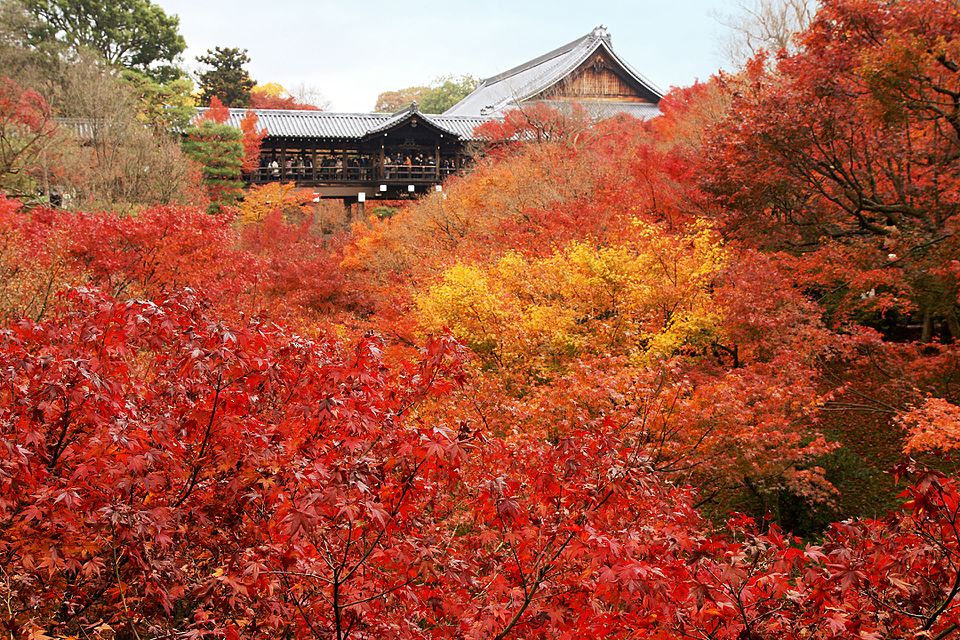
Just one train station from Kyoto Station. Getting off at Tofuku-ji Station on the JR Nara Line and walking up the hill, a massive complex of temple buildings gradually comes into view. This is Tofuku-ji. Every autumn, hundreds of thousands of people flock from across Japan to catch a glimpse of the “sea of blazing autumn foliage” spread below the Tsutenkyo Bridge, making this Zen temple one of Kyoto’s most celebrated autumn leaf destinations.
Yet Tofuku-ji’s appeal extends far beyond autumn foliage. The towering Sanmon gate, approximately 22 meters tall, is the oldest and largest surviving Zen temple gate in Japan, designated a National Treasure. Furthermore, the Hojo Garden “Hassō no Niwa” (Garden of Eight Aspects), designed by the legendary Showa-era garden designer Shigemori Mirei, is the supreme masterpiece of modern karesansui. Its innovative checkerboard pattern of moss and stone, fusing Zen tradition with modern art, has attracted worldwide attention.
Tofuku-ji is a prestigious Zen temple ranked fourth among the Kyoto Gozan (Five Great Zen Temples), with a history stretching back to the Kamakura period. Named by taking one character each from Nara’s Todai-ji and Kofuku-ji, the temple was conceived on a grand scale from its very inception. This article provides a comprehensive guide to Tofuku-ji, tracing its history from founding to the present, covering must-see highlights, nearby attractions, and access information. If you’re planning a trip to Kyoto, please read on to the end.
Overview of Tofuku-ji
Tofuku-ji is the head temple of the Tofuku-ji branch of Rinzai Zen Buddhism, located in Higashiyama-ku, Kyoto. Its formal name is “Enichisan Tofuku Zenji.” The mountain name is “Enichisan,” the founding priest was Shoichi Kokushi Enni, a high priest who returned from Song China, and the founder was the regent Kujo Michiie.
| Official Name | Enichisan Tofuku Zenji |
|---|---|
| Location | 15-778 Honmachi, Higashiyama-ku, Kyoto |
| Sect | Head Temple, Tofuku-ji Branch of Rinzai Zen |
| Principal Image | Shaka Nyorai (Shakyamuni Buddha) |
| Founding Priest | Shoichi Kokushi Enni |
| Founder | Kujo Michiie (Regent) |
| Established | Conceived 1236, completed 1255 |
| Visiting Hours | Apr-Oct: 9:00-16:30 / Nov-early Dec: 8:30-16:30 / Dec-Mar: 9:00-16:00 |
| Admission | Tsutenkyo Bridge & Kaizando: Adults ¥600 (¥1,000 autumn special) / Hojo Garden: Adults ¥500 |
| Closed | Open year-round |
*Please check the official Tofuku-ji website for the latest visiting hours and fees.
Tofuku-ji ranks fourth among the Kyoto Gozan. The Kyoto Gozan is the temple ranking system established by the Muromachi shogunate for Rinzai Zen temples, placing Tofuku-ji after Tenryu-ji (first), Shokoku-ji (second), and Kennin-ji (third). The grounds span approximately 200,000 square meters (about 4.3 Tokyo Domes), with 25 sub-temples still scattered throughout.
The temple’s name was derived by taking one character each from Nara’s two great temples, “Todai-ji” and “Kofuku-ji.” This embodied founder Kujo Michiie’s grand wish: “A temple as great as Todai-ji and as prosperous as Kofuku-ji.” Indeed, the principal Shaka Nyorai statue once housed in the Buddha Hall stood approximately 15 meters tall, rivaling Nara’s Great Buddha in scale. Though this colossal statue was lost in a Meiji-era fire, the story continues to be told as testimony to the temple’s original grandeur.
Tofuku-ji is also nationally famous as an autumn foliage destination. Approximately 2,000 maple trees are planted in the Sengyokukan ravine that runs through the grounds, and about 400,000 tourists visit annually to see the spectacular autumn views from the Tsutenkyo Bridge. During peak foliage from mid-November to early December, the temple opens 30 minutes early at 8:30 AM due to its immense popularity.
History of Tofuku-ji
1. Kamakura Period (1236-): Kujo Michiie’s Grand Dream and a 19-Year Endeavor
The man who conceived Tofuku-ji’s founding was the Kamakura-period nobleman Kujo Michiie (1193-1252). Michiie was the head of the prestigious Kujo family descended from the Fujiwara clan, and served as both regent and chancellor—one of the most powerful nobles of his era. Behind his ambition to build this great temple lay not only a personal wish to create a family temple, but also a political intent to demonstrate Kujo family authority by constructing a massive Zen temple in Kyoto to rival Nara’s great temples.
Construction began in 1236 on an unprecedented scale. Named “Tofuku-ji” by combining characters from “Todai-ji” and “Kofuku-ji,” the temple aimed for a grandeur worthy of its name. Plans called for a Shaka Nyorai statue approximately 15 meters tall, to be installed alongside attendant statues in a massive Buddha Hall, with master sculptors and carpenters gathered from across the nation.
The man Michiie invited as founding priest was Enni (1202-1280), who had trained in Song China and returned to Japan. Born in Suruga Province (present-day Shizuoka), Enni entered the priesthood young and spent six years in rigorous training in Song China. Receiving certification of enlightenment from his master Wuzhun Shifan, Enni returned as a polymath monk versed not only in Zen but also in Tendai and Shingon Buddhism. Later bestowed the title “Shoichi Kokushi” by the imperial court, Enni is one of the most important figures in Japanese Zen history. He also brought back noodle-making and flour-milling techniques from Song China, and is known as the father of Hakata’s udon and soba.
After a full 19 years of construction, Tofuku-ji was finally completed in 1255. The finished complex featured the full “Seven-Hall Formation”—Buddha Hall, Dharma Hall, Sanmon Gate, Zen Hall, Kitchen, Lavatory (Tosu), and Bathhouse—on a scale praised as the greatest in Kyoto.
2. Muromachi Period: Prosperity as the Fourth of the Kyoto Gozan and Cultural Flourishing
From the late Kamakura through the Muromachi period, Tofuku-ji developed rapidly. The greatest factor was the Muromachi shogunate’s “Kyoto Gozan” system. In the ranking established by Ashikaga Yoshimitsu, Tofuku-ji was placed fourth, receiving official shogunal patronage.
During this era, training monks gathered at Tofuku-ji from across the nation. Several hundred monks are said to have resided in the Zen Hall at any given time, leading strictly disciplined lives. Known as the “Senbutsujō” (Buddha Selection Hall), Tofuku-ji’s Zen Hall was one of Japan’s largest. The temple was also renowned as a center of learning, with Zen monks serving as intellectuals versed in Chinese classical literature and poetry, carrying the torch of Gozan Literature.
Sub-temples multiplied dramatically during this period. Disciples of eminent monks each built small temples, and at its peak, over 50 sub-temples lined the vast grounds. Today 25 remain, with Fundain, Ryoginan, and Reiun-in each known for their beautiful gardens.
Tofuku-ji also functioned as a major center of Zen art. Numerous Buddhist paintings and calligraphy transmitted from Song and Yuan China were collected, significantly influencing the development of Japanese ink painting. In particular, Kitsunzan Minchō (1352-1431), a painter-monk of Tofuku-ji, left numerous Buddhist paintings, and “Minchō” holds a special place in the Muromachi art world. His “Five Hundred Arhats” was highly praised as a supreme masterpiece and remains carefully preserved as a temple treasure.
3. The Onin War and Great Fires: Repeated Ordeals and the Lost Giant Buddha
The greatest turning points in Tofuku-ji’s history were its repeated fires. The Onin War that erupted in 1467 engulfed temples and shrines throughout Kyoto, and Tofuku-ji suffered serious damage. Parts of the main complex were destroyed, and many sub-temples were reduced to ashes.
However, the most devastating blow came with the great fire of 1881. Both the Buddha Hall and Dharma Hall were simultaneously engulfed in flames and completely destroyed. Most critically, the principal Shaka Nyorai statue that had been the object of devotion for over 600 years since founding was lost. This massive seated Shaka Nyorai, approximately 15 meters tall, had rivaled Nara’s Great Buddha in scale and was Tofuku-ji’s symbolic existence. Today, the Buddha hand (the left hand alone measuring approximately 2 meters) displayed before the Sanmon is a surviving fragment, a precious relic conveying the original scale.
That Tofuku-ji was not completely lost despite repeated fires is almost miraculous. The National Treasure Sanmon gate miraculously escaped the flames, preserving early Muromachi architecture to this day. The Zen Hall, lavatory, and bathhouse—buildings related to monastic training—also survived, ensuring the temple’s function as a Zen training center was never interrupted. Furthermore, countless masterpiece paintings by Minchō and other painter-monks, along with precious calligraphy connected to founder Enni, were saved from the fires through the monks’ desperate rescue efforts.
4. Meiji to Showa: Reconstruction and Shigemori Mirei’s Garden Revolution
For Tofuku-ji, which had lost its Buddha Hall and Dharma Hall in the Meiji fire, rebuilding the temple complex was a cherished aspiration. However, the enormous costs required to restore the former massive complex, combined with the impact of the Meiji government’s anti-Buddhist policies, made reconstruction far from easy.
In 1934, after more than half a century, the Main Hall (combined Buddha Hall and Dharma Hall) was finally rebuilt. Designed by Kyoto Imperial University professor Shimoda Kikutaro, it is praised as a masterpiece of modern architecture that incorporates traditional Zen-style design while using reinforced concrete construction. The ceiling features a dragon painting by Domoto Insho, which became the new symbol of Tofuku-ji.
The most important event in Tofuku-ji’s revival was the creation of the Hojo Garden “Hassō no Niwa” in 1939. Its creator was the young 35-year-old garden designer Shigemori Mirei (1896-1975). Shigemori championed “Eternal Modernism” and proposed revolutionary designs that overturned all conventions of Japanese garden design.
The “Hassō no Niwa,” with four gardens arranged on the north, south, east, and west sides of the Hojo, employs traditional karesansui techniques while featuring bold modern art-inspired designs including checkerboard patterns and dynamic stone arrangements. The north garden’s checkerboard pattern—a design alternating moss and cut stone like a checkerboard—sparked controversy when created but is now internationally acclaimed as the supreme masterpiece of modern Japanese gardens. Starting with Tofuku-ji, Shigemori went on to design over 200 gardens across Japan, leaving a monumental legacy in modern garden design history.
5. Modern Era: A Zen Garden and Autumn Temple Attracting World Attention
Today’s Tofuku-ji attracts significant domestic and international attention not only as an autumn foliage destination but as a center for Zen culture and modern garden art. Shigemori Mirei’s “Hassō no Niwa” was registered as a National Place of Scenic Beauty in 2014, officially reaffirming its cultural value. It is extremely rare for a garden created in the Showa era to receive national scenic beauty designation, testifying to how revolutionary Shigemori’s design truly was.
During autumn, Tofuku-ji is one of Kyoto’s most popular tourist spots. The autumn foliage of approximately 2,000 maples viewed from the Tsutenkyo Bridge, known as “Tsūten Kōyō,” is simply breathtaking as gradations of red, orange, and yellow fill the ravine. During peak season from mid-November to early December, it is not uncommon for tens of thousands of visitors per day, and photography while standing on the bridge is sometimes prohibited due to crowding.
International attention has also risen rapidly in recent years. Shigemori Mirei’s gardens are frequently featured in Western design and architecture publications as “the perfect fusion of Japanese tradition and modernism.” In 2023, the National Treasure Hojo of the sub-temple Ryoginan was specially opened to the public, generating significant attention. Tofuku-ji continues to serve as the head temple of the Rinzai Tofuku-ji branch overseeing approximately 370 affiliated temples, sharing Zen teachings through zazen sessions and sutra-copying experiences.
Highlights and Recommended Spots
Here are the must-see spots at Tofuku-ji. Beyond its fame as an autumn foliage destination, the temple is packed with year-round attractions including National Treasure architecture and innovative gardens.
Tsutenkyo Bridge and Sengyokukan Autumn Foliage
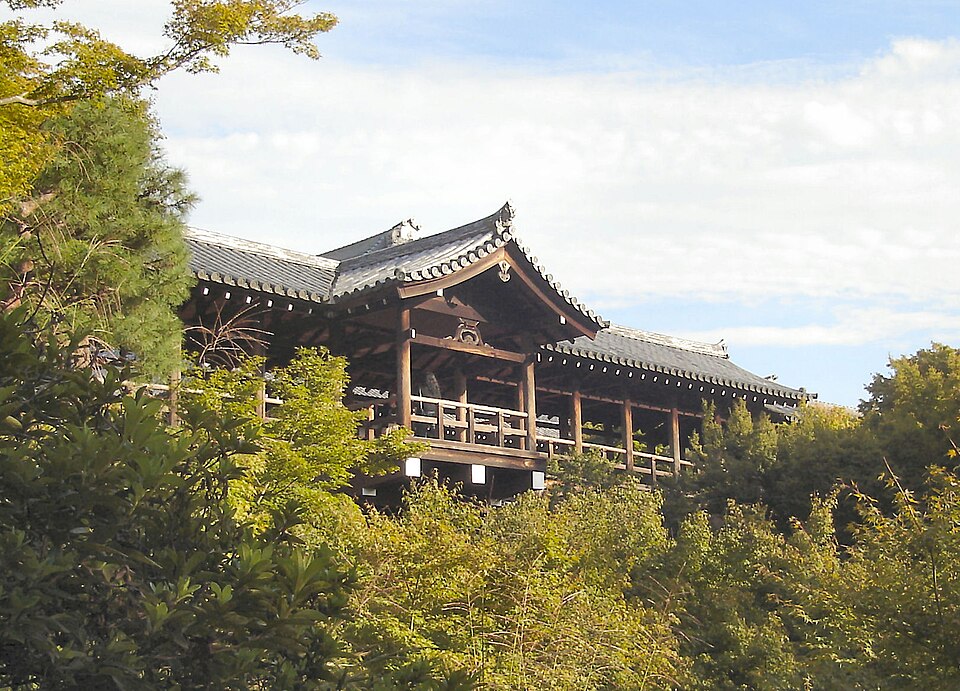
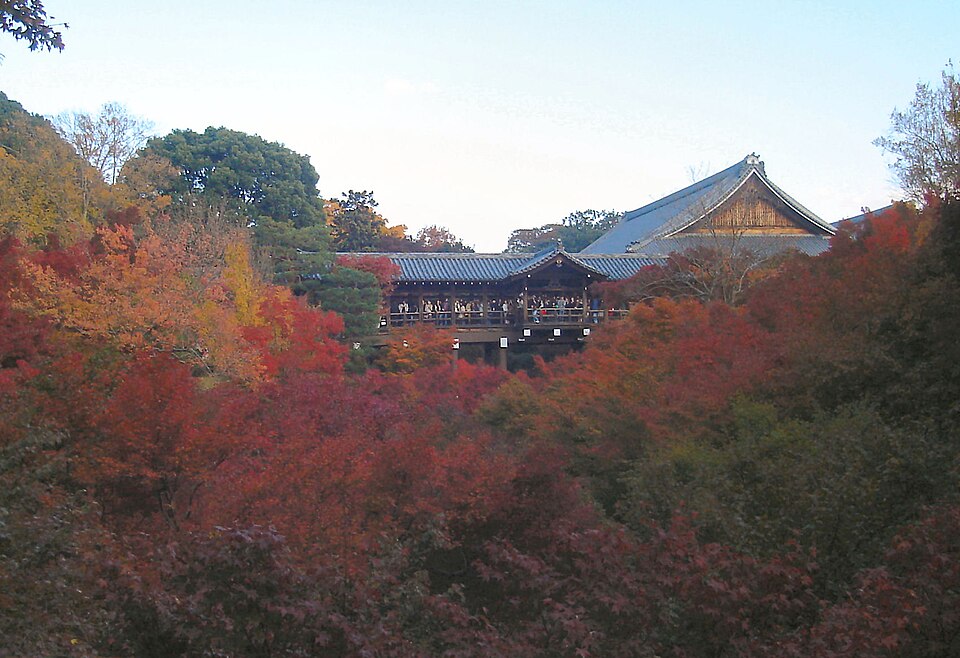
No discussion of Tofuku-ji is complete without the spectacular autumn views from the Tsutenkyo Bridge. This wooden covered bridge connecting the Hojo and Kaizando spans the Sengyokukan ravine, offering views of approximately 2,000 maple trees spread below.
Known as “Tsūten Kōyō,” this scenery becomes truly breathtaking during peak foliage from mid-November to early December. Standing on the bridge, from your feet to the distant Gaunbashi Bridge, gradations of red, vermillion, orange, yellow, and green fill the ravine, creating a sensation of floating above a sea of autumn foliage clouds.
Here’s an interesting tidbit: the reason Tofuku-ji’s autumn foliage is so magnificent is actually the result of centuries of human effort. The grounds originally had many cherry trees, but the Muromachi-era painter-monk Kitsunzan Minchō is said to have ordered all cherry trees felled because “cherry blossom viewing parties interfere with training,” replacing them with maples. Without Minchō’s decisive action, today’s Tsūten Kōyō would not exist.
For visiting during foliage season, arriving right at opening at 8:30 AM (during the special autumn viewing period) is recommended. The soft morning light filtering through the maple leaves creates an exceptional glow, and the crowds are relatively manageable. Note that standing and photography on the Tsutenkyo Bridge may be restricted during peak season.
Sanmon Gate (National Treasure)
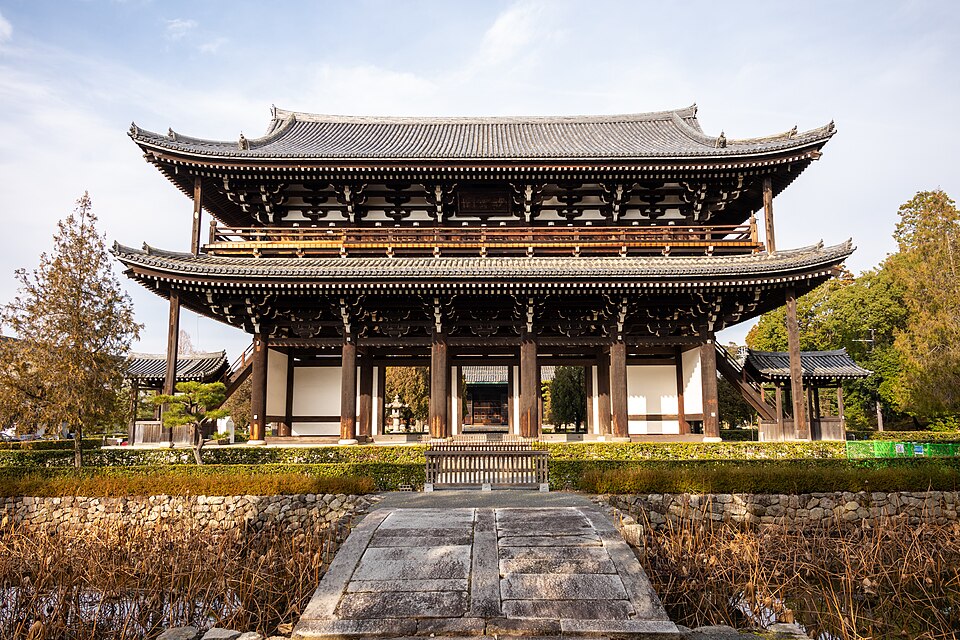
Tofuku-ji’s Sanmon gate, rebuilt in 1425 during the early Muromachi period, is a magnificent two-story gate. Standing approximately 22 meters tall with a frontage of about 25 meters, it is the oldest and largest surviving Zen temple gate in Japan. Designated a National Treasure, this Sanmon symbolizes Tofuku-ji’s grand scale.
“Sanmon” is short for “Sangedatsumon” (Gate of Three Liberations), representing the three states of Buddhist enlightenment: emptiness, formlessness, and non-action. Passing through this gate is said to enter a pure world free from worldly desires, making the Sanmon an extremely important structure in Zen temple architecture.
What makes Tofuku-ji’s Sanmon special is not just its overwhelming scale. The upper level houses a Shaka Nyorai statue and Sixteen Arhats, with vivid Buddhist paintings on the ceiling and pillars. These are attributed to painter-monk Minchō and his disciples, with some areas retaining vivid colors after 600 years. The upper level is normally closed to the public, but during special openings, it offers an excellent viewpoint to appreciate the vastness of Tofuku-ji’s grounds.
When standing before the Sanmon, pay special attention to the precision of its architectural structure. The massive pillars and intricately assembled bracket complexes (tokyō) represent the finest of Zen-style (Chinese-derived) architecture, assembled entirely without a single nail. You cannot help but feel reverence for the wooden construction technology that has withstood Kyoto’s elements for over 600 years.
Hojo Garden “Hassō no Niwa” (By Shigemori Mirei, National Place of Scenic Beauty)
Tofuku-ji’s Hojo Garden “Hassō no Niwa” (Garden of Eight Aspects) is the supreme masterpiece of modern karesansui, created by garden designer Shigemori Mirei in 1939. With four differently designed gardens on the north, south, east, and west of the Hojo, it was named after Buddhism’s “Eight Aspects of the Buddha’s Enlightenment.” Registered as a National Place of Scenic Beauty in 2014, it received exceptionally high recognition for a Showa-era garden.
The south garden is the most dynamic. Eighteen massive stones arranged in four groups on white sand represent the mythical islands of “Horai,” “Hojo,” “Eishu,” and “Koryo” where immortals dwell. The contrast between the powerful stone formations and white sand ripples evokes a cosmic scale.
The most popular is likely the north garden. This design of paving stones and moss arranged in a checkerboard pattern is an image anyone has seen in photographs, even if they’ve never visited Tofuku-ji. The orderly square grid narrows as it recedes into the distance, dissolving into the moss. This perspectival technique—creating infinite depth in a limited space—is quintessentially Shigemori. Garden researchers sometimes describe it as “expressing Zen philosophy like a Mondrian painting.”
The west garden features azalea hedges and white sand in an ichimatsu (grid) pattern, while the east garden uses cylindrical stones to represent the Big Dipper—each showcasing Shigemori’s original creativity. Taking time to appreciate all four gardens in sequence reveals the masterful fusion of tradition and innovation in Shigemori Mirei’s garden world. Allow 30 minutes to 1 hour.
Zen Hall (Important Cultural Property)
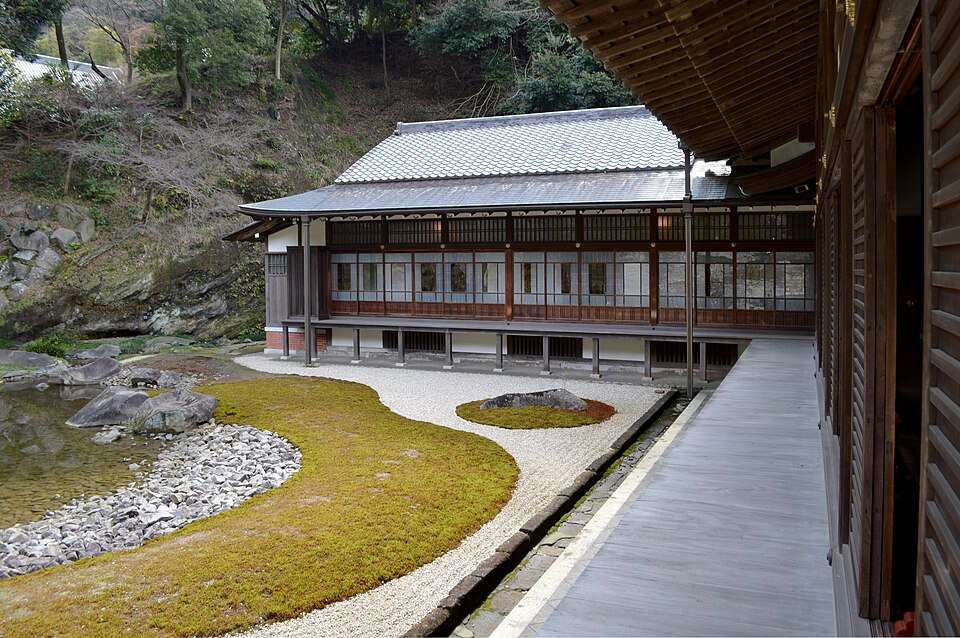
Tofuku-ji’s Zen Hall is a precious surviving example of medieval Zen architecture, designated an Important Cultural Property. Measuring approximately 27 meters wide and 14 meters deep, it is one of the largest surviving Zen halls in Japan. Rebuilt in 1347, this building has approximately 680 years of history.
A Zen Hall is a dedicated building for monks to practice zazen (seated meditation). Inside, platforms called “tan” (approximately 1 meter wide) line the walls for zazen practice, where monks sit in meditation, eat meals, and sleep. The Zen Hall thus serves simultaneously as meditation hall, dining hall, and bedroom. Tofuku-ji’s Zen Hall could accommodate approximately 400 monks practicing simultaneously, testifying to the temple’s former scale.
Monks continue zazen practice in Tofuku-ji’s Zen Hall today, maintaining the unbroken tradition of Zen training. While ordinary visitors cannot usually enter, you can sense the sparse, taut atmosphere from outside through the windows. The space, stripped of all superfluous decoration, seems to embody the Zen spirit of “mu” (nothingness). Those interested in Zen architecture may enjoy comparing it with the Dharma Hall of Nanzen-ji.
Near the Zen Hall stands the Tosu (Zen toilet), a Muromachi-period building designated an Important Cultural Property that could accommodate 100 people simultaneously. In Zen Buddhism, even the toilet is a place of practice, and this building hints at the strict etiquette that governed every aspect of monastic life.
Ryoginan (National Treasure) and Kaizando
Ryoginan is one of Tofuku-ji’s sub-temples, built on the former residence of founder Shoichi Kokushi Enni. Its Hojo dates from the early Muromachi period and is designated a National Treasure as the oldest surviving Hojo architecture. Usually closed to the public, it can be viewed during special openings held several times a year.
Ryoginan has another highlight: three gardens created by Shigemori Mirei in his later years. Named “Garden of Nothingness,” “Dragon Garden,” and “Garden of Inseparability,” these gardens showcase an evolved version of Shigemori’s creative world beyond the “Hassō no Niwa.” The “Dragon Garden” in particular, depicting a dragon ascending from the sea using red sand and black stones, is considered the pinnacle of Shigemori’s art.
The nearby Kaizando (Joraku-an) houses a wooden statue of founder Enni. Its distinctive architecture features an upper-story pavilion called the Den’ekaku, with an elegant appearance reminiscent of Kinkaku-ji’s Shariden. Before the Kaizando spreads a garden combining karesansui and pond elements, forming the central autumn foliage area of Tofuku-ji together with the Tsutenkyo Bridge.
The corridor connecting the Kaizando and Tsutenkyo Bridge offers one of Tofuku-ji’s finest viewpoints. Beyond foliage season, spring brings green maples covering the ravine, and winter creates magical scenery as light filters through bare branches. Those wishing to avoid the Tsutenkyo crowds may prefer to enjoy the views from this corridor.
Nearby Attractions
Fushimi Inari Taisha
About a 15-minute walk or one JR Nara Line station from Tofuku-ji, Fushimi Inari Taisha is the head shrine of approximately 30,000 Inari shrines nationwide. The iconic scene of vermilion Senbon Torii gates stretching endlessly up the mountainside is known worldwide as one of Kyoto’s most iconic images.
Tofuku-ji and Fushimi Inari Taisha are very close, making it efficient to visit both together. The recommended route is to visit Tofuku-ji in the morning, then walk to Fushimi Inari. From Tofuku-ji’s solemn Zen space to Fushimi Inari’s vivid vermilion world of bustling energy—experiencing two contrasting forms of faith in one day is a luxury unique to this area.
Fushimi Inari Taisha is free to enter (open 24 hours), so you can easily stop by after visiting Tofuku-ji. While climbing to the summit of Mount Inari takes about 2 hours round-trip, even just the entrance area of the Senbon Torii is sufficient to enjoy its charm. Comparing the quiet Zen world of Tofuku-ji with the vibrant Shinto world of Fushimi Inari as you walk is one of the true pleasures of Kyoto sightseeing.
Sennyū-ji
About a 10-minute walk from Tofuku-ji, Sennyū-ji, known by the title “Mitera” (Imperial Temple), is a temple closely associated with the imperial family. Revered as the mortuary temple of successive emperors, its grounds contain the imperial tombs (Tsukiwa-no-Misasagi) of Emperor Shijō and other emperors.
Sennyū-ji’s greatest attraction is the “Yōkihi Kannon” (Yang Guifei Kannon) statue housed in the Buddha Hall. Said to have been transmitted from Southern Song China, this wooden seated Kannon statue was named after the Chinese beauty Yang Guifei for its beauty. Its elongated, elegant face clearly shows characteristics of continental Buddhist sculpture, and many visitors come seeking blessings for “beauty prayers.”
Sennyū-ji attracts fewer tourists than Tofuku-ji, making it appealing for quiet contemplation. Visiting after the bustle of Tofuku-ji, the dignified atmosphere befitting an imperial mortuary temple feels spiritually cleansing. During foliage season, it is less crowded than Tofuku-ji, making it a recommended hidden gem.
Kiyomizu-dera
About 15 minutes by bus from Tofuku-ji, Kiyomizu-dera, one of Kyoto’s most iconic attractions, is also easy to visit in combination with Tofuku-ji. The main hall’s stage, known as the “Stage of Kiyomizu,” is a masterpiece of wooden architecture assembled entirely without nails, and the views from this platform extending approximately 13 meters above the cliff are breathtaking.
Kiyomizu-dera is one of the “Historic Monuments of Ancient Kyoto” World Heritage Sites and draws visitors from home and abroad year-round. While Tofuku-ji embodies the austere aesthetics of Zen Buddhism, Kiyomizu-dera has been cherished as a center of popular faith. Comparing both temples offers a deeper understanding of the diversity of Kyoto’s Buddhist culture.
An efficient plan is to visit Tofuku-ji in the morning, then take a bus to the Kiyomizu-dera area for temple visiting and a stroll through Ninenzaka and Sannenzaka. With many Kyoto-style souvenir shops and sweet shops around Kiyomizu-dera, you can savor Kyoto’s charm throughout the day.
Access
By Train
The nearest stations are JR Nara Line “Tofukuji Station” and Keihan Main Line “Tofukuji Station” (same station building), both about a 10-minute walk to Tofuku-ji’s Hikamon gate. From Kyoto Station, it’s just one stop (about 3 minutes) on the JR Nara Line—extremely convenient. From the Osaka area, you can come directly on the Keihan Main Line to “Tofukuji Station.” Keihan Main Line “Tobakaido Station” also provides access in about 10 minutes on foot.
By Bus
By Kyoto City Bus, take routes 202, 207, or 208 and get off at “Tofukuji” bus stop, about a 5-minute walk. However, during autumn foliage season (mid-November to early December), surrounding roads become very congested and buses may be significantly delayed. During this period, taking the train is strongly recommended.
By Car
About 20 minutes from “Kyoto-Minami IC” on the Meishin Expressway, or about 15 minutes from “Kamogawa-Nishi IC” on the Hanshin Expressway Route 8. Tofuku-ji has a free visitor parking lot, but capacity is limited (about 30 spaces) and fills up quickly, especially during foliage season. The parking lot may be closed during peak season, so public transportation is recommended. Several paid parking lots are available near Tofukuji Station.
Recommended Access Route
The most recommended route is the JR Nara Line from Kyoto Station. Arriving in just one stop (about 3 minutes) makes it extremely convenient for those staying near Kyoto Station. Extra trains may run during foliage season. Also, since Tofuku-ji and Fushimi Inari Taisha are adjacent stations on the JR Nara Line, both can be efficiently visited in one day.
Summary
Tofuku-ji is a Zen temple of the fourth rank among the Kyoto Gozan, packed with highlights including the spectacular autumn views from the Tsutenkyo Bridge, Japan’s oldest and largest National Treasure Sanmon gate, and the innovative Hojo Garden “Hassō no Niwa” by Shigemori Mirei. With approximately 800 years of history since its Kamakura-period founding, Tofuku-ji has preserved its tradition as a Zen training center through repeated fires—its journey mirrors the story of Japanese Buddhism itself.
While the autumn foliage season is magnificent, the fresh green maples of spring and snow-covered winter gardens each have their own beauty. The convenience of being just one station from Kyoto Station is also appealing. Please visit Tofuku-ji to experience the spirit of Zen and the beauty of Japanese gardens firsthand.
If you’re interested in Kyoto’s Zen temples, be sure to also check out our articles on Nanzen-ji and Ryoan-ji. Each offers a different Zen world to discover.