- Introduction
- Overview of Zojo-ji
- History of Zojo-ji
- Period 1: Muromachi Era (1393) — Founding as a Center of Pure Land Buddhism
- Period 2: Early Edo Period (1598–) — The Encounter with Tokugawa Ieyasu and Rapid Expansion
- Period 3: End of Edo to Meiji (1868–) — Anti-Buddhist Movement and Reduction of Grounds
- Period 4: Taisho to Showa (1923–1945) — Trials of the Great Kanto Earthquake and War
- Period 5: Late Showa to Present — Restoration and Transformation into a “Photogenic Sacred Spot”
- Highlights and Recommended Spots
- 1. Sangedatsu-mon Gate — A Nationally Important Cultural Property and the Oldest Surviving Structure
- 2. Ankokuden Hall (Black Buddha) — The Hidden Statue of Amida Nyorai
- 3. Tokugawa Shogunal Mausoleum — A Serene Sacred Ground Where Six Shoguns Rest
- 4. Daiden (Main Hall) — A Modern Main Hall Rebuilt in Reinforced Concrete
- 5. Bell Tower and Great Temple Bell — New Year’s Eve Bell Echoing Across Tokyo’s Sky
- Nearby Attractions
- How to Get There
Introduction
Step into the green temple grounds that spread beneath Tokyo Tower, and the urban bustle fades away, replaced by a quiet, solemn atmosphere. This is Zojo-ji, a temple that has served as the family temple of the Tokugawa shoguns for approximately 400 years. Looking across the grounds from the vivid vermilion Sangedatsu-mon Gate at the front entrance, Tokyo Tower glows red in the background — this striking contrast has captivated travelers from around the world as one of Tokyo’s most iconic views.
Zojo-ji is one of the seven head temples of Jodo-shu (Pure Land Buddhism) and a sacred site where six of the fifteen Tokugawa shoguns rest in eternal peace. The temple attracts approximately two million visitors annually, and nearly all of Shiba Park was once part of Zojo-ji’s grounds. At its peak, the temple compound covered roughly 250,000 tsubo (approximately 830,000 square meters), but it was reduced to its current size following the Meiji Restoration and World War II. Even so, the current grounds still span about 25,000 square meters, offering a tranquil oasis that seems worlds apart from central Tokyo.
This article provides a detailed look at Zojo-ji’s history — from its founding in the Muromachi period to its designation as the Tokugawa family temple, through the trials of the anti-Buddhist movement of the Meiji era and wartime destruction, up to the present day. We also cover must-see highlights including the Sangedatsu-mon Gate, the Tokugawa Shogunal Mausoleum, and Ankokuden Hall, along with nearby attractions in the Hamamatsucho and Shiba Park area, and detailed access information. Discover the charm of this historically rich temple as a fresh perspective on your Tokyo sightseeing.
Overview of Zojo-ji
Zojo-ji is the head temple of Jodo-shu Buddhism located in Shiba Park, Minato City, Tokyo. Its formal name is “Sanenzankoudo-in Zojo-ji.” The principal image of worship is Amida Nyorai (the Black Buddha), a hidden Buddhist statue that can only be viewed on special opening days.
| Official Name | Sanenzankoudo-in Zojo-ji |
|---|---|
| Address | 4-7-35 Shiba-koen, Minato-ku, Tokyo |
| Buddhist Sect | Jodo-shu (one of seven head temples) |
| Principal Image | Amida Nyorai (Black Buddha) |
| Founded | 1393 (Meitoku 4) |
| Founder | Yuyo Shoso Shonin |
| Visiting Hours | Grounds open freely (Ankokuden 6:00–17:30) |
| Admission | Free (Tokugawa Mausoleum: 500 yen for adults) |
| Closed | Open year-round |
| Phone | 03-3432-1431 |
*Please check the official Zojo-ji website for the latest visiting hours and fees.
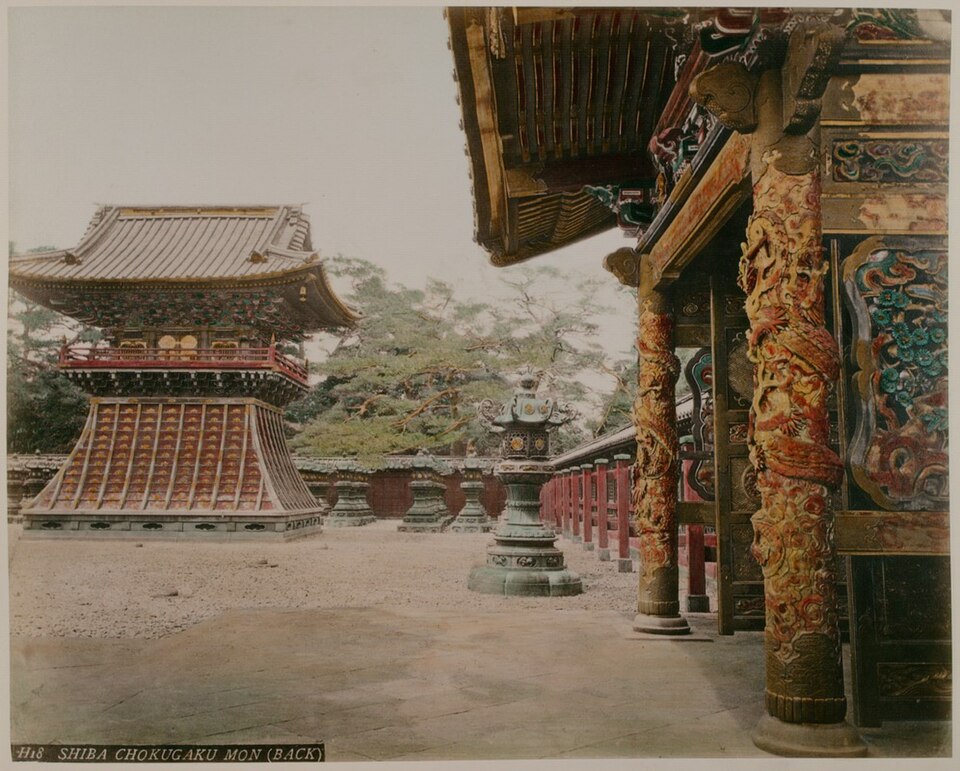
Zojo-ji’s most distinctive feature is its deep connection to the Tokugawa shogunal family. After Tokugawa Ieyasu designated Zojo-ji as the prayer and family temple of the Edo shogunate in 1598, the temple expanded explosively under shogunal patronage. At its zenith, Zojo-ji formed a vast temple city stretching from present-day Hibiya Park in the north to Shiba Daijingu Shrine in the south, with over 100 sub-temples and 48 seminary halls.
The Sangedatsu-mon Gate, designated as a nationally Important Cultural Property, still stands in the temple grounds, preserving the magnificence of the Edo period as a structure built during that era. The Tokugawa Shogunal Mausoleum houses the tombs of six shoguns — the 2nd (Hidetada), 6th (Ienobu), 7th (Ietsugu), 9th (Ieshige), 12th (Iyeyoshi), and 14th (Iemochi) — along with their wives, concubines, and children. Welcoming approximately two million visitors per year, this temple is cherished both for its historical significance and as a place of tranquility within the city.
History of Zojo-ji
Period 1: Muromachi Era (1393) — Founding as a Center of Pure Land Buddhism
Zojo-ji traces its origins to 1393 (Meitoku 4). The founding priest, Yuyo Shoso Shonin, established a small hermitage as a sub-temple of “Komyo-ji” in what is now the Kioicho area of Chiyoda City (formerly Kojimachi Kaizuka). Shoso was an eminent monk who promoted the spread of Jodo-shu Buddhism in the Kanto region and harbored a strong ambition to establish Zojo-ji as the head temple of the Pure Land sect in eastern Japan.
Jodo-shu is a Buddhist sect founded by Honen Shonin at the end of the Heian period, teaching that anyone can attain rebirth in the Pure Land by chanting “Namu Amida Butsu.” It is easy to imagine how this sect, which attracted believers from samurai to commoners, resonated with people seeking peace and salvation in an age of civil war. From its very inception, Zojo-ji maintained a strong identity as a center of learning and doctrine for Pure Land Buddhism in the Kanto region.
In its early years, Zojo-ji was merely a modest temple of one sect, smaller in scale and situated at a different location from today. However, through the efforts of Shoso Shonin, it established its position as the headquarters of Jodo-shu in the Kanto region, laying the foundation for future prosperity. About 200 years after its founding, an encounter with Tokugawa Ieyasu would dramatically transform the temple’s fate.
Period 2: Early Edo Period (1598–) — The Encounter with Tokugawa Ieyasu and Rapid Expansion
The turning point that dramatically altered Zojo-ji’s history arrived in 1598 (Keicho 3). That year, Tokugawa Ieyasu received Pure Land Buddhist teachings from the temple’s 12th head priest, Genyo Zonno Shonin, and designated Zojo-ji as the Tokugawa family temple. From that moment, a single Buddhist temple gained the backing of political power and began its unprecedented expansion.
By Ieyasu’s order, Zojo-ji was relocated to its present site in Shiba in 1598. This location, positioned at the “rear demon gate” (ura-kimon, southwest direction) protecting the southwest of Edo Castle, paired with Kan’ei-ji Temple guarding the demon gate (northeast) to spiritually protect the castle. Ieyasu granted vast tracts of land for the expansion of Zojo-ji’s grounds, and from the Keicho to Genna eras, major structures including the Sangedatsu-mon Gate, the Daiden (Main Hall), and the sutra repository were successively constructed.
Throughout the Edo period, Zojo-ji flourished as one of “Edo’s great temples.” Its grounds grew to encompass what is now Shiba Park, Tokyo Tower, and parts of Hibiya Park, becoming a vast religious city where over 3,000 monks studied and trained at any given time. For the people of Edo, Zojo-ji was not only a place of prayer but also a space of recreation where many gathered for temple fairs and festivals. The prosperity built through its deep ties with the shogunal family represented one of the pinnacles of Edo culture.
Period 3: End of Edo to Meiji (1868–) — Anti-Buddhist Movement and Reduction of Grounds
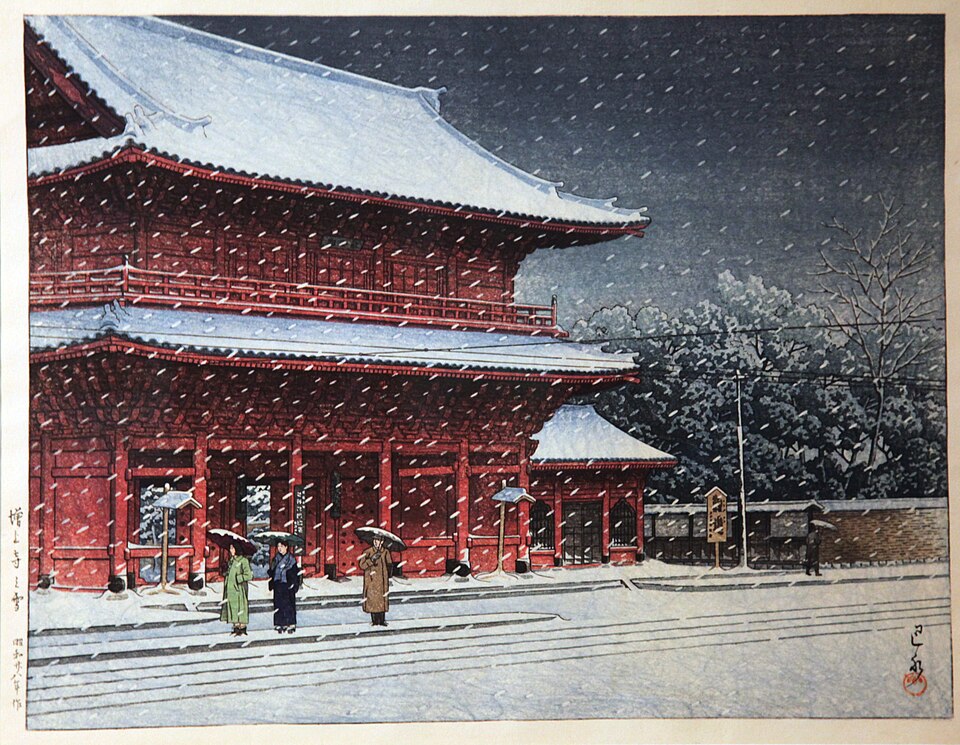
The Meiji Restoration dealt a devastating blow to Zojo-ji. The Shinbutsu Bunri decree of 1868, which ordered the separation of Shinto and Buddhism, and the subsequent wave of anti-Buddhist sentiment (haibutsu kishaku) struck Zojo-ji — now stripped of Tokugawa patronage — with full force. The new government seized the majority of Zojo-ji’s grounds and reorganized them as public land for what became Shiba Park (originally extending toward Hama Rikyu).
In 1873 (Meiji 6), the bulk of Zojo-ji’s grounds were designated as “Shiba Park,” one of Japan’s first Western-style parks, and most of the more than 100 sub-temples were forced into closure or merger. Many of the halls and pagodas that once filled the vast compound were demolished, and Zojo-ji’s landholdings shrank to a fraction of their peak. Having lost the mighty Tokugawa sponsorship and enduring continuous reduction of its grounds, the early Meiji period was a time of existential crisis for Zojo-ji.
Yet Zojo-ji never allowed its flame of faith to be extinguished. In 1889 (Meiji 22), the temple established a Jodo-shu seminary (later Jodo-shu University, a predecessor of today’s Taisho University) within its grounds, strengthening its role as a center of sectarian learning. Even amid the hardship of territorial reduction, Zojo-ji found a new purpose as a modern religious educational institution. The adversities of this era can be said to have nurtured the strength that would enable the temple to rise again.
Period 4: Taisho to Showa (1923–1945) — Trials of the Great Kanto Earthquake and War
Just as Zojo-ji was beginning to recover from the hardships of the anti-Buddhist movement, further trials arrived. The Great Kanto Earthquake of September 1, 1923 inflicted severe damage on the temple’s buildings. Halls dating back to the Edo period were damaged or collapsed in various areas, requiring enormous expense and time to restore. Nevertheless, with the support of believers nationwide, Zojo-ji gradually healed its wounds from the earthquake.
Just as recovery was getting back on track, World War II plunged Zojo-ji into yet another crisis. The Great Tokyo Air Raid of March 10, 1945 devastated the temple. The magnificent Daiden (Main Hall), built in the Edo period, along with many other halls, was consumed by fire. Parts of the Tokugawa Shogunal Mausoleum were also damaged, and cultural treasures accumulated over centuries were lost.
When Tokyo Tower was constructed in 1958, Zojo-ji found itself making a fresh start alongside the very symbol of Japan’s rapid economic growth. Post-war Japan rising from the ashes, and Zojo-ji striving for restoration — their parallel journeys mirrored the spirit of the times. It was during this period that the view of Tokyo Tower from the temple grounds was born, later becoming a new symbol of Zojo-ji.
Period 5: Late Showa to Present — Restoration and Transformation into a “Photogenic Sacred Spot”
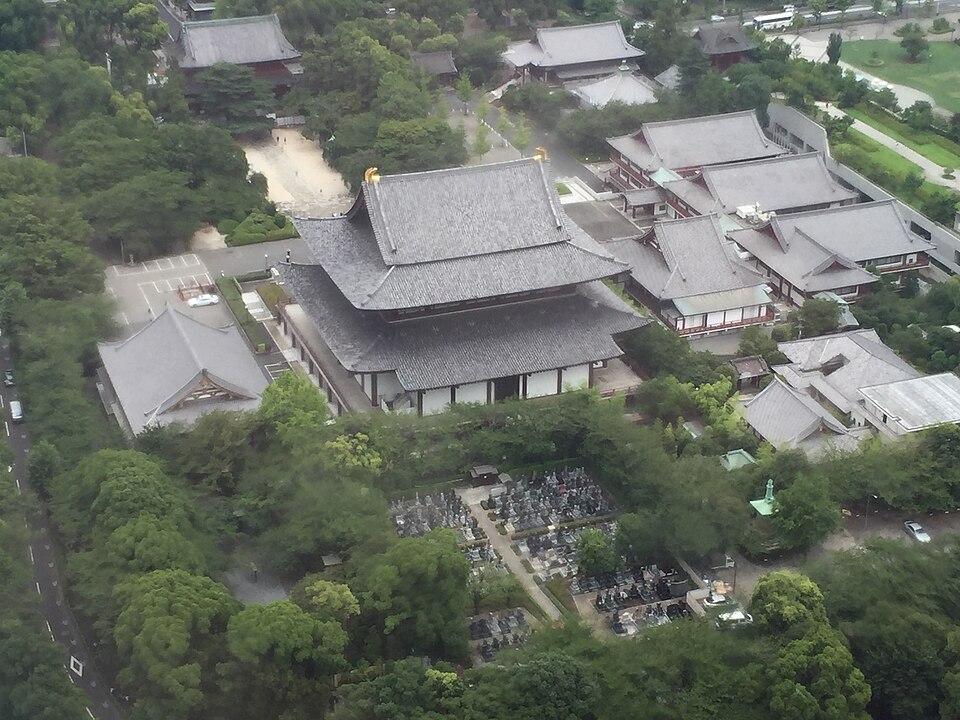
Zojo-ji’s full-scale restoration was finally completed with the reconstruction of the Daiden (Main Hall) in 1974. Though built with reinforced concrete, the current Daiden incorporates traditional temple architecture styling and has become the modern face of Zojo-ji, known for its beautiful contrast with Tokyo Tower. The completion of this hall, covering approximately 2,000 square meters, symbolized the temple’s resurrection from post-war ruins.
From the Showa to Heisei eras, Zojo-ji has continuously adapted to the changing times. The Wind Chime Festival (Furin Matsuri), which began in the 1960s, has become a beloved summer tradition, with thousands of wind chimes decorating the approach path and drawing many visitors. The grounds, integrated with Shiba Park, have become a precious green space in central Tokyo, with strollers and joggers a common everyday sight.
Today, Zojo-ji continues its traditional religious activities while also growing significantly as a tourist destination. Photos of the Sangedatsu-mon Gate with Tokyo Tower in the background have spread worldwide through social media, making it known among international tourists as an “Instagrammable spot in Tokyo.” Among the approximately two million annual visitors, many are tourists from overseas. With a full calendar of annual events including New Year’s Eve bell ringing, hatsumode (first shrine visit of the year), and cherry blossom festivals, this ancient temple with over 600 years of history continues to serve as a spiritual pillar of Tokyo in the Reiwa era.
Highlights and Recommended Spots
Zojo-ji’s grounds are dotted with diverse attractions, from architecturally significant structures steeped in history to seasonal scenic views. Here is a curated selection of spots where you can lose track of time despite being in the heart of Tokyo.
1. Sangedatsu-mon Gate — A Nationally Important Cultural Property and the Oldest Surviving Structure
The Sangedatsu-mon Gate, the iconic face of Zojo-ji, is a two-story gate built in 1622 (Genna 8) and designated as a nationally Important Cultural Property. Standing approximately 21 meters tall, it is the oldest surviving structure on Zojo-ji’s grounds, having miraculously escaped damage from both the Great Kanto Earthquake and the Tokyo air raids to preserve its Edo-period appearance.
The name “Sangedatsu-mon” derives from the Buddhist teaching that passing through this gate liberates one from the “three poisons” (greed, anger, and ignorance). Inside the gate, statues of the Shaka Triad and the Sixteen Arhats remain enshrined, and interior viewings are held on designated days. From the upper level, visitors can survey the entire Zojo-ji grounds and, on clear days, see as far as Tokyo Bay.
The greatest appeal of the Sangedatsu-mon Gate is the view it creates with Tokyo Tower rising behind it. The contrast between this Edo-period historical structure and the Showa-era steel tower, spanning centuries, has attracted photographers and travelers as one of Tokyo’s most iconic scenes. Photographs taken from the front in the crisp morning light, or from the side with Tokyo Tower framed in the composition, have become a quintessential Tokyo souvenir.
2. Ankokuden Hall (Black Buddha) — The Hidden Statue of Amida Nyorai
The most deeply revered object at Zojo-ji is the Amida Nyorai statue known as the “Kuro Honzon” (Black Buddha), enshrined in Ankokuden Hall. Standing approximately 60 centimeters tall, the statue has a dark, soot-like coloring that earned it the name “Black Buddha” — said to be either the result of centuries of incense smoke or an intentional feature of the original design.
The Black Buddha is known as a statue that Tokugawa Ieyasu revered deeply. It is said that Ieyasu always prayed to it before going into battle, and he believed that his victories in numerous campaigns, including the Battle of Sekigahara, were thanks to this Buddha’s divine protection. Because of Ieyasu’s profound devotion, the Black Buddha is still venerated today as a source of good fortune in victory and success, attracting many worshippers.
As a “hidden Buddha” (hibutsu), the Black Buddha is only revealed on the 1st and 15th of each month and on special festival days. On regular days, the doors of the shrine remain closed, but on opening days, visitors can view the statue directly. Its blessings are said to include victory, good fortune, and matchmaking. It is especially popular among students preparing for exams and those facing important challenges, who come to pray with clasped hands. Numerous ema (votive tablets) inscribed with wishes are dedicated before Ankokuden Hall, creating a space brimming with prayerful energy.
3. Tokugawa Shogunal Mausoleum — A Serene Sacred Ground Where Six Shoguns Rest
Located on the south side of Zojo-ji’s grounds, the Tokugawa Shogunal Mausoleum is a sacred space where six shoguns — the 2nd (Hidetada), 6th (Ienobu), 7th (Ietsugu), 9th (Ieshige), 12th (Ieyoshi), and 14th (Iemochi) — rest alongside their wives, concubines, and children. Admission is 500 yen for adults, and it is typically open from 9:00 to 17:00 (hours vary by season).
Research on burial goods, some of which were dispersed to institutions such as the Tokyo National Museum, has revealed the splendid funerary culture of the Edo period. An excavation conducted in 1958 uncovered magnificent burial items from the coffins of shoguns and their consorts, some of which can be viewed in Zojo-ji’s treasure exhibition room. Gold-lacquered kimonos, coral ornaments, and cosmetic sets — these are precious historical artifacts that tell the story of the Tokugawa family’s glory.
Stone lanterns associated with the Tokugawa family line the approach to the mausoleum, and as you walk through the quiet grove, you may feel as though you are traveling back to the Edo period. Many visitors are struck that such a profoundly serene historical space exists in the very center of Tokyo. Visiting in combination with Tokugawa Ieyasu’s mausoleum at Nikko Tosho-gu will deepen your understanding of the Tokugawa shogunate’s religious worldview and the meaning of their authority.
4. Daiden (Main Hall) — A Modern Main Hall Rebuilt in Reinforced Concrete
The current Daiden (Main Hall) was rebuilt in 1974 and is a modern structure with a total floor area of approximately 2,000 square meters. Despite being constructed with reinforced concrete, its exterior incorporates traditional temple architecture styling, lending the grounds a sense of appropriate grandeur. Inside, a golden Amida Nyorai statue stands approximately 9 meters tall, leaving visitors in awe of its magnificence.
Standing before the Daiden, you can see Tokyo Tower peeking out from behind it. The 333-meter steel tower paired with a main hall that carries the religious authority inherited from the Edo period — this combination seems to embody the very essence of Tokyo: the coexistence of tradition and modernity. The contrast between Tokyo Tower illuminated at night and the quietly standing Daiden is particularly beautiful.
Inside the Daiden, morning prayers (chouka) are held daily at 6:00 AM, and visitors are welcome to participate freely. Sitting quietly with hands clasped as the sound of sutra chanting fills the hall is a special moment that helps you forget the busyness of everyday life. On the 15th of each month, a special memorial service called “Gyoki” is conducted, drawing many worshippers.
5. Bell Tower and Great Temple Bell — New Year’s Eve Bell Echoing Across Tokyo’s Sky
Zojo-ji’s great temple bell (daibonsho) was cast in 1702 (Genroku 15) and is registered as a Tokyo Metropolitan Designated Tangible Cultural Property. Standing approximately 3 meters tall and weighing about 15 tons, it is one of the largest bells in Tokyo and is counted among the “Three Great Bells of Edo.” The bell tower stands quietly in a corner of the grounds, drawing the attention of visitors.
The great bell attracts the most attention during the New Year’s Eve “Joya no Kane” (bell-ringing) ceremony held every December 31st. The scene of 108 bell tolls echoing through the sky over Shiba on New Year’s Eve draws large crowds every year. Visitors can participate in ringing the bell, and the experience of striking it while Tokyo Tower is lit up for the countdown is a uniquely Zojo-ji New Year’s memory.
Beyond New Year’s Eve, the great bell is also rung during morning prayers and memorial services. When walking through Shiba Park and the surrounding area, the occasional sound of the bell carries a deep resonance that makes you forget you are in the heart of Tokyo. Standing before the bell tower with ears attuned, feeling the waves of sound envelop you — this is an unforgettable memory of visiting Zojo-ji.
Nearby Attractions
The Shiba and Hamamatsucho area of Minato City, where Zojo-ji is located, is a zone rich with some of Tokyo’s most popular tourist spots. Here are nearby attractions worth visiting in combination with your Zojo-ji pilgrimage.
1. Tokyo Tower — The Showa-Era Symbol Rising Right Next to Zojo-ji
The attraction inseparably linked with Zojo-ji is Tokyo Tower, standing just a 5-minute walk away. Built in 1958, this 333-meter broadcasting tower remains beloved by many as the symbol of Japan’s rapid economic growth.
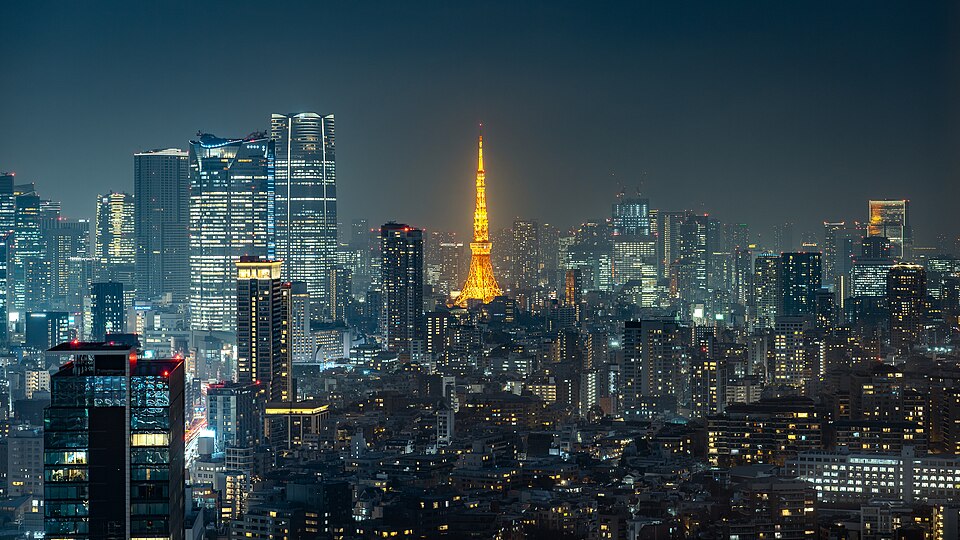
Tokyo Tower’s Main Deck (150 meters) and Top Deck (250 meters) offer a 360-degree Tokyo panorama that includes a view of Zojo-ji’s grounds. Conversely, the view of Tokyo Tower framed through Zojo-ji’s Sangedatsu-mon Gate is known worldwide as one of Tokyo’s finest vistas. At night, the illuminated Tokyo Tower beautifully lights up the temple grounds, creating a magical atmosphere. Visiting both Zojo-ji and Tokyo Tower together allows you to fully savor the charm of Tokyo where history and modernity intersect.
2. Shiba Park — A Central Tokyo Oasis Surrounding Zojo-ji
Shiba Park, which wraps around Zojo-ji’s grounds, is a historic park established in 1873 as one of Japan’s first Western-style parks. Originally part of Zojo-ji’s vast temple grounds, Buddhist ruins are scattered throughout the park.
In spring, approximately 1,300 cherry trees burst into bloom, making it a famous spot for hanami (cherry blossom viewing). Families and office workers enjoy their leisure on the lawns, drawn by the remarkably lush greenery so unexpected in central Tokyo. The park also features sports facilities including a pool, tennis courts, and a baseball field, serving as a recreational retreat for locals. A stroll through the park before or after visiting Zojo-ji gives you a tangible sense of just how vast the temple’s original grounds once were.
3. Toranomon and Shimbashi Area — A City Stroll Filled with Gourmet Food and Culture
Within a 15–20 minute walk northeast of Zojo-ji, you will find the redeveloped Toranomon Hills and Shimbashi, known as the mecca of the Japanese salaryman. The area around Shimbashi’s SL Square is famous as a down-to-earth gourmet zone lined with izakaya (Japanese pubs) and ramen shops.
The Imperial Palace and Hibiya Park are also within cycling or walking distance. The Imperial Palace outer moat running course is one of Tokyo’s most popular jogging routes, and a historical walking route connecting Shiba Park, Zojo-ji, Hibiya Park, and the Imperial Palace through greenery is also well-loved. This area, where historic architecture and modern cityscapes coexist, is a rare place where you can experience Tokyo’s multi-layered charm in a single day.
How to Get There
Public transportation is the most convenient way to reach Zojo-ji. Located in the heart of Tokyo, the temple is accessible from multiple train lines.
By Train
The closest route is a 3-minute walk from Shibakoen Station (Exit A4) on the Toei Mita Line. Alternatively, Daimon Station (Exit A6) on the Toei Asakusa and Oedo Lines is about a 5-minute walk. From Hamamatsucho Station (North Exit) on the JR Yamanote and Keihin-Tohoku Lines, it is approximately an 8–10 minute walk. The route from any station is flat and easy to walk.
By Bus
If using Toei buses, the nearest stop is “Shiba-Daimon.” Buses run from Shimbashi Station and Shinagawa Station areas.
By Car / Parking
From the Shuto Expressway, take the “Shiba-koen Exit” or “Ichinohashi Exit,” then drive approximately 5 minutes. There is no dedicated parking lot on the temple grounds, so please use nearby coin-operated parking lots. Multiple parking facilities are available around Shiba Park and the surrounding area. Parking is also available near Tokyo Tower, which is convenient if you plan to visit both.
As Part of a Sightseeing Route
Zojo-ji is a staple of west Tokyo sightseeing courses when combined with Tokyo Tower and the Imperial Palace. A recommended full-day itinerary is to visit Shiba Park, Zojo-ji, and Tokyo Tower in the morning, then head to Senso-ji Temple or Meiji Jingu Shrine in the afternoon.
Conclusion
Zojo-ji is a venerable temple with approximately 630 years of history — founded in the Muromachi period, it reigned at the center of Edo as the Tokugawa shoguns’ family temple, and endured the trials of the anti-Buddhist movement and wartime destruction to persist into the modern era. Its grounds are filled with attractions where you can feel history firsthand, including the Sangedatsu-mon Gate, the Black Buddha (Ankokuden Hall), and the Tokugawa Shogunal Mausoleum.
With Tokyo Tower rising behind it, Zojo-ji stands as a symbol of Tokyo’s defining landscape — where history and modernity coexist. From quiet worship to photography and historical exploration, this versatile destination is a place you should absolutely visit when sightseeing in Tokyo. Leave the hustle and bustle of the city behind and experience a moment of tranquility in this sacred space of prayer that transcends 600 years.