
🕓 2024/6/01
#Culture
A Detailed Guide to the History and Overview of Shinsekai

Table of Contents
- Overview of Shinsekai
- History of Shinsekai
- Recommended Spots in Shinsekai
- Must-Try Gourmet Food in Shinsekai
Introduction
Shinsekai is a historic entertainment district located in Naniwa Ward, Osaka City, a fascinating area where diverse cultures and entertainment converge. Since its establishment in 1912, iconic landmarks such as Tsutenkaku Tower and Janjan Yokocho have continued to captivate visitors. This article provides a detailed look at the history, highlights, and exquisite cuisine of Shinsekai.
Shinsekai is beloved by many tourists for its unique atmosphere and rich food culture. From its historical background to the latest tourist spots, we bring you all the information you need to fully enjoy the charms of Shinsekai. Please use this article as a reference before your visit to savor the diverse attractions of Shinsekai.
Overview of Shinsekai

Shinsekai is a historic entertainment district located in Ebisu-higashi, Naniwa Ward, Osaka City. It was born in 1912, triggered by the opening of the first Tsutenkaku Tower and the Luna Park amusement park. At the time, Shinsekai featured streetscapes modeled after Paris and New York, developing as an entertainment district that incorporated modern urban landscapes.
At its center stands Tsutenkaku Tower, a symbol of Osaka, and the surrounding area is home to the shopping street known as Janjan Yokocho. This area retains a retro atmosphere reminiscent of its former prosperity, preserving the ambiance of the early Showa era. Streets radiating from Tsutenkaku are lined with traditional restaurants and entertainment facilities, offering visitors a nostalgic experience.

Kushikatsu (deep-fried skewered meat and vegetables) is particularly famous as the area’s signature dish. Numerous kushikatsu shops line the streets, and the crispy batter and rich flavors of kushikatsu are a must-eat for tourists visiting Shinsekai. These shops have a casual, down-to-earth atmosphere that appeals not only to locals but also to tourists.
Additionally, Shinsekai has many facilities where you can enjoy shogi (Japanese chess). Particularly famous is the “Janjan Yokocho Shogi Club,” where local shogi enthusiasts gather to play in a friendly atmosphere. Such shogi clubs are one of the cultural attractions of Shinsekai, offering visitors the opportunity to experience traditional Japanese culture.

During the postwar reconstruction period, the area thrived as a gathering place for many citizens, and it remains a popular tourist destination today. The streetscape of Shinsekai blends historic structures with modern facilities, making it an area with diverse charms that continues to captivate many tourists.
2. History of Shinsekai
■ 1910s
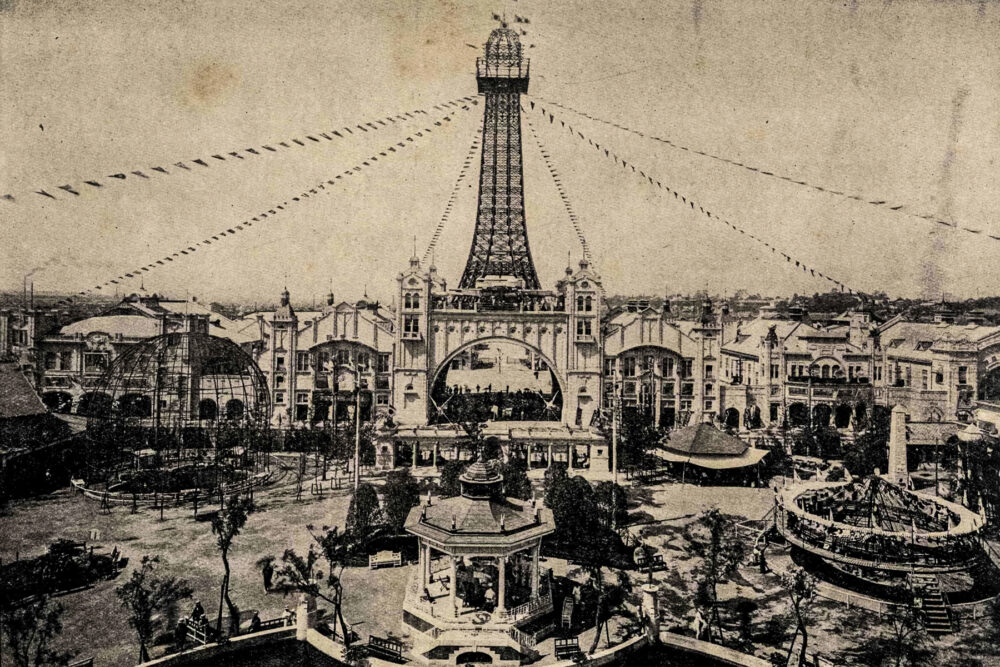
Shinsekai was born in 1912. Located on the south side of Osaka City, this area had a spectacular start with two major facilities: Tsutenkaku Tower and Luna Park. Tsutenkaku was built to resemble the Eiffel Tower, and Luna Park attracted many tourists as an amusement park. During this period, Shinsekai was called “New Paris” or “Second Sennichi,” and attempts were made to replicate modern urban landscapes.
■ 1920s

In 1923, Luna Park closed, but the area itself continued to attract visitors. Tsutenkaku also remained an important symbol. However, in 1923, all of Shinsekai was affected by the Great Kanto Earthquake, necessitating reconstruction. During the 1920s, Shinsekai was bustling with theaters and entertainment facilities.
■ 1940s

On January 16, 1943, the first Tsutenkaku Tower was struck by fire. The fire originated from the “Ohashi-za” movie theater located at the base of Tsutenkaku, and the flames spread to the tower. Tsutenkaku suffered significant damage from the blaze.
At the time, Japan was in the midst of the Pacific War, and metal resources were scarce under the wartime regime. In February 1943, it was decided that Tsutenkaku would be dismantled and donated as approximately 300 tons of steel in accordance with the wartime metal requisition order. Tsutenkaku was subsequently demolished and had completely disappeared by April. During this period, Shinsekai faced difficult times, and the entire area was forced to undergo major transformation.
■ 1950s

After the war, Shinsekai began to show signs of revival. In 1956, the second Tsutenkaku Tower was completed, rising once again as a symbol of the area. Tsutenkaku became a symbol of Shinsekai’s rebirth, attracting many tourists. During the postwar reconstruction period, many restaurants and entertainment facilities reopened, and the vitality of Shinsekai returned.
■ 1970s to 1990s

The Japan World Exposition (Expo ’70) held in Osaka in 1970 was a large-scale event symbolizing Japan’s industrial technological progress and hope for the future. The success of this exposition brought economic benefits to all of Osaka, and Shinsekai was also affected. Many tourists visited Shinsekai, and shopping streets like Janjan Yokocho were bustling with activity. During this period, Shinsekai accumulated many restaurants and entertainment facilities, becoming a popular spot for both locals and tourists.
In the 1990s, while all of Japan was affected by the collapse of the bubble economy, Shinsekai maintained its unique charm. However, during this period, issues of public safety and morality in the area were also raised. Particularly, nighttime safety and problematic behavior at some facilities became topics of concern.
■ 2000s Onward

In the 2000s, Shinsekai underwent a reevaluation as a tourist destination. Along with regional redevelopment, many restaurants and entertainment facilities received renewed attention, and kushikatsu in particular became widely known as Shinsekai’s signature dish. During this period, Shinsekai’s facilities and services for tourists expanded, and it became a popular spot visited by many people from both Japan and abroad.
In particular, the area around Tsutenkaku became an attractive place for tourists, and the local food culture and unique atmosphere were once again in the spotlight.
Throughout its long history, Shinsekai has undergone many changes yet has always continued to exist as a center of Osaka’s culture and entertainment. Iconic landmarks like Tsutenkaku, diverse food culture, and the warmth of the local people form the charm of Shinsekai.
Highlights of Shinsekai
■ Janjan Yokocho

This is the nickname for the Nanyo-dori Shopping Street in Shinsekai, an approximately 180-meter-long arcade shopping street stretching from Dobutsuen-mae Station to Tsutenkaku. The street got its name from the sounds of shamisen and drums that rang out “jan jan” from the shops after the war. Here, you can find many down-to-earth restaurants including kushikatsu shops famous for the rule “no double-dipping in the sauce,” as well as yakiniku, sushi, udon, and standing bars. Go and shogi clubs are also thriving, and watching the games is also an enjoyable experience.
■ Kasuga Amusement Hall

Located in Janjan Yokocho in Shinsekai, this is a historic game center that has been in operation since around 1959. It once hosted movie screenings and theatrical performances, beloved by many, but has now been reborn as a retro game center, providing visitors with fun entertainment.
This amusement hall offers a variety of games, from video games to medal games and electromechanical games. Its retro atmosphere, reminiscent of the Showa era, is its distinguishing feature, and it attracts many tourists and locals. There are also experiential games like Whac-A-Croc and Time Crisis, as well as UFO catchers and electromechanical games.
■ Tsutenkaku Tower

Tsutenkaku Tower is the symbol of Shinsekai and one of Osaka’s most iconic tourist spots. The first Tsutenkaku was built in 1912. Its design combined the Eiffel Tower and the Arc de Triomphe, and at approximately 75 meters tall, it boasted the tallest height in the Orient at the time. The name means “a tower that reaches to the heavens” and was given by the Meiji-era Confucian scholar Fujisawa Nangaku. However, it was damaged by fire in 1943 and subsequently demolished.
In 1956, the second Tsutenkaku was rebuilt due to strong demand from local residents. The current Tsutenkaku stands 108 meters tall and was designed by Naito Tachu, who is also known for designing Nagoya TV Tower, Sapporo TV Tower, and Tokyo Tower. This new Tsutenkaku features exhibition spaces and entrance gates on the lower floors and observation decks on the upper floors.
From the observation deck of Tsutenkaku, you can enjoy a 360-degree panoramic view of the Osaka cityscape. The observation deck features a statue of Billiken, the “God of Good Luck,” and it is said that rubbing its feet brings good fortune. Billiken was designed in America in 1908 and is especially popular at Tsutenkaku in Japan.
■ Billiken

Billiken is known as the “God of Good Fortune” and is one of the symbols of Shinsekai. Billiken was designed in 1908 by American artist Florence Pretz. Said to be modeled after a god she saw in a dream, the statue initially gained widespread popularity in America and was brought to Japan in 1909. It is especially famous at Tsutenkaku in Osaka.
The first Billiken statue at Tsutenkaku was displayed inside the White Tower at “Luna Park,” which opened in 1912. However, when Luna Park closed in 1923, the Billiken statue went missing. Later, in 1979, a second Billiken statue was restored on the third floor of Tsutenkaku to commemorate the revival of Shinsekai. This second Billiken statue was replaced by a third generation in 2012, and the current Billiken statue is taller, with the belief that rubbing the soles of its feet brings good luck.
■ Shinsekai Hondori Shopping Street W Market

This is the main shopping street of Shinsekai, lined with numerous shops and restaurants. This area is a place where you can enjoy local food culture and unique atmosphere, making it an attractive spot for tourists as well. It is a market event held every Sunday where shops handling diverse products gather. At this market, sundries, clothing, and food are sold, and you can enjoy a lively atmosphere similar to a flea market. A distinctive feature is that there are “no price tags,” and visitors negotiate prices directly with the shopkeepers.
There are two main events: the “Shinsekai Night Market” on Saturday evenings and the “Bright Black Market” on Sunday afternoons. The Shinsekai Night Market is an evening market that is especially popular with tourists.
Recommended Gourmet Food in Shinsekai
Beyond the gourmet options listed below, Shinsekai has many restaurants offering delicious cuisine that you can enjoy while eating your way through the streets and sightseeing. Be sure to try the unique dishes offered at each establishment.
■ Kushikatsu

When you think of Shinsekai, kushikatsu is undoubtedly the most famous dish. With crispy batter and a variety of ingredients, kushikatsu is hugely popular with visitors. In particular, the rule of “no double-dipping in the sauce” is famous — you get a generous coating of sauce on the first dip. Notable restaurants include “Yaekatsu” and “Daruma,” where you can enjoy delicious kushikatsu made with fresh ingredients.
■ Doteyaki

Doteyaki is a dish of beef Achilles tendon simmered in miso, and it is one of Shinsekai’s popular gourmet items. The izakaya “Nonkiya” offers doteyaki at a reasonable price of 100 yen per skewer, featuring a melt-in-your-mouth texture and rich flavor. It is a perfect accompaniment to alcoholic drinks.
■ Takoyaki

Osaka’s famous takoyaki (octopus balls) can also be enjoyed in Shinsekai. Crispy on the outside and soft and creamy on the inside, takoyaki is hugely popular with tourists. Each shop offers its own unique recipe, with a wide variety of flavors ranging from simple sauce to options topped with mayonnaise and aonori (green seaweed flakes).
■ Croquettes

The croquettes at “Niku no Sakamoto” are a recommended street food snack in Shinsekai. At an affordable price of 80 yen each, you can enjoy the sweet, fluffy texture of potatoes. A distinctive feature is that they are delicious even without sauce.
■ Stew Udon

At “Azuma” in Janjan Yokocho, stew udon is a popular dish. Extra-thick udon noodles are served in a stew-like broth, packed with plenty of ingredients for a highly satisfying meal. It is a hidden gem loved more by locals than tourists.
Summary
This area, with its unique atmosphere and warm local people, makes even first-time visitors feel right at home. By savoring the historical background, cultural highlights, and the food culture unique to Shinsekai, you will feel its charm even more deeply.
Through a stroll around Shinsekai, discover the energetic and vibrant side of Osaka and create unforgettable memories. We hope this guide will help you in exploring Shinsekai and contribute to a wonderful journey.