- Introduction
- Overview of Engaku-ji
- History of Engaku-ji
- Period 1 — The Mongol Invasions and Founding (1282, Koan 5)
- Period 2 — Patronage of the Kamakura Shogunate and Prosperity (13th–14th Century)
- Period 3 — Fall of the Kamakura Shogunate and Warring States Trials (14th–16th Century)
- Period 4 — Edo Period Restoration and Revival (17th–19th Century)
- Period 5 — From Meiji, Taisho, and Showa to the Present (Modern Era)
- Highlights & Recommended Spots
- 1. Sanmon (Main Gate) — Kamakura’s Largest Temple Gate with Spectacular Views
- 2. National Treasure: Ogane (Great Bell) — The Largest Bell in the Kanto Region from the Kamakura Period
- 3. National Treasure: Shariden (Relic Hall) — A One-of-a-Kind Architectural Treasure Steeped in the Legend of the White Deer
- 4. Byakurochi Pond and the Butsuden — The Heart of the Temple Grounds
- 5. Obai-in and the Sub-Temple Corridors — The Everyday Spaces of Zen
- Nearby Sightseeing Spots
- Access Information
Introduction
The moment you step through the ticket gates at JR Kita-Kamakura Station, a massive main gate nestled deep within the mountain’s embrace spreads out before you. Though only two stations from the bustling Kamakura Station, when you stand before the gates of Engaku-ji, a gentle silence settles upon your shoulders. Towering cedar trees stretch straight toward the sky, and the surface of Byakurochi Pond shimmers through the morning mist — Engaku-ji’s majestic beauty captivates every first-time visitor without fail.
Engaku-ji was founded in 1282 (Koan 5) by Hojo Tokimune, the eighth regent of the Kamakura shogunate, to console the spirits of soldiers — both Japanese and Mongol — who perished during the Mongol invasions of Japan (Genko). As the head temple of the Engaku-ji branch of the Rinzai school of Zen Buddhism, its training hall remains active to this day, making it one of the most important temples representing Japanese Zen culture. Spanning approximately 60,000 square meters with 24 sub-temples, the vast grounds are dotted with numerous Important Cultural Properties, including a National Treasure temple bell (bonsho) from the Kamakura period. With around one million visitors annually, Engaku-ji radiates a special presence even within Kamakura. Among Japan’s historic temples — alongside Todai-ji (Nara) and Kiyomizu-dera (Kyoto) — Engaku-ji stands apart with the historical gravitas of its Kamakura-period founding.
This article traces the 700-plus-year history of Engaku-ji in detail, from its founding against the backdrop of the Mongol invasions, through the fall of the Kamakura shogunate, the devastation of the Warring States period, the restoration during the Edo period, and its role as a modern center for Zen culture. We also provide a thorough guide to must-see highlights including the National Treasure temple bell and Shariden (relic hall), nearby sightseeing spots, and access information. Where the spirit of Zen intersects with medieval Japanese history — that is Engaku-ji. It is also an ideal starting point for a full-day Kamakura tour combined with Hase-dera Temple and the Great Buddha of Kamakura.

Overview of Engaku-ji
Engaku-ji is the head temple of the Engaku-ji branch of the Rinzai school of Zen Buddhism, located in Yamanouchi, Kamakura, Kanagawa Prefecture. Read as “Engaku-ji,” its formal name is “Zuirokusan Engaku Kosho Zenji.” The mountain name “Zuirokusan” (Mountain of Auspicious Deer) derives from a legend that a herd of white deer descended from the mountains and joined the audience during the temple’s founding ceremony.
| Official Name | Zuirokusan Engaku Kosho Zenji |
|---|---|
| Address | 409 Yamanouchi, Kamakura, Kanagawa Prefecture |
| Sect | Rinzai school, Engaku-ji branch (Head Temple) |
| Principal Image | Crowned Shakyamuni (Hokan Shaka Nyorai) |
| Founded | 1282 (Koan 5) |
| Founder | Hojo Tokimune |
| Founding Priest | Mugaku Sogen (Wuxue Zuyuan) |
| Visiting Hours | 8:00 – 17:00 (until 16:30 from November to March) |
| Admission | Adults: 600 yen / Children (elementary & middle school): 200 yen |
| Closed | Open year-round |
| Phone | 0467-22-0478 |
*Please check the official Engaku-ji website for the latest visiting hours and admission fees.
Engaku-ji holds the second rank among the “Five Great Zen Temples of Kamakura” (Kamakura Gozan), making it one of the most prominent Zen temples in the city. The Kamakura Gozan refers to the five officially recognized prestigious Zen temples of the shogunate, with Engaku-ji ranking just below the first-ranked Kencho-ji. The temple grounds offer many programs for experiencing Zen culture, including the annual Treasure Airing (Hobutsu Kaze-ire, held every November) and zazen meditation sessions (held monthly), making it highly popular with international visitors as well.
“Engaku-ji by the Numbers”: approximately 740 years since its founding; grounds spanning about 60,000 square meters (roughly 10 times the playing field of Tokyo Dome); 24 sub-temples; 2 National Treasures (the temple bell and the Shariden); numerous Important Cultural Properties; approximately 1 million visitors per year. The Engaku-ji Obon ceremony (Urabon-e), held around the same time as the annual Kamakura Citizens’ Fireworks Festival at the end of August, has become a cherished summer tradition for local residents.
History of Engaku-ji
Period 1 — The Mongol Invasions and Founding (1282, Koan 5)
The founding of Engaku-ji was rooted in an unprecedented national crisis in Japanese history: the Mongol invasions. In 1274 (Bun’ei 11) and 1281 (Koan 4), two massive invasions by the Yuan dynasty (Mongol Empire) — known as the “Bun’ei Campaign” and the “Koan Campaign” — brought the Kamakura shogunate and Japanese warrior clans to the brink of disaster. Fortunately, both invasions were thwarted by devastating storms (later called “kamikaze” or “divine wind”) that destroyed the Yuan fleets, saving Japan from conquest. However, many warriors perished, and the shogunate’s finances were severely depleted.
The leader who directed Japan’s defense was Hojo Tokimune, the eighth regent of the Kamakura shogunate. In 1282 (Koan 5), Tokimune founded Engaku-ji to console the spirits of soldiers who died in the Mongol invasions — both Japanese and Yuan — and to pray for the nation’s peace and stability. The decision to memorialize even the enemy’s fallen soldiers, rooted in Buddhist compassion, speaks to the depth of Buddhist thought within warrior society.
The founding priest (first head priest) invited to lead Engaku-ji was Mugaku Sogen (Wuxue Zuyuan, 1226–1286), a Chinese Zen monk who had come from Song dynasty China. It is said that when Mongol forces were closing in, Mugaku calmly declared, “The death of a child is merely like the wind blowing out a lamp,” demonstrating the composed spirit of Zen to Hojo Tokimune. Deeply moved by this state of enlightenment, Tokimune revered Mugaku as his master and resolved to found Engaku-ji — a bond between teacher and student that became the driving force behind the creation of this great Zen temple.
The site chosen for the temple was a valley (yatsu) in Yamanouchi, in the northern part of Kamakura. Surrounded by mountains on three sides, this topography fulfilled the ideal condition for Zen temple layout known as “haizan rinsui” (mountains behind, water in front), directly transplanting the Southern Song dynasty’s Zen temple architectural style to the Kanto region. From the very beginning, a grand temple complex was constructed, bringing new culture and architectural styles from the Chinese mainland to Kamakura.
Period 2 — Patronage of the Kamakura Shogunate and Prosperity (13th–14th Century)
Engaku-ji experienced rapid growth immediately after its founding. The ninth regent Hojo Sadatoki, who succeeded Tokimune, also gave generous patronage to Engaku-ji and actively promoted the construction of buildings and sub-temples on the grounds. In 1288 (Sho’o 1), a predecessor to the treasure hall was built, marking the beginning of the accumulation of Kamakura-period cultural properties.
By the early 14th century, the Engaku-ji grounds had grown into a vast temple complex with dozens of sub-temples. The temple’s property at that time is estimated to have been several times its current size, with the entire Yamanouchi valley essentially serving as Engaku-ji’s grounds. Chinese Zen monks who had come to Japan and their Japanese disciples engaged in rigorous training, and while functioning as the cultural center of Kamakura, the temple also became a hub from which Zen thought, ink wash painting, garden culture, and the tea ceremony spread throughout Japan.
The temple bell, said to have been cast in 1275 (Kenji 1), still hangs in the bell tower and remains in active use today. At 259.5 centimeters tall with a diameter of 108 centimeters, this massive bell is known as the “Greatest Temple Bell in the Kanto Region.” While it is one of the largest Kamakura-period temple bells, subsequent research has debated its exact dating, with some scholars now attributing it to the late Kamakura or Nanbokucho period. Regardless, this National Treasure bell has continued to mark the hours in Kamakura alongside Engaku-ji’s history for over seven centuries.
The successive Hojo regents particularly valued Engaku-ji as one of their family temples (bodaiji). Burial sites for regents including Hojo Tokimune and Hojo Sadatoki were established on the grounds, and Engaku-ji became deeply involved in the shogunate’s official ceremonies. This close relationship between the Kamakura shogunate and Engaku-ji meant that when the shogunate fell, Engaku-ji would also face great trials.
Period 3 — Fall of the Kamakura Shogunate and Warring States Trials (14th–16th Century)
Emperor Go-Daigo’s campaign to overthrow the shogunate (the Genko War), which began in 1331 (Shochu 2/Genko 1), culminated in the fall of the Kamakura shogunate in 1333 (Genko 3). When Nitta Yoshisada’s forces attacked and captured Kamakura, the last regent Hojo Takatoki and numerous members of the Hojo clan committed ritual suicide at Tosho-ji Temple, bringing an end to the Kamakura shogunate that had lasted over 140 years.
The fall of the Kamakura shogunate was a devastating blow to Engaku-ji as well. Having lost its primary patrons, the temple’s economic foundation was shaken — some sub-temples were abandoned, and maintaining the vast complex became increasingly difficult. However, Ashikaga Takauji, who seized control of Kamakura (and later became the first shogun of the Muromachi shogunate), was also a devout follower of Zen Buddhism and did not withhold his patronage of Engaku-ji. Throughout the Muromachi period, Engaku-ji maintained its status as the second-ranked temple of the Kamakura Gozan.
However, the Warring States period of the 15th–16th centuries brought Engaku-ji’s greatest trial. A major fire in 1488 (Chokyo 2) destroyed many temple buildings. As conflict intensified between the Later Hojo clan, who controlled Sagami Province, and the Uesugi and Takeda clans, Kamakura found itself on the periphery of battlefields, repeatedly suffering fires and plundering. Multiple military conflicts damaged Engaku-ji’s buildings, including Uesugi Kenshin’s 1561 (Eiroku 4) advance on Kamakura (his march to assume the title of Kanto Kanrei at Tsurugaoka Hachimangu). Throughout the Warring States period, Engaku-ji’s grounds are estimated to have shrunk to less than half their peak size.
Yet Engaku-ji’s lifeline endured thanks to the deep faith of warriors who sought the spirit of Zen. The Later Hojo clan also protected Engaku-ji, and even as its scale diminished, the temple’s function as a training hall was maintained. The fact that the spirit of Zen continued to be sought by warriors during this age of conflict was the very source of Engaku-ji’s vitality.
Period 4 — Edo Period Restoration and Revival (17th–19th Century)
When Tokugawa Ieyasu, who brought an end to the chaos of the Warring States period, established the Edo shogunate (1603), social stability brought renewed efforts to restore temples and shrines across the country. The arrival of the Edo period represented a major opportunity for Engaku-ji to recover from the devastation of the Warring States era. The Tokugawa shogunate granted Engaku-ji vermilion seal documents (shuinjo, guaranteeing land ownership rights), stabilizing the temple’s economic foundation.
Particularly important was the role played by the head priests who served at Engaku-ji in the early Edo period. During the Kan’ei era (1624–1644), a monk revered as the restorer of Engaku-ji directed the refurbishment of the grounds, systematically rebuilding and repairing temple buildings lost during the Warring States period. Many of the major buildings seen on the grounds today, including the Somon (main gate, rebuilt in 1783) and the Butsuden (Buddha Hall, rebuilt in 1964), trace their foundations to this Edo-period restoration effort.
Throughout the Edo period, Engaku-ji gradually opened its zazen practice to the common people as well. Against the backdrop of an Edo-era Zen boom, not only the samurai class but also merchants and farmers visited Engaku-ji to practice zazen and experience the spirit of Zen. Additionally, thanks to its location near the Kamegayatsu-zaka pass — one of the “Seven Entrances to Kamakura” — Engaku-ji was frequented by travelers as a key point along the Kamakura Highway. By the late Edo period, terakoya (temple schools) operated on the grounds, serving as a place for children’s education.
During the Bunka-Bunsei era (1804–1830), further development of the Engaku-ji grounds took place. The rebuilding of the Benten-do, repairs to the bell tower for the Ogane (great bell), and maintenance of the sub-temples were concentrated in this period. The fundamental appearance of Engaku-ji that we see today was shaped during the late Edo period. Toward the end of the Edo era, prominent figures who would shape the Meiji Restoration — such as Katsu Kaishu and Iwakura Tomomi — also visited Engaku-ji, demonstrating that the temple continued to serve as a spiritual sanctuary amid the changing times.
Period 5 — From Meiji, Taisho, and Showa to the Present (Modern Era)
After the Meiji Restoration (1868), the storm of haibutsu kishaku (the anti-Buddhist movement) swept through Buddhist temples across the nation. As the Shinbutsu Bunri (Separation of Shinto and Buddhism) decree drove many temples to abandonment, Engaku-ji also temporarily faced a crisis of survival. However, it was two outstanding Zen masters of the Meiji era — Imakita Kosen (1816–1892) and Shaku Soen (1859–1919) — who rescued Engaku-ji from this adversity and revived it as a modern Zen training center.
Imakita Kosen assumed the position of chief abbot (kancho) of Engaku-ji in 1879 (Meiji 12), devoting himself to restoring the dilapidated grounds and cultivating the next generation. His disciple Shaku Soen, who trained at Engaku-ji and later became chief abbot himself, is known as the figure who introduced Japanese Zen to the world during the Meiji and Taisho eras. Soen maintained friendships with Meiji-era industrialist Shibusawa Eiichi and author Natsume Soseki, spreading Zen philosophy among the intellectual circles of modern Japan. Furthermore, Soen’s disciple D.T. Suzuki (Suzuki Daisetsu, 1870–1966) was the philosopher who made “ZEN” a global word, laying the foundation for Engaku-ji to become a worldwide center for Zen culture.
The Great Kanto Earthquake of 1923 (Taisho 12) inflicted severe damage on Engaku-ji, causing many temple buildings to collapse. Yet the National Treasure temple bell survived the earthquake unscathed, watching over the reconstruction efforts. During the Showa era, full-scale repair and rebuilding projects continued, and in 1964 (Showa 39), the Butsuden (Buddha Hall) was rebuilt.
From the postwar period of rapid economic growth to the present day, Engaku-ji has attracted a new generation of visitors as a “place for Zen and healing.” The monthly “General Zazen Sessions” draw a wide range of participants — from corporate executives to young people — and the temple has become an established part of Kamakura’s Zen cultural tourism circuit. In 2019, the Engaku-ji YouTube channel was launched, actively embracing digital-age Zen outreach by sharing dharma talks by the head priest and seasonal footage of the temple grounds to the world. More than 740 years after its founding, Engaku-ji continues to convey the spirit of Zen to the modern world as a living training monastery.
Highlights & Recommended Spots
The vast grounds of Engaku-ji are dotted with diverse attractions, from National Treasures to beautiful gardens. Here are five spots that first-time visitors should especially seek out.
1. Sanmon (Main Gate) — Kamakura’s Largest Temple Gate with Spectacular Views
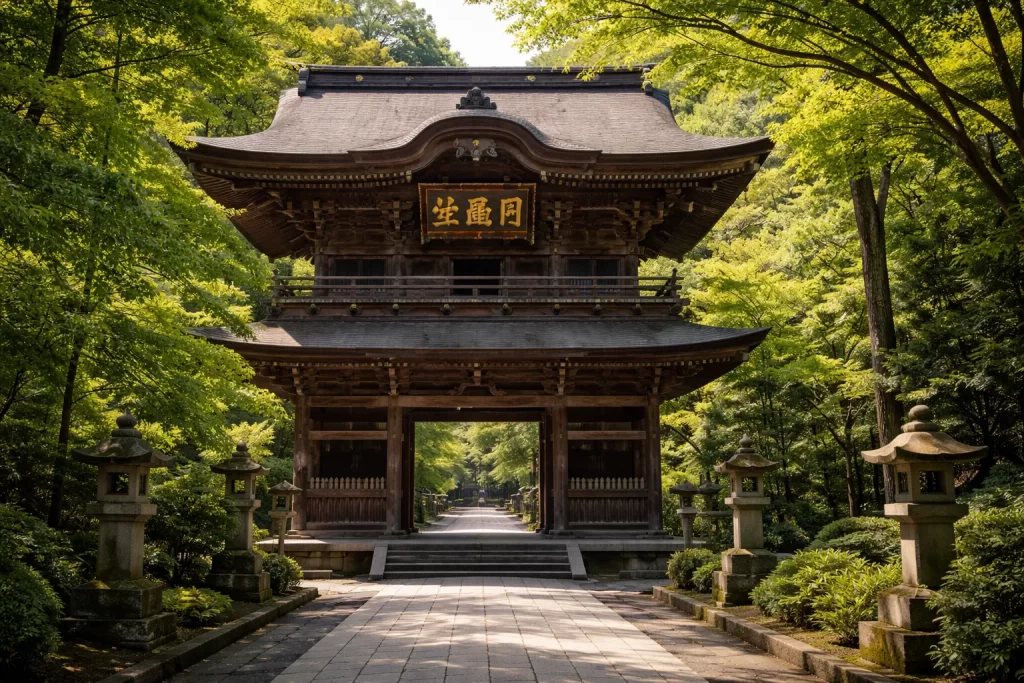
Towering directly in front of you as you exit Kita-Kamakura Station is the Sanmon (main gate) of Engaku-ji. The current Sanmon was rebuilt in 1718 (Kyoho 3) and is a two-story gate (nijumon) approximately 12 meters tall. The four pillars of the lower level are thick round columns about 60 centimeters in diameter, while the upper level displays a plaque inscribed with “Zuirokusan.” The term Sanmon is short for “Sangedatsumon” (Gate of the Three Liberations), representing the three states of enlightenment: emptiness (ku), formlessness (muso), and purposelessness (mugan). It is said that passing through this gate liberates one from worldly desires — a place where Zen architectural philosophy is distilled.
The upper level (rojo) of the Sanmon is opened to the public during special viewing periods (check for spring and autumn opening dates each year). The view from above is exceptional — the mountain ridges of Kita-Kamakura and the greenery of the temple grounds spread below, and on clear days you can even see as far as Yuigahama Beach. Buddhist statues including the Sixteen Rakan (Arhats) and Shakyamuni Buddha are enshrined in the upper level, and viewing these statues up close is a powerful experience. The area around the Sanmon is surrounded by old cedar and maple trees, and during the autumn foliage season the contrast between the gate and the colorful leaves is particularly beautiful, drawing many photography enthusiasts.
The stone steps in front of the Sanmon are steep, so take care with your footing when going up and down. They can be especially slippery on rainy days, so comfortable walking shoes are recommended. Standing directly beneath the Sanmon and looking up, you can truly appreciate its overwhelming scale and the beauty of its intricate woodwork — making it clear why it is called “Kamakura’s largest temple gate.”
2. National Treasure: Ogane (Great Bell) — The Largest Bell in the Kanto Region from the Kamakura Period
Near the Benten-do (Benzaiten Hall), situated on a hilltop within the Engaku-ji grounds, hangs the “Ogane” (Great Bell) in its bell tower — one of the largest temple bells in Japan. Designated as a National Treasure, this bell measures 259.5 centimeters in height, 108.0 centimeters in diameter, and weighs approximately 800 kilograms, earning it the title “Greatest Temple Bell in the Kanto Region.”
The surface of the Ogane is engraved with beautiful patterns and Sanskrit characters (bonji), making it a masterpiece of medieval Japanese metalwork. The front bears the inscription “Zuirokusan Engaku Zenji Kane” (Bell of Zuirokusan Engaku Zen Temple), clearly identifying it as Engaku-ji’s bell. This bell remains in daily use, and its resonant tones permeate the Kita-Kamakura valley every morning and evening. On New Year’s Eve, the 108 tolls of the joya no kane (New Year’s Eve bell) solemnly envelop the night sky over Kita-Kamakura.
To reach the Benten-do where the Ogane is located, you must climb steep stone steps from behind the Butsuden. The ascent requires some physical effort, but the view that awaits at the top — the bell tower and Benten-do surrounded by dense forest, with the rooftops of the sub-temples spreading below — makes the effort worthwhile. Benten-do enshrines Benzaiten (the goddess of fortune), one of the “Seven Lucky Gods of Kamakura and Enoshima” (alongside Enoshima and Tsurugaoka), and is believed to bring blessings of matchmaking, the arts, and financial fortune.
3. National Treasure: Shariden (Relic Hall) — A One-of-a-Kind Architectural Treasure Steeped in the Legend of the White Deer
Engaku-ji’s second National Treasure is the Shariden (Relic Hall), tucked away deep within the temple grounds. The Shariden was built to enshrine a relic of the Buddha (busshari) and is designated as a National Treasure as a representative masterpiece of Zen-style (Karayo/Zenshuyo) architecture introduced from China (Song and Yuan dynasties) during the Kamakura to Nanbokucho periods.
At first glance, the Shariden’s exterior appears modest, but closer inspection of its details reveals an exotic beauty that sets it apart from traditional Japanese architecture. The complex bracket systems (tokyo) beneath the eaves and the fan-shaped rafters (ogi-daruki) radiating outward are the most distinctive features of Zen-style architecture. Inside, relics of Shakyamuni Buddha are reportedly enshrined, and the building itself functions as a sacred vessel.
The Shariden is normally closed to the public and is only opened for interior viewing during the annual “Treasure Airing” (Hobutsu Kaze-ire) on November 3rd and during special viewing periods. Visiting during these times offers a rare opportunity to experience the pinnacle of architectural craftsmanship from over 700 years ago up close. The garden in front of the Shariden features white sand, embodying the simple, serene beauty that symbolizes the spirit of Zen. Both inside and out, it is one of the finest examples of Kamakura architecture and an absolute must-see for anyone interested in architectural history.
4. Byakurochi Pond and the Butsuden — The Heart of the Temple Grounds
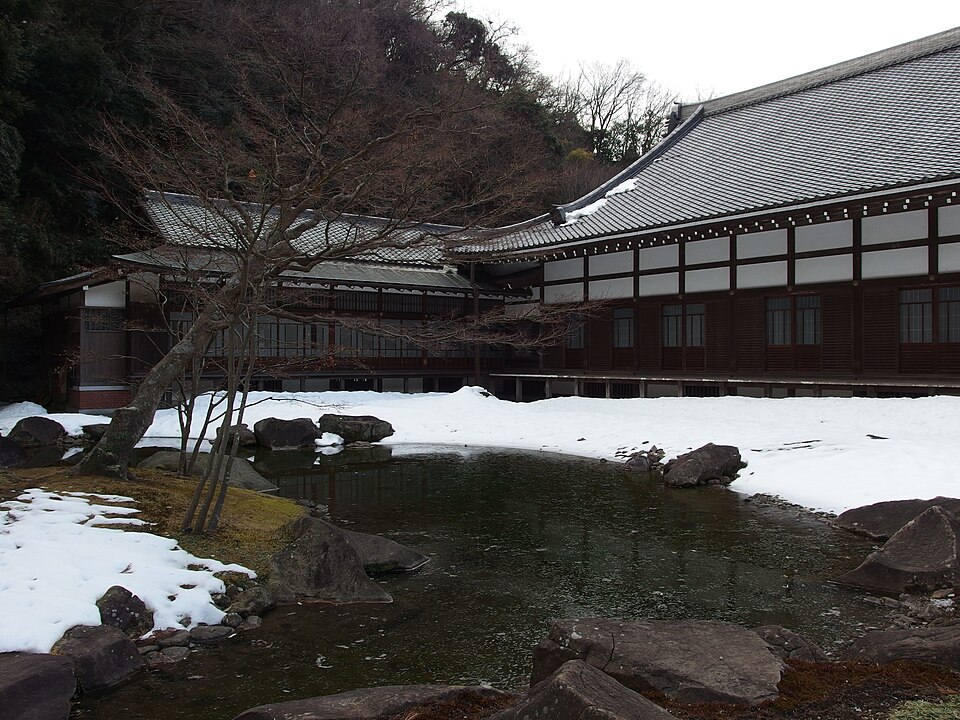
After passing through the Sanmon and climbing the stone steps, a tranquil pond appears on your left — this is Byakurochi Pond. It is associated with the legend behind Engaku-ji’s name: “white deer descended from the mountains during the founding ceremony.” The name is also said to derive from “Byakurokudo” (White Deer Cave). The sight of surrounding trees reflected on the pond’s surface is particularly enchanting in the morning mist.
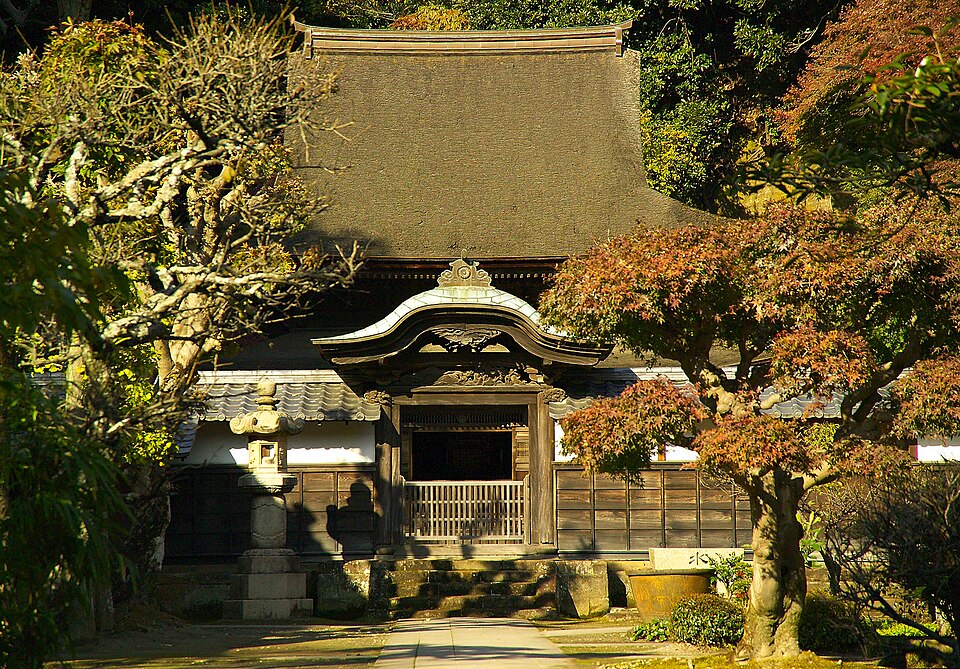
Beyond Byakurochi Pond stands the Butsuden (Buddha Hall). The current Butsuden was rebuilt in 1964 (Showa 39) and is a substantial structure incorporating Chinese Zen-style architecture. Inside, the principal image — a seated Crowned Shakyamuni (Hokan Shaka Nyorai) — is enshrined, flanked by statues of a white elephant (byakuzo) and a blue lion (seishi). The white elephant and blue lion are the mounts of Monju Bosatsu (Manjushri) and Fugen Bosatsu (Samantabhadra) respectively, symbolizing wisdom and practice.
The front courtyard of the Butsuden is wide and open, making it an excellent photo spot where you can frame both the Butsuden and the Sanmon together. The scene is especially atmospheric in the soft morning light of late autumn, when mist drifts around the Butsuden’s roof and the surrounding trees. The “Butsuden Bell” in front of the hall can be rung during your visit, its clear tone resonating throughout the grounds. After your visit, enter the Butsuden to offer a prayer to the Crowned Shakyamuni and experience a moment of the profound tranquility characteristic of a Zen temple.
5. Obai-in and the Sub-Temple Corridors — The Everyday Spaces of Zen
Scattered throughout the Engaku-ji grounds are 24 sub-temples (tatchu). Sub-temples are small temples built within the grounds to tend to the graves of eminent monks, each with its own independent buildings, gardens, and burial grounds. Among Engaku-ji’s sub-temples, Obai-in, located in the northern part of the grounds, is especially worth visiting.
Obai-in was established as the memorial hall (tosho) of Engaku-ji’s founding priest Mugaku Sogen, making it one of the oldest sub-temples. The grounds contain a memorial shrine (byosho) to the founding priest, and you can feel the historical weight of this place as the birthplace of Engaku-ji. The garden features a charming Zen garden of white sand and moss, where you can spend time contemplating the spirit of Zen in undisturbed silence. Obai-in is generally closed to the public but opens its interior during special viewing periods.
Another sub-temple, Butsunichi-an, was established as the memorial hall of Hojo Tokimune and can be visited for an additional admission fee to view its garden. The garden at Butsunichi-an is a quintessential Zen garden of moss and stone, and the scenery is especially beautiful during the autumn foliage season. Enjoying a cup of matcha tea (available for a fee) while gazing at the garden is one of the most luxurious ways to experience Kamakura’s Zen culture. When visiting Engaku-ji, be sure to venture beyond the main buildings and explore the tranquil gardens of the sub-temples as well.
Nearby Sightseeing Spots
Kencho-ji — The First-Ranked Great Zen Temple of the Kamakura Gozan
About a 15-minute walk south from Engaku-ji (or a 5-minute bus ride from Kita-Kamakura Station), Kencho-ji is the oldest Zen temple in Kamakura and holds the first rank among the Five Great Zen Temples of Kamakura. Founded in 1253 (Kencho 5) by Hojo Tokiyori, who invited the Chinese Zen monk Lanxi Daolong (Rankei Doryu) to serve as founding priest, this temple — established thirty years before Engaku-ji — can be regarded as the sacred birthplace of Japan’s Zen culture.
Kencho-ji’s highlights include its National Treasure temple bell (one of Kamakura’s two great bells alongside Engaku-ji’s Ogane), one of the largest Sanmon gates in Kamakura (an Important Cultural Property), and the Hansōbo — the starting point of the Ten’en Hiking Course with its spectacular views. Climbing to Hansōbo rewards you with a panoramic view of Kamakura’s townscape and Yuigahama Beach. Kencho-ji is also said to be the birthplace of “kenchinjiru” (Kencho-ji soup) — legend has it that a soup made from vegetable scraps used in the temple’s shojin ryori (Buddhist vegetarian cuisine) became known as “Kencho-ji jiru” and eventually “kenchinjiru.” A “Kamakura Gozan Zen Temple Tour” combining Engaku-ji and Kencho-ji is the best course for gaining a deep understanding of Kamakura’s Zen culture. A full-day Kamakura itinerary that also includes Hase-dera Temple and the Great Buddha of Kamakura is also popular.
Tokei-ji — The Temple of Divorce and Flowers
Located right next to Engaku-ji (about a 3-minute walk from Kita-Kamakura Station), Tokei-ji is a historically significant convent known as the “Temple of Divorce” and “Refuge Temple.” Founded in 1285 (Koan 8) by Kakusan-ni (wife of Hojo Tokimune), a disciple of Mugaku Sogen, Engaku-ji’s founding priest. During the Edo period, the temple functioned as an official “divorce temple” (enkiridera) under the “Divorce Temple Law,” where women fleeing abusive husbands could seek refuge and be granted a divorce, earning nationwide fame as a “women’s refuge temple.”
Today, Tokei-ji is cherished as a “temple of flowers,” with seasonal blooms adorning the grounds year-round — plum blossoms, daffodils, and iwakagami in spring; irises and Japanese iris in early summer; and cosmos in autumn. Though the grounds are small, their concentrated beauty offers a charm quite different from Engaku-ji’s grandeur — a delicate, refined atmosphere. The temple is also known for housing the graves of notable literary and intellectual figures such as philosopher Nishida Kitaro and author Osaragi Jiro, making it a place to trace the footsteps of famous individuals connected to Kamakura. Its proximity makes it an ideal stop before or after visiting Engaku-ji.
Kamakura & Hase Area — Tsurugaoka Hachimangu and the Great Buddha
From Kita-Kamakura, where Engaku-ji is located, it’s just two train stations (about 3 minutes) to Kamakura Station, and then a short ride on the Enoden line to Hase Station (about 10 minutes), where the Great Buddha of Kamakura (Kotoku-in) and Hase-dera Temple await. The Great Buddha is a National Treasure bronze seated Amida Nyorai statue approximately 11.3 meters tall, known worldwide as the symbol of Kamakura. Hase-dera is a beloved temple famous for its Eleven-Headed Kannon statue (one of the largest wooden Kannon statues in Japan) and an observation deck offering panoramic views of the Kamakura coast.
Combined with Tsurugaoka Hachimangu (Kamakura’s premier Shinto shrine) and Komachi-dori (a bustling shopping street for food and souvenirs) near Kamakura Station, you can complete the ultimate one-day Kamakura itinerary: “Engaku-ji → Kencho-ji → Kamakura → Tsurugaoka Hachimangu → Hase-dera → Great Buddha.” By combining the JR Yokosuka Line, Enoden, and walking, you can efficiently visit all of Kamakura’s major spots. For those with an intellectual curiosity, comparing Zen architecture with the shrines and temples of Nikko, such as Nikko Toshogu, adds another stimulating dimension to your trip.
Access Information
The most convenient way to reach Engaku-ji is via JR Yokosuka Line’s Kita-Kamakura Station. The moment you exit the ticket gates, the main gate of Engaku-ji is right before your eyes. The walk from the station takes just about 1 minute — an unbeatable location.
By Train
Alight at Kita-Kamakura Station on the JR Yokosuka Line and exit through the east ticket gate (about 1 minute on foot). From Tokyo Station: approximately 55 minutes on the direct Yokosuka Line (1,026 yen). From Yokohama Station: approximately 25 minutes (454 yen). From Kamakura Station: one stop, approximately 3 minutes (147 yen). Note that Kita-Kamakura Station has a small platform, so boarding and alighting may take longer on weekends and during peak travel seasons.
By Car / Parking
From the Asahina IC on the Yokohama-Yokosuka Expressway: approximately 20 minutes. Alternatively, access is possible through the Kamakura city center. However, Engaku-ji does not have its own parking lot, and nearby coin-operated parking spaces are limited. Traffic congestion in the Kamakura and Kita-Kamakura area becomes severe on weekends and holidays, so access by train is strongly recommended.
Tips for the Kita-Kamakura Station Area
The area around Kita-Kamakura Station is close to residential neighborhoods, with few large restaurants or convenience stores. It is recommended to arrange meals and drinks near Kamakura Station before or after your visit. The admission counter at Engaku-ji is located near the gate, where you pay the 600-yen (adult) admission fee to enter the grounds. The grounds are vast, so a leisurely visit takes 2–3 hours. Comfortable walking shoes are essential.
Conclusion
Engaku-ji is a Zen temple built by Hojo Tokimune, who overcame the national crisis of the Mongol invasions, under the noble principle of “honoring the spirits of all the fallen, regardless of friend or foe.” Over more than 740 years, the temple has survived wave after wave of history — the fall of the Kamakura shogunate, the devastation of the Warring States era, the restoration during the Edo period, and the modern Zen boom — and the spirit of Zen still lives and breathes within its grounds today.
The National Treasure temple bell and Shariden, the majestic Sanmon gate, the serene gardens of the sub-temples, and the zazen meditation experience — what Engaku-ji offers is among the most profound experiences in all of Kamakura sightseeing. Amid the rich nature of Kita-Kamakura and a space infused with over 700 years of history, we invite you to experience the spirit of Zen for yourself.
![[Samurai residence in Kakunodate x Sake] Enjoy local sake on a sake brewery tour! A trip to enjoy Kakunodate and sake](https://article.bespes-jt.com/wp-content/uploads/hubfs/5a08e56095285b6be5596baecd4bc393.jpg)
