- Introduction
- Overview of Kamigamo Shrine
- History of Kamigamo Shrine
- 1. The Age of Mythology: The Descent of Kamo-wake-ikazuchi-no-Okami and the Kamo Clan’s Faith
- 2. The Heian Period: Guardian of the Imperial Capital — The Aoi Festival and Deep Bonds with the Imperial Family
- 3. Medieval to Early Modern Period: Trials of War and Restoration — Surviving the Onin War
- 4. Meiji to Showa Period: The Tide of Modernization and the Continuation of Shikinen Sengu
- 5. Heisei to Reiwa: World Heritage Registration and Kamigamo Shrine Today
- Highlights & Must-See Spots
- 1. Tatesuna (Sacred Sand Cones) — Conical Sand Mounds Representing the Mountain Where the Deity Descended
- 2. Honden & Gongen (National Treasures) — Masterpieces of Kamo-zukuri Architecture
- 3. Romon Gate & Tama Bridge — The Vermilion Gateway to the Sacred Domain
- 4. Shinme (Sacred Horse) — The White Horse Serving the Deity
- 5. Nara-no-Ogawa & Mitarashi River — The Serene Waterscape Flowing Through the Shrine Grounds
- Nearby Sightseeing Spots
- Access Information
- Summary
- Frequently Asked Questions
Introduction
As you step into the grounds of Kamigamo Shrine, nestled along the banks of the Kamo River in Kita Ward, Kyoto, the first thing that catches your eye is the vast lawn-covered approach and the vermilion shrine buildings standing serenely beyond it. A gentle atmosphere, far removed from the bustle of the city, envelops the entire precinct, drawing visitors into a world steeped in ancient history. In the stillness, where only the rustling of wind-swept trees and the murmur of the Mitarashi River can be heard, you will feel the purity of this sacred ground that has been preserved for over 1,300 years.
Kamigamo Shrine, formally known as Kamo-wake-ikazuchi Jinja, is one of the oldest shrines in Kyoto. Its founding dates back to the age of mythology, and according to shrine tradition, the present shrine buildings were first constructed in 677 AD (the 6th year of Emperor Tenmu’s reign). In 1994, it was registered as one of the component sites of the UNESCO World Cultural Heritage “Historic Monuments of Ancient Kyoto,” earning international recognition for its cultural significance. Widely known as the venue for the Aoi Festival (Aoi Matsuri), one of Kyoto’s three great festivals, every year on May 15 a magnificent procession reminiscent of a Heian-era picture scroll adorns the streets of Kyoto.
This article provides a comprehensive guide to Kamigamo Shrine, covering everything from the creation myth behind its founding, the history of 21 shikinen sengu (periodic shrine rebuildings), the National Treasure main hall (Honden) and companion hall (Gongen), unique highlights such as the sacred sand cones (Tatesuna) and the shrine horse (Shinme), as well as nearby sightseeing spots and access information. We hope this guide will be useful in planning your Kyoto trip.
Overview of Kamigamo Shrine
Kamigamo Shrine is enshrined at Kamigamo Motoyama in Kita Ward, Kyoto, and serves as the ichinomiya (highest-ranking shrine) of Yamashiro Province, dedicated to the tutelary deity of the Kamo clan. It is one of the oldest shrines in Kyoto. Its formal name is Kamo-wake-ikazuchi Jinja, and the enshrined deity is Kamo-wake-ikazuchi-no-Okami. As the name suggests—containing the character for thunder (ikazuchi)—the shrine has long been revered for its divine virtues of warding off evil, lightning, and directional misfortune.
| Formal Name | Kamo-wake-ikazuchi Jinja |
|---|---|
| Address | 339 Kamigamo Motoyama, Kita-ku, Kyoto, Kyoto Prefecture |
| Enshrined Deity | Kamo-wake-ikazuchi-no-Okami |
| Shrine Rank | Shikinaisha (Myojin Taisha), Ichinomiya of Yamashiro Province, Former Kanpei Taisha, Chokusaisha |
| Founded | According to shrine tradition: 677 AD (6th year of Emperor Tenmu’s reign) |
| Visiting Hours | 5:30 AM – 5:00 PM (Special worship: 10:00 AM – 4:00 PM, weekends and holidays only) |
| Admission | Free (Special worship: 500 yen for adults) |
| Closed | Open year-round |
| Phone | 075-781-0011 |
*Please check the official Kamigamo Shrine website for the latest visiting hours and fees.
Together with Shimogamo Shrine (Kamo-mioya Jinja), Kamigamo Shrine is collectively known as “Kamo-sha” and has maintained an exceptionally deep connection with the Imperial household since ancient times. Listed as a Myojin Taisha in the Engishiki Jimmyocho (a register of shrines from the Heian period), it has been venerated as the ichinomiya of Yamashiro Province. Considered second in rank only to Ise Grand Shrine, it is also a chokusaisha—a shrine where imperial envoys have been dispatched without interruption throughout history. The total area of the shrine grounds spans approximately 660,000 square meters (equivalent to about 14 Tokyo Domes), with the vast majority covered by dense forest preserved as sacred domain.
The shrine attracts approximately 1.5 million visitors annually, with around 700,000 hatsumode (New Year) visitors during the first three days of January alone. The grounds contain 2 National Treasure buildings—the Honden and Gongen—as well as 34 Important Cultural Properties, making it a veritable treasure trove of shrine architecture. It is also one of the few shrines where the tradition of shikinen sengu (periodic rebuilding every 21 years) continues to this day; the most recent 42nd shikinen sengu was conducted in 2015.
History of Kamigamo Shrine
1. The Age of Mythology: The Descent of Kamo-wake-ikazuchi-no-Okami and the Kamo Clan’s Faith
The origins of Kamigamo Shrine trace back to the mythological age described in the Kojiki and Nihon Shoki. The founding legend passed down in shrine tradition is a mystical tale that also establishes the legitimacy of the Kamo clan’s lineage. When Tamayori-hime, the daughter of Kamo-taketsunumi-no-Mikoto (the ancestral deity of the Kamo clan), was purifying herself in the Kamo River, a vermilion-lacquered arrow came floating downstream. When she picked up the arrow and brought it home, she eventually gave birth to a boy. This child was Kamo-wake-ikazuchi-no-Okami.
The name “Wake-ikazuchi” means “young thunder,” and the deity was revered as a god possessing fierce and powerful divine authority, like a bolt of lightning. According to legend, at the feast celebrating the boy’s coming of age, his grandfather Kamo-taketsunumi-no-Mikoto said, “Offer this sake to the one you consider your father.” Kamo-wake-ikazuchi-no-Okami raised the cup toward the heavens and ascended into the sky with a clap of thunder. Because of this, people revered him as the god of thunder and enshrined Mount Koyama—the place of his descent—as the sacred mountain (shintaizan).
From an archaeological perspective, it is estimated that the Kamo clan settled in this area and began conducting rituals between the late Jomon period and the Yayoi period. The Kamo were a powerful clan based in ancient Yamashiro Province, skilled in ironworking and agriculture. According to shrine tradition, the shrine buildings were constructed at the present site in 677 AD (the 6th year of Emperor Tenmu’s reign), which is regarded as the official founding year of Kamigamo Shrine. In the Nara period, imperial reverence grew even deeper, with records showing that official offerings were already being presented in 701 AD (the 1st year of Taiho).
2. The Heian Period: Guardian of the Imperial Capital — The Aoi Festival and Deep Bonds with the Imperial Family
The transfer of the capital to Heian-kyo (Kyoto) in 794 AD was a pivotal moment of growth for Kamigamo Shrine. Emperor Kanmu deeply revered the Kamo shrines, situated to the north of the new capital, as guardian deities of the imperial city, and elevated the Kamo shrine festivals to national events. This was the origin of today’s Aoi Festival (Kamo Festival), which was so prominent during the Heian period that “the festival” simply meant the Aoi Festival. The Tale of Genji describes the splendor of the Aoi Festival, and the famous scene of the carriage quarrel between Lady Aoi and Lady Rokujo vividly conveys the festival’s grandeur in those times.
During the Heian period, the Saiin system was established, in which an unmarried imperial princess served as the Saio (priestess) at the Kamo shrines. This paralleled the Saigu system at Ise Grand Shrine, symbolizing the Kamo shrines’ status as second only to Ise. The first Saiin was Princess Uchiko, daughter of Emperor Saga, and over a span of approximately 400 years, 35 generations of Saio served the shrine. The Saiin palace was located to the northwest of present-day Kamigamo Shrine, and the remains of the Kamo Saiin still preserve traces of this history.
It was also during this era that the shrine buildings of Kamigamo Shrine were extensively developed. The distinctive architectural style known as “Kamo-zukuri” was established, in which the Honden (main hall) and Gongen (companion hall) stand side by side. The shikinen sengu system of rebuilding the shrine every 21 years is also believed to have begun in the Heian period, serving as a mechanism to preserve the shrine’s purity while transmitting architectural techniques to the next generation—a tradition that continues to this day. During the Heian period, Kamigamo Shrine was one of the most important shrines in Kyoto, wielding both religious authority and political influence.
3. Medieval to Early Modern Period: Trials of War and Restoration — Surviving the Onin War
Despite reaching the height of its prosperity during the Heian period, Kamigamo Shrine endured numerous trials during the turbulent medieval era. The Onin War (1467–1477) in particular reduced much of Kyoto to ashes, causing severe damage to the shrine buildings. Furthermore, during the Sengoku (Warring States) period, local warlords repeatedly seized the shrine’s estates, severely undermining its economic foundation.
However, with the support of the imperial court and powerful patrons, Kamigamo Shrine was restored each time. During the Muromachi period, the Ashikaga shoguns supported the repair of the shrine buildings, and during the Sengoku period, Oda Nobunaga issued documents guaranteeing the shrine’s estates. Toyotomi Hideyoshi also valued the Kamo shrines and ordered the restoration of the buildings in 1594.
With the advent of the Edo period, Kamigamo Shrine came under the stable protection of the Tokugawa shogunate. In 1628, under the orders of the third shogun Tokugawa Iemitsu, the Honden and Gongen were rebuilt, laying the foundation for the current National Treasure buildings. The Honden and Gongen constructed during this period have been repeatedly maintained through subsequent shikinen sengu while preserving their basic form, carrying the exquisite beauty of “Kamo-zukuri” architecture down to the present day. Throughout the Edo period, shikinen sengu was performed without interruption, with detailed records remaining from the Genroku, Kyoho, Bunka, and other eras.
4. Meiji to Showa Period: The Tide of Modernization and the Continuation of Shikinen Sengu
The Meiji Restoration was a major turning point for Kamigamo Shrine as well. The Shinbutsu Bunri (Separation of Shinto and Buddhism) edict of 1868 led to the removal of Buddhist-related facilities from the grounds, returning the shrine to its form as a purely Shinto institution. Under the shrine ranking system of 1871, it was classified as a Kanpei Taisha (government-designated grand shrine), positioning it among the nation’s highest-ranking shrines. The Aoi Festival was temporarily suspended in the early Meiji period but was revived in 1884 and has continued uninterrupted since then.
During the Taisho era, flood control works on the Kamo River were advanced, providing a foundation to protect the shrine buildings from repeated flood damage. However, during the Showa era, the Pacific War made it difficult to maintain the shrine buildings for a time. Fortunately, Kamigamo Shrine escaped the ravages of war, and after overcoming the post-war turmoil, the Honden and Gongen were designated as National Treasures in 1953. This established a framework for protection as cultural properties, and the tradition of shikinen sengu was also continued with national support.
During the Showa era, the shake-machi (shrine priest quarter) of Kamigamo Shrine also gained attention as an important cultural landscape. The shake-machi is a neighborhood where the residences of priests who served Kamigamo Shrine for generations are lined up along the Myojin River, with earthen walls and elegant gates creating a historic streetscape found nowhere else in Kyoto. Today, this shake-machi is designated as a National Important Preservation District for Groups of Traditional Buildings.
5. Heisei to Reiwa: World Heritage Registration and Kamigamo Shrine Today
In 1994, Kamigamo Shrine was registered as one of the component sites of the UNESCO World Cultural Heritage “Historic Monuments of Ancient Kyoto.” Alongside Kinkaku-ji (Golden Pavilion) and Kiyomizu-dera, it was recognized internationally as one of Kyoto’s most representative cultural heritage sites. Following the World Heritage registration, the number of international visitors increased, and information signage in English and French was expanded.
In 2015, the 42nd shikinen sengu was conducted. During the “Shossengu” ceremony, the sacred object was transferred from the temporary hall to the newly restored Honden in a solemn ritual performed in the dead of night. This shikinen sengu attracted visitors from across the country and served as a powerful reminder of the weight of a tradition carried on for over 1,300 years. The next shikinen sengu is scheduled for 2036.
Modern-day Kamigamo Shrine actively embraces new initiatives while preserving tradition. On the fourth Sunday of every month, the “Kamigamo Handmade Market” is held on the grounds, where local artisans and craft makers gather for a popular market. The shrine is also a highly sought-after wedding venue, with a steady stream of couples choosing to hold their Shinto wedding ceremonies here. With approximately 1.5 million annual visitors, it ranks among the top shrines in Kyoto. Each season brings its own beauty—cherry blossoms in spring, fresh green in summer, autumn foliage, and a dusting of snow in winter—making the grounds a stunning sight throughout the year.
Highlights & Must-See Spots
Here are the must-see highlights when visiting Kamigamo Shrine. This sacred space, nurtured over more than 1,300 years of history, is filled with unique attractions that cannot be found at any other shrine.
1. Tatesuna (Sacred Sand Cones) — Conical Sand Mounds Representing the Mountain Where the Deity Descended
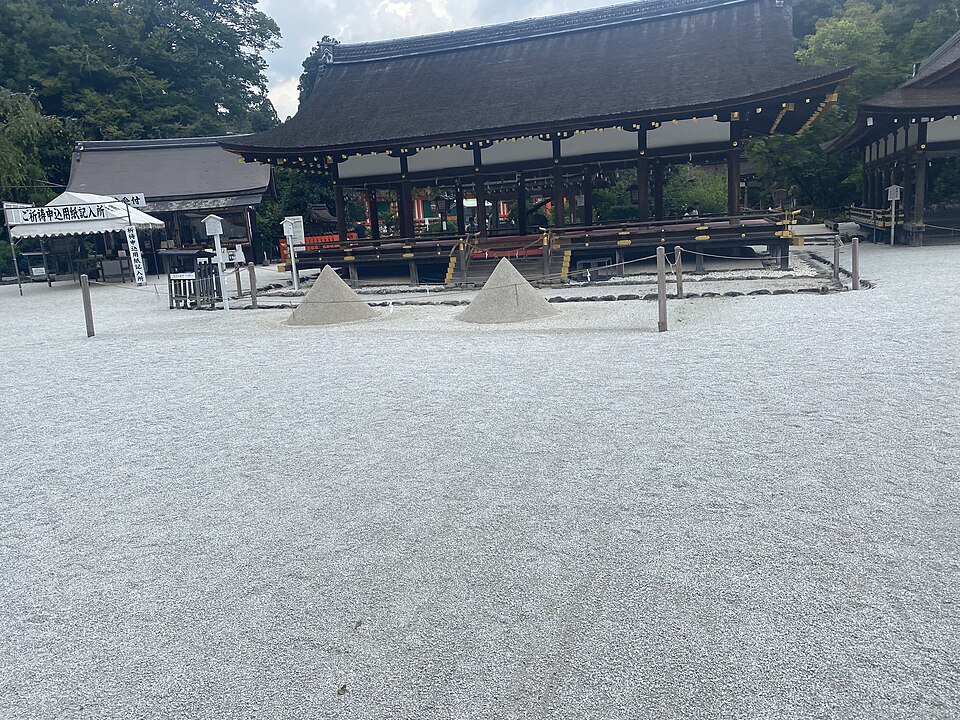
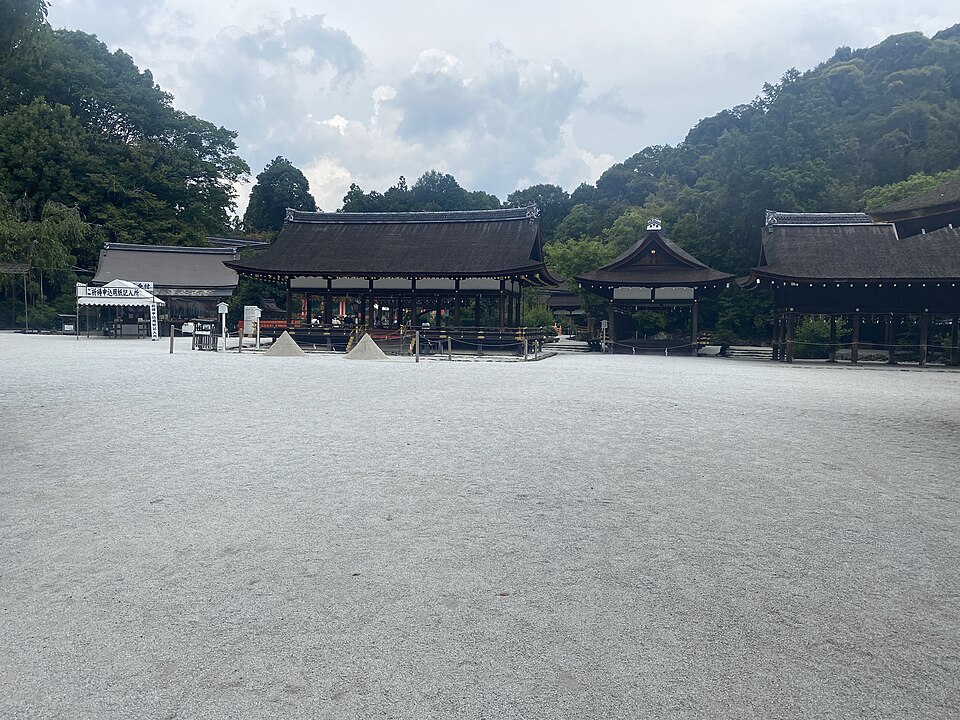
One of the most memorable sights at Kamigamo Shrine is the pair of conical sand mounds called “Tatesuna,” arranged symmetrically in front of the Hosodono (slender hall). Standing approximately one meter tall, these beautifully shaped cones are said to represent Mount Koyama, the sacred mountain where the enshrined deity Kamo-wake-ikazuchi-no-Okami is believed to have descended, and they serve as yorishiro (objects that attract divine spirits). The left cone is topped with three pine needles and the right with two, based on the principles of Onmyodo (yin-yang philosophy).
The Tatesuna are also said to be the origin of “purification sand,” and there is a theory that the Japanese custom of placing mounds of salt at the entrances of homes and shops derives from these sacred sand cones. To this day, the shrine’s amulet office distributes “kiyome-zuna” (purification sand), which many visitors purchase for purifying their homes and properties. The beauty of the Tatesuna lies in the stunning fusion of precisely crafted geometric forms shaped by human hands and the understated simplicity of natural sand.
The Tatesuna are also a popular photography spot. Shooting in the soft morning light beautifully brings out the shadows on the sand. A composition combining the roof of the Hosodono with the Tatesuna is the quintessential Kamigamo Shrine photograph. On days after rain, the damp sand takes on a deeper color, revealing yet another face. Be sure to observe the Tatesuna from various angles, not just from directly in front of the Hosodono.
2. Honden & Gongen (National Treasures) — Masterpieces of Kamo-zukuri Architecture
Located at the innermost part of Kamigamo Shrine, the Honden (main hall) and Gongen (companion hall) are both designated as National Treasures and are among the finest examples of shrine architecture. The current buildings were constructed during the shikinen sengu of 1863 and are built in the “Kamo-zukuri” style unique to Kamigamo Shrine. Kamo-zukuri is considered the prototype of “nagare-zukuri” (flowing style) and is characterized by the elegant curve of the front roof, which extends outward to form the kohai (worship canopy).
The Honden enshrines the deity Kamo-wake-ikazuchi-no-Okami, while the Gongen is a “reserve hall” of nearly identical structure and scale. During shikinen sengu, the sacred object is transferred from the Honden to the Gongen (or vice versa), ensuring that one of the two always functions as the active shrine hall. This dual-hall arrangement is reminiscent of the Inner and Outer Shrines of Ise Grand Shrine and symbolizes the high status of Kamigamo Shrine.
During regular visits, the Honden and Gongen can only be viewed from outside the sacred fence (mizugaki), but by signing up for special worship (500 yen for adults), a shrine priest will guide you inside the fence for a close-up view of these National Treasure buildings. The contrast between the cypress bark roof, vermilion pillars, and white walls is exquisite, offering a firsthand encounter with the finest shrine architecture dating back to the Heian period. If you visit Kamigamo Shrine, we highly recommend experiencing the special worship tour.
3. Romon Gate & Tama Bridge — The Vermilion Gateway to the Sacred Domain
After passing through the second torii gate and walking along the lawn-covered approach, the striking vermilion Romon gate comes into view. Designated as an Important Cultural Property, this gate is one of the most splendid structures in the Kamigamo Shrine complex, its imposing figure standing approximately 13 meters tall to welcome visitors. In front of the Romon, the Tama Bridge (also an Important Cultural Property) spans the Mitarashi River, with its vermilion railings and crystal-clear water creating a picture-perfect scene.
Passing through the Romon gate, you will see the Chumon (inner gate) and beyond it the sacred fence surrounding the Honden and Gongen. The space from the Romon to the Honden symbolizes the boundary between the secular world and the sacred domain, and with each step deeper inside, you will feel the atmosphere growing increasingly solemn. Early morning visits are particularly rewarding, as the Romon’s vermilion hue glows even more vividly in the morning sunlight, heightening the sense of sanctity.
Pay attention to the architectural details of the Romon as well. The irimoya-zukuri (hip-and-gable) cypress bark roof is complemented by lattice windows of differing designs on the upper and lower stories, blending elements of Heian-era palace architecture with shrine architectural beauty. While the Tama Bridge itself is normally closed to foot traffic, visitors cross a nearby bridge to reach the Romon. In the seasons of fresh green and autumn foliage, the trees surrounding the Romon and Tama Bridge add layers of seasonal color to the scene.
4. Shinme (Sacred Horse) — The White Horse Serving the Deity
Within the grounds of Kamigamo Shrine stands the Shinme-sha (sacred horse stable), where a white sacred horse is kept. The Shinme is a horse dedicated to the service of the deity, and Kamigamo Shrine has cherished white horses as sacred animals since ancient times. On Sundays, holidays, and during festivals, visitors can see the sacred horse walking through the grounds—a beloved sight that never fails to delight.
The connection between Kamigamo Shrine and horses runs deep. During the Heian period, the Kamo Kurabeuma (Kamo horse race) was held on May 5th (Tango no Sekku, or Boys’ Day), in which horses raced across the shrine’s lawn to divine the harvest fortune for the year. This tradition continues today, with the “Kamo Kurabeuma Ashizoroe-shiki” and “Kamo Kurabeuma” being offered annually on May 5th. This ritual, boasting a history of approximately 900 years, is registered as an Intangible Folk Cultural Property of Kyoto City and is a precious event that preserves the form of Heian-era court ceremonies.
While visitors cannot touch the sacred horse, they can view it up close from behind the fence. The beautiful sight of the gentle-eyed white horse is especially popular with families visiting with children. Please note that viewing may not be available on some days depending on the horse’s health or weather conditions. When visiting Kamigamo Shrine, be sure to stop by the Shinme-sha.
5. Nara-no-Ogawa & Mitarashi River — The Serene Waterscape Flowing Through the Shrine Grounds
The Nara-no-Ogawa stream and the Mitarashi River flowing through the grounds of Kamigamo Shrine are symbols of the shrine’s purity. The Mitarashi River flows along the eastern side of the Honden and passes beneath the Tama Bridge in front of the Romon gate. Its water is remarkably clear—so transparent that every small pebble on the riverbed is visible. Cool even in summer, this pristine stream has been used as a place for misogi (ritual purification) since ancient times.
“Nara-no-Ogawa” is the name of the Mitarashi River after it exits the shrine grounds, and it is also celebrated in the Hyakunin Isshu (One Hundred Poems by One Hundred Poets): “As the breeze stirs the Nara-no-Ogawa at dusk, the purification rite is the only sign of summer” (by Fujiwara no Ietaka). As this poem describes, during the Nagoshi no Harae (Summer Purification) in the sixth month of the lunar calendar, paper effigies (hitogata) are floated down the stream in a ritual to cleanse the impurities accumulated over the first half of the year.
When strolling through the grounds, take time to listen to the gentle murmur of the stream. In the fresh green season, sunlight filtering through the leaves dances on the water’s surface, creating a dreamlike scene. In summer, visitors can be seen sitting by the stream seeking relief from the heat, offering a refreshing respite from Kyoto’s hot summers. Visit Kamigamo Shrine in person to experience why it is sometimes called the “water shrine.”
Nearby Sightseeing Spots
Shimogamo Shrine (Kamo-mioya Jinja) — The Other Sacred Sanctuary of the Kamo Shrines
Located approximately 3 kilometers south of Kamigamo Shrine, at the confluence of the Kamo River and Takano River, Shimogamo Shrine is the other sacred sanctuary that together with Kamigamo Shrine forms “Kamo-sha.” Formally known as Kamo-mioya Jinja, it enshrines Tamayori-hime-no-Mikoto, the mother of Kamigamo Shrine’s deity Kamo-wake-ikazuchi-no-Okami, and Kamo-taketsunumi-no-Mikoto, his grandfather. In other words, Shimogamo Shrine is the “parent shrine” of Kamigamo Shrine, and visiting both provides a complete picture of the Kamo clan mythology.
From Kamigamo Shrine, Shimogamo Shrine is about a 40-minute walk along the Kamo River or approximately 15 minutes by bus. During the Aoi Festival, the procession passes through Shimogamo Shrine en route to Kamigamo Shrine, and the path connecting the two shrines is fondly known as the “Aoi Festival Road.” Also registered as a World Cultural Heritage site, Shimogamo Shrine offers its own rich array of highlights, including the primeval forest of Tadasu no Mori and the matchmaking power spot of Aioi-sha, each offering a different charm from Kamigamo Shrine. We highly recommend visiting both shrines together to experience the grand worldview of the Kamo shrines.
Daitoku-ji Temple — A Treasure Trove of Zen Culture
Approximately 2 kilometers southwest of Kamigamo Shrine (about 10 minutes by bus), Daitoku-ji is the head temple of the Rinzai Daitoku-ji school of Zen Buddhism. Closely associated with the monk Ikkyu Sojun (popularly known as “Ikkyu-san”) and the tea master Sen no Rikyu, its grounds house more than 20 sub-temples. Koto-in and Daisen-in, which are open to the public, feature masterpieces of karesansui (dry landscape) gardens.
After experiencing the pure Shinto world of Kamigamo Shrine, visiting Daitoku-ji to encounter the spirit of Zen offers a multi-faceted way to enjoy Kyoto’s religious culture. In front of Daitoku-ji’s gate, you will also find long-established Kyoto confectionery shops, perfect for a post-visit rest. During the autumn foliage season, Koto-in’s approach is blanketed in brilliant red, and it is popular as part of a circuit tour of the Kitayama area that also includes Kinkaku-ji (Golden Pavilion).
Kyoto Botanical Garden — Enjoy Seasonal Flowers and Nature
Approximately 1.5 kilometers south of Kamigamo Shrine (about a 20-minute walk), the Kyoto Botanical Garden is the oldest public botanical garden in Japan, having opened in 1924. Spanning approximately 24 hectares, it cultivates around 12,000 species of plants, offering beautiful flowers to enjoy throughout all four seasons. The spring tulip fields and cherry blossom groves, as well as the autumn rose garden, are particularly spectacular.
The botanical garden is an ideal complement to a visit to Kamigamo Shrine, allowing you to leisurely enjoy nature before or after your shrine visit. The garden also features one of Japan’s largest conservatories, housing everything from tropical plants to alpine flora. Admission is just 200 yen for adults, and a pleasant route is to stroll along the Kamo River between the two sites. Experience a different kind of beauty from the natural landscapes of Arashiyama—the carefully cultivated elegance of a formal garden.
Access Information
By Train
- Kyoto Municipal Subway Karasuma Line: From Kitayama Station, take City Bus No. 4 for about 10 minutes to “Kamigamo Jinja-mae” stop
- From JR Kyoto Station: Take the Karasuma Line subway to Kitaoji Station, then City Bus Kita-3 for about 15 minutes to “Misonoguchi-cho” stop, about 3 minutes on foot
- Keihan Railway: From Demachiyanagi Station, take City Bus No. 4 for about 30 minutes to “Kamigamo Jinja-mae” stop
By Bus
- Kyoto City Bus No. 4, get off at “Kamigamo Jinja-mae (Misonobashi),” directly in front
- Kyoto City Bus Kita-3, get off at “Misonoguchi-cho,” about 3 minutes on foot
- From JR Kyoto Station, take City Bus No. 9 for about 40 minutes to “Kamigamo Misonobashi,” about 3 minutes on foot
By Car
- About 30 minutes from Kyoto Minami IC on the Meishin Expressway
- Free parking available at Kamigamo Shrine (approximately 170 spaces; temporary parking lots also open during busy periods)
- Parking lots become very crowded during the Aoi Festival and New Year periods; public transportation is recommended
Recommended Access
Kamigamo Shrine is located somewhat outside central Kyoto, so buses are the most convenient option. From JR Kyoto Station, City Bus No. 9 runs directly in about 40 minutes; from Shijo Kawaramachi, City Bus No. 4 takes about 30 minutes. Transferring to a bus from Kitaoji Station on the subway is also relatively smooth—from Kitaoji Bus Terminal, the Kita-3 bus takes about 15 minutes. If visiting Shimogamo Shrine as well, City Bus No. 4 conveniently connects both shrines. Kamigamo Shrine also has a free parking lot, making driving an option. However, please be aware that congestion is expected during busy periods.
Summary
Kamigamo Shrine is one of Kyoto’s oldest shrines with over 1,300 years of history, and as a World Heritage site, it possesses a unique appeal found nowhere else—including the National Treasure Honden and Gongen, the mystical Tatesuna sand cones, and the Aoi Festival, one of Kyoto’s three great festivals. The fact that the tradition of shikinen sengu has been carried on through 21 cycles symbolizes the profound depth of Japan’s Shinto culture. The clear streams flowing through the vast grounds and the tranquil atmosphere of the sacred domain will surely cleanse and refresh the spirit of every visitor.
The possibilities for exploring Kyoto with Kamigamo Shrine as your starting point are endless—from a “Kamo shrine pilgrimage” paired with Shimogamo Shrine, to a Kitayama area circuit that includes Kinkaku-ji and Daitoku-ji. If you wish to experience the deep history and culture of Kyoto, we invite you to visit Kamigamo Shrine.