- Introduction
- Overview of Kencho-ji
- History of Kencho-ji
- Highlights and Recommended Spots
- 1. Sanmon (Main Gate) — The Entrance to a Zen Temple and Symbol of “Tenka Zenrin”
- 2. Butsuden and the National Treasure Temple Bell — A Grand Relocated Structure Connecting Edo and Kamakura
- 3. Hojo and Garden — A Karesansui Born from Chinese Zen Aesthetics
- 4. Hansobo Daigongen — Kamakura’s Best Panoramic Views and a Power Spot for Good Fortune
- 5. Sub-Temples and Zazen Experience — Encountering Living Zen Culture
- Nearby Sightseeing Spots
- Access Information
Introduction
Kencho-ji stands near the northern edge of Kamakura, close to the entrance of the Tenen Hiking Course. The moment you pass through its main gate, you are enveloped by a deep green tunnel created by towering cedar trees and crisp, pure air. The profound stillness that pervades every corner of the grounds tells you that this is no mere tourist attraction, but a living Zen training monastery that continues to function to this day.
Kencho-ji was founded in 1253 (Kencho 5) by Hojo Tokiyori, the fifth regent of the Kamakura shogunate, making it Japan’s first full-fledged Zen training monastery. Its founding abbot was Rankei Doryu (Lanxi Daolong), a renowned monk invited from Song Dynasty China. More than 770 years after its founding, Kencho-ji remains a “living Zen temple,” serving as the head temple of the Rinzai sect’s Kencho-ji school, where monks continue to devote themselves to Zen practice. Ranked first among the Kamakura Gozan (Five Great Zen Temples of Kamakura), this celebrated temple is a cornerstone of Japan’s Zen culture, drawing a constant stream of visitors and researchers from Japan and abroad.

Overview of Kencho-ji
Kencho-ji is the head temple of the Rinzai sect’s Kencho-ji school, located in Yamanouchi, Kamakura, Kanagawa Prefecture, and is renowned as “Japan’s first Zen temple.” Its formal name is “Kofukusan Kencho Kokoku Zenji.”
| Official Name | Kofukusan Kencho Kokoku Zenji |
|---|---|
| Address | 8 Yamanouchi, Kamakura, Kanagawa Prefecture |
| Sect | Rinzai sect, Kencho-ji school (Head Temple) |
| Mountain Name | Kofukusan |
| Founded | 1253 (Kencho 5) |
| Founding Abbot | Rankei Doryu (Daikaku Zenji) |
| Patron | Hojo Tokiyori (5th Regent of the Kamakura Shogunate) |
| Visiting Hours | 8:30 AM – 4:30 PM (Last admission at 4:00 PM) |
| Admission Fee | Adults: 500 yen, Elementary/Junior High Students: 200 yen |
| Closed | Open year-round |
| Phone Number | 0467-22-0981 |
*Please check the official Kencho-ji website for the latest visiting hours and admission fees.
As the foremost of the “Kamakura Gozan” (Five Great Zen Temples of Kamakura), Kencho-ji was the center of Japanese Zen culture from the Kamakura period through the Muromachi period. The Kamakura Gozan was a ranking system for Zen temples established by the Kamakura shogunate, with Kencho-ji ranked first and Engaku-ji ranked second. This system was modeled after the Five Mountains system of China (Song and Yuan dynasties), reflecting the shogunate’s deliberate effort to embrace Zen culture.
Kencho-ji by the numbers: the temple grounds cover approximately 150,000 square meters, with 10 sub-temples (tacchu). At its founding, the complex boasted 49 sub-temples and a full seven-hall garan (temple compound), but repeated fires destroyed much of it. The temple holds numerous National Treasures and Important Cultural Properties; the National Treasure temple bell (cast in 1255, Kencho 7) is sometimes called one of Japan’s Three Great Bells. Seven byakushin (Chinese juniper) trees estimated to be over 750 years old still stand on the grounds — living cultural assets said to have been grown from seeds that the founding abbot Rankei Doryu brought from China.
History of Kencho-ji
Period 1 — The Founding (1253)
In the mid-13th century, when Kencho-ji was born, Kamakura was experiencing one of the most dynamic periods of spiritual and cultural innovation in Japanese history.
Tokiyori’s encounter with Zen came through his meeting with Rankei Doryu (1213-1278), a distinguished monk from Song Dynasty China who arrived in Japan around 1240 (Ninji 1).
In 1253 (Kencho 5), Tokiyori opened a grand Zen training monastery on the site where Kencho-ji stands today.
As the founding abbot, Rankei Doryu transmitted a pure style of Zen practice to Japanese monks.
Seven byakushin (Chinese juniper) trees, believed to have been planted at the time of founding, still remain on the grounds today.
Period 2 — Growth and Prosperity (Mid to Late Kamakura Period)
Within just a few decades of its founding, Kencho-ji established its reputation as one of East Asia’s premier Zen training centers.
After Hojo Tokiyori passed away at the young age of 37 in 1263 (Kocho 3), patronage of Kencho-ji continued.
Mugaku Sogen (Wuxue Zuyuan, 1226-1286) became the second head priest.
During Kencho-ji’s golden age, many monks came from China (Song and Yuan dynasties) and the Korean Peninsula, studying and training alongside Japanese monks.
Period 3 — Turning Points and Trials (Muromachi to Sengoku Period)
The greatest turning point for Kencho-ji was the fall of the Kamakura shogunate in 1333 (Genko 3).
The Muromachi shogunate established a Five Mountains system in Kyoto, placing the “Kyoto Gozan” above the “Kamakura Gozan.” This forced a relative decline in Kencho-ji’s status, though it maintained its prestige as the foremost of the Kamakura Gozan.
However, the great fire of 1373 (Oan 6) dealt a devastating blow to Kencho-ji.
As the Sengoku (Warring States) period began, Hojo Soun (Ise Sozui) advanced into Sagami (from 1491), and the Later Hojo clan came to control Kamakura.
Yet even through these trials, Kencho-ji’s dharma flame never went out.
Period 4 — Revival and Restoration (Edo Period)
A major contributor to Kencho-ji’s revival was Takuan Soho (1573-1645), an early Edo-period Zen monk, along with the distinguished monks who followed him.
In the Edo period, the Tokugawa shogunate enacted “Temple Regulations” to control religious institutions and organized the hierarchical relationships between head temples and branch temples by sect.
The most important reconstruction project was the relocation of the current Butsuden (Buddha Hall).
The Hatto (Dharma Hall) was also rebuilt in 1675 (Enpo 3).
From the mid to late Edo period, Kencho-ji gradually regained its former prestige.
Period 5 — The Modern Era (Meiji to Present)
The storm of the Meiji Restoration (1868), with its separation of Shinto and Buddhism (shinbutsu bunri) and the anti-Buddhist movement (haibutsu kishaku), also affected Kencho-ji.
From the Meiji era onward, Kencho-ji became actively involved in the international dissemination of Zen.
Today, Kencho-ji continues to function as a training monastery.
In 1993 (Heisei 5), the Kencho-ji grounds were reassessed as part of Kamakura’s cultural landscape and positioned as a core asset in the World Heritage candidacy of “Kamakura, Home of the Samurai” (the application was withdrawn in 2013, but the temple’s cultural value remains unchanged).
Highlights and Recommended Spots
Kencho-ji’s grounds are so vast that a single visit is not enough to see everything.
1. Sanmon (Main Gate) — The Entrance to a Zen Temple and Symbol of “Tenka Zenrin”
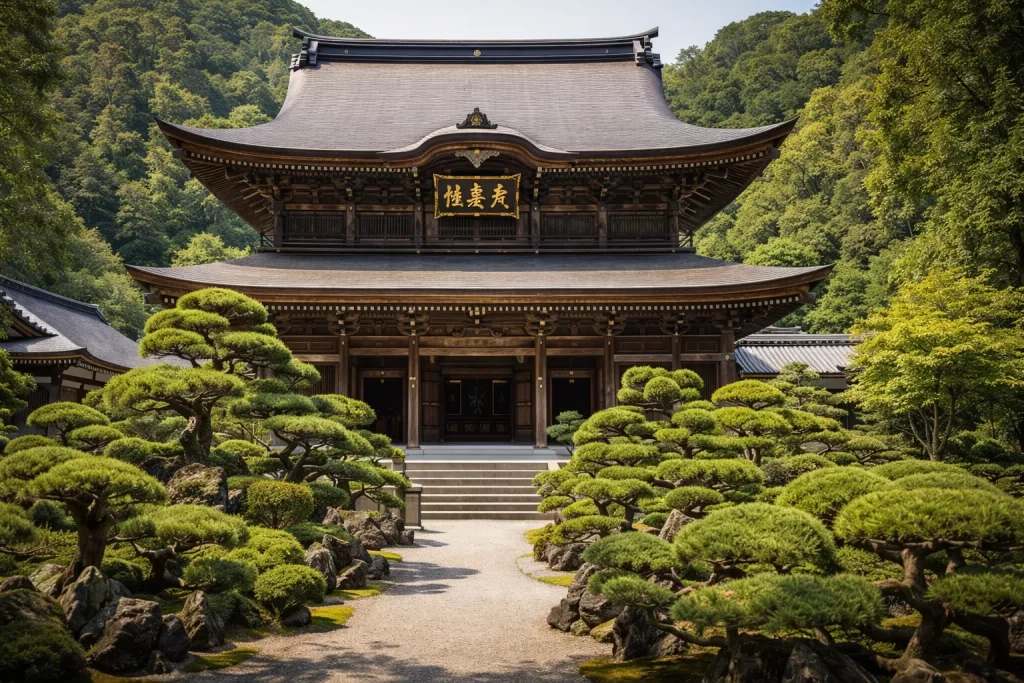
The first thing that catches your eye upon entering the Kencho-ji grounds is the massive Sanmon (Main Gate) standing beyond the Somon (Outer Gate).
The Sanmon bears a plaque inscribed with the characters “Kofukusan.” This calligraphy is traditionally attributed to Fujiwara no Yukinari, a celebrated calligrapher of the Kamakura period, though it is actually the work of a later master calligrapher.
Be sure to pause and look up before passing through the Sanmon.
Along the approach from the Sanmon to the Butsuden stand the byakushin trees mentioned earlier.
2. Butsuden and the National Treasure Temple Bell — A Grand Relocated Structure Connecting Edo and Kamakura
Passing through the Sanmon and continuing along the approach, the Hatto appears on your left and the Butsuden (Buddha Hall) straight ahead.
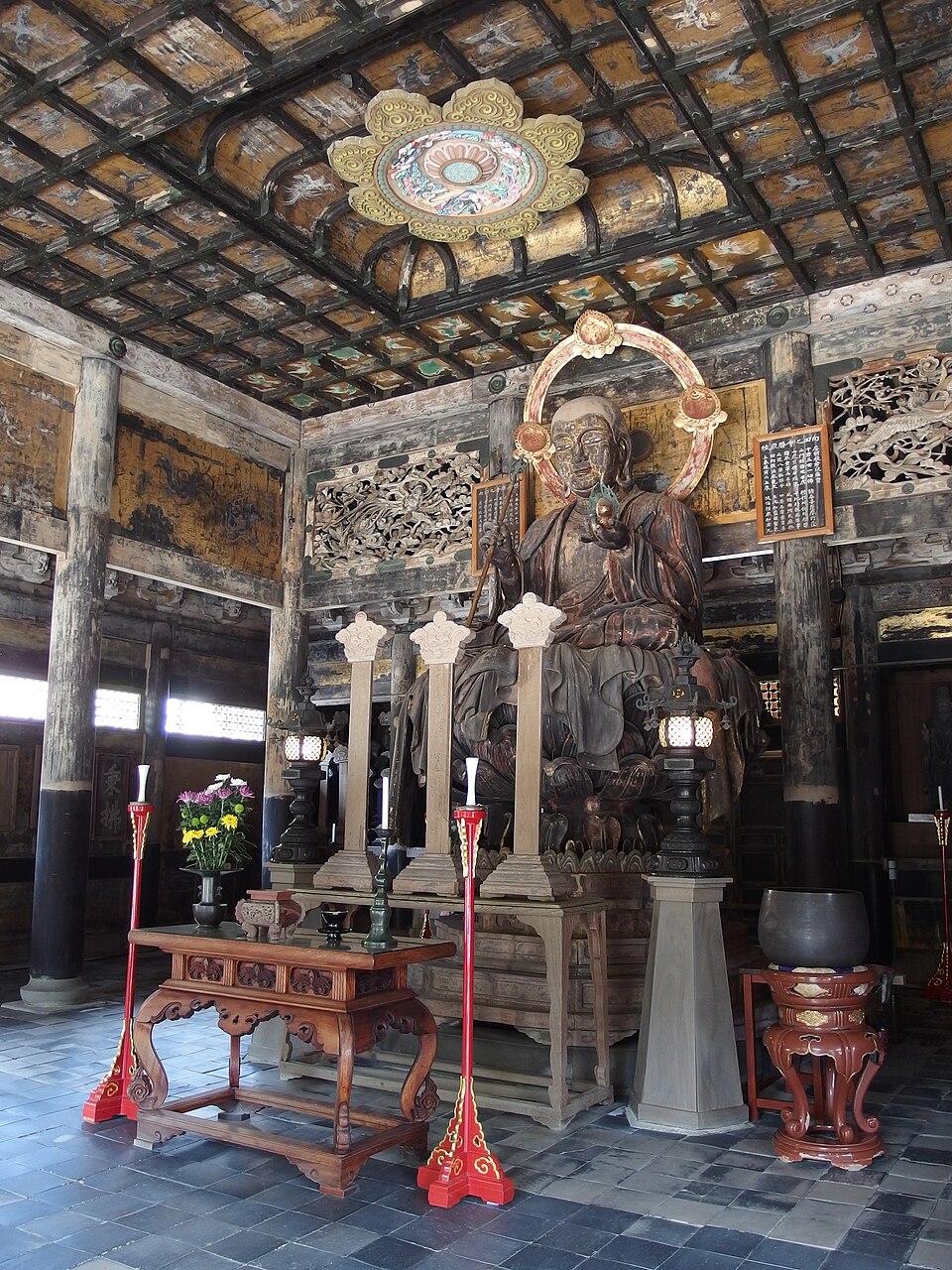
Inside the Butsuden is enshrined the principal image, a seated Jizo Bosatsu (Important Cultural Property) approximately 2.4 meters tall.
On the north side of the Butsuden is a bell tower housing the National Treasure temple bell.
Proceeding beyond the Butsuden, you reach the Hatto (Dharma Hall).
3. Hojo and Garden — A Karesansui Born from Chinese Zen Aesthetics
The Hojo (Abbot’s Quarters), located at the innermost part of Kencho-ji, has served as both the head priest’s residence and a public reception space.
The Hojo garden is attributed to Muso Soseki (1275-1351), a representative Zen monk and garden designer of the Kamakura and Muromachi periods who also designed the gardens at Saiho-ji (Moss Temple) and Tenryu-ji in Kyoto.
Sitting on the veranda of the Hojo and gazing at the garden, the noise of the city feels like a distant world.
On the east side of the Hojo is a building called the “Tokugetsuro” (Moon-Viewing Pavilion), used for Zen tea ceremonies (charei).
4. Hansobo Daigongen — Kamakura’s Best Panoramic Views and a Power Spot for Good Fortune
About 10 to 15 minutes up the mountain path from the Hojo, you will find the Hansobo.
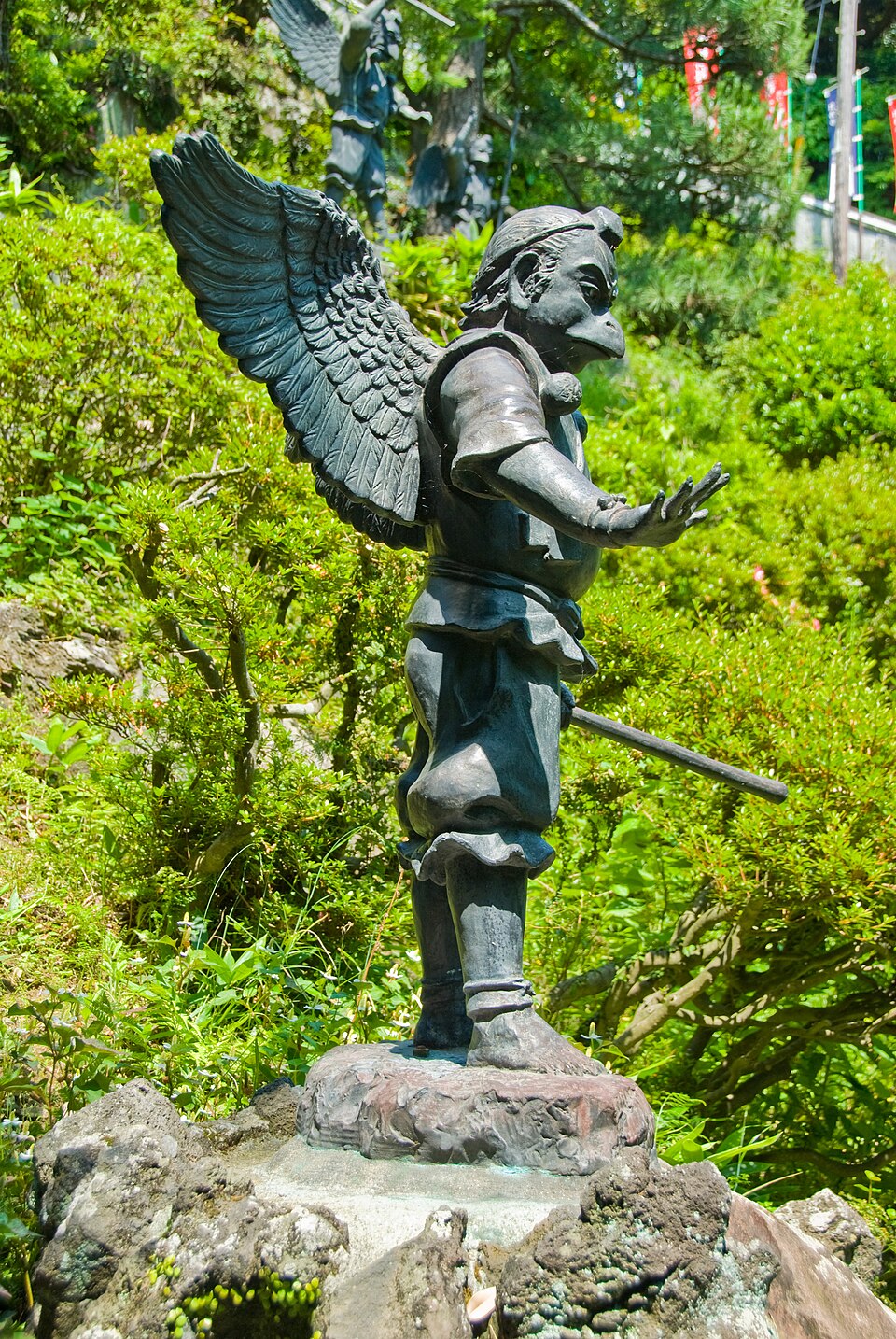
Along the approach to Hansobo stand more than a dozen tengu statues of various sizes.
The greatest appeal of Hansobo is the view.
Continuing along the mountain path from Hansobo, you can connect to the Tenen Hiking Course.
5. Sub-Temples and Zazen Experience — Encountering Living Zen Culture
Scattered throughout the Kencho-ji grounds are 10 sub-temples (tacchu).
One of Kencho-ji’s most distinctive features is its zazen experience programs open to the general public.
Kencho-ji also accepts reservations for “Zazen Experience Programs (individual and group)” on an ongoing basis.
Additionally, Kencho-ji holds an annual event in November inspired by “Kencho-jiru” (Kencho-ji soup).
Nearby Sightseeing Spots
Kencho-ji is located in the heart of Kamakura’s sightseeing area, surrounded by historically and culturally significant spots.
1. Tsurugaoka Hachimangu — The Heart of Kamakura, Guardian Deity of the Warriors
A 10-minute walk south from Kencho-ji brings you to Tsurugaoka Hachimangu, Kamakura’s largest shrine.
While Kencho-ji served as a place for Zen (spiritual discipline), Tsurugaoka Hachimangu was a place of prayer for warriors (victory and martial fortune).
2. Engaku-ji — Second of the Kamakura Gozan, a Zen Temple Founded by Hojo Tokimune
A 15-minute walk northeast from Kencho-ji brings you to Engaku-ji.
Engaku-ji is a celebrated temple that houses the National Treasure Shariden (Relic Hall in Shozoku-in), and the tranquility created by the ancient trees and moss gardens on its grounds is exceptional.
3. Hase-dera — A Paradise Garden and the Temple of the Eleven-Headed Kannon
Located about 15 minutes from Kamakura Station by bus or the Enoden train line, Hase-dera is popular as a “temple of flowers and gardens,” offering a striking contrast to Kencho-ji.
Flowers bloom throughout the seasons on the Hase-dera grounds, and during the hydrangea season in June, it ranks among Kamakura’s most popular spots.
Access Information
The most convenient way to reach Kencho-ji is by combining train and bus.
By Train
The most popular route is a 15-minute walk from JR Yokosuka Line Kita-Kamakura Station. Engaku-ji is located right next to the station, and from there you head south along the Kamakura Kaido road for about 15 minutes to reach the Somon (Outer Gate) of Kencho-ji. Along the way, you can also stop at other Zen temples such as Meigetsuin (famous for its hydrangeas), making this an ideal route for a Zen temple tour.
If walking from JR Kamakura Station (East Exit), the journey takes about 30 minutes. Head north along Wakamiya Oji, pass Tsurugaoka Hachimangu, and continue straight to reach Kencho-ji. This route is recommended if you plan to visit Tsurugaoka Hachimangu as well.
By Bus
From JR Kamakura Station East Exit, take an Enoshima Electric Railway bus bound for “Ofuna” or “Kamakura Reien Seimonmae” and get off at the “Kencho-ji” bus stop. The ride takes approximately 10 to 15 minutes and costs about 200 yen.
By Car / Parking
From the Shuto Expressway/Yokohama-Yokosuka Road, take the “Asahina IC” exit (approximately 15 minutes). Roads in Kamakura are narrow, and traffic congestion is severe on weekends and holidays, so public transportation is strongly recommended. There are paid parking lots near Kencho-ji, but spaces are limited.
Best Season to Visit
Kencho-ji can be visited year-round, but it is especially beautiful during the cherry blossom and fresh green byakushin season in spring (March-April) and the autumn foliage season in November. If you plan to join the Sunday morning zazen session (starting at 6:00 AM), you can enjoy the grounds in the refreshing early hours with few other tourists. To avoid crowds, weekday mornings around 9:00 AM are recommended.
Summary
Kencho-ji is a celebrated Kamakura temple with over 770 years of history as Japan’s first full-fledged Zen training monastery. The temple compound layout embodying the unchanging spirit of Zen since its founding, the National Treasure temple bell, the towering byakushin trees over 750 years old, and its continuing role as a living monastery where monks practice Zen — all of these elements come together to form Kencho-ji’s unparalleled appeal.
While it is a popular staple of Kamakura sightseeing, joining an early morning zazen session offers an experience of “Zen daily life” entirely different from that of an ordinary tourist. Whether you seek to immerse yourself deeply in history and culture or simply desire a quiet escape from the everyday, Kencho-ji will not disappoint. When you visit Kamakura, be sure to pass through the Sanmon gate and walk among the fragrant byakushin trees. For those who wish to deepen their understanding of Zen, we also recommend visiting Enryaku-ji on Mt. Hiei (head temple of the Tendai sect) and Kinkaku-ji (Kyoto), which has deep connections to Zen culture.