Introduction
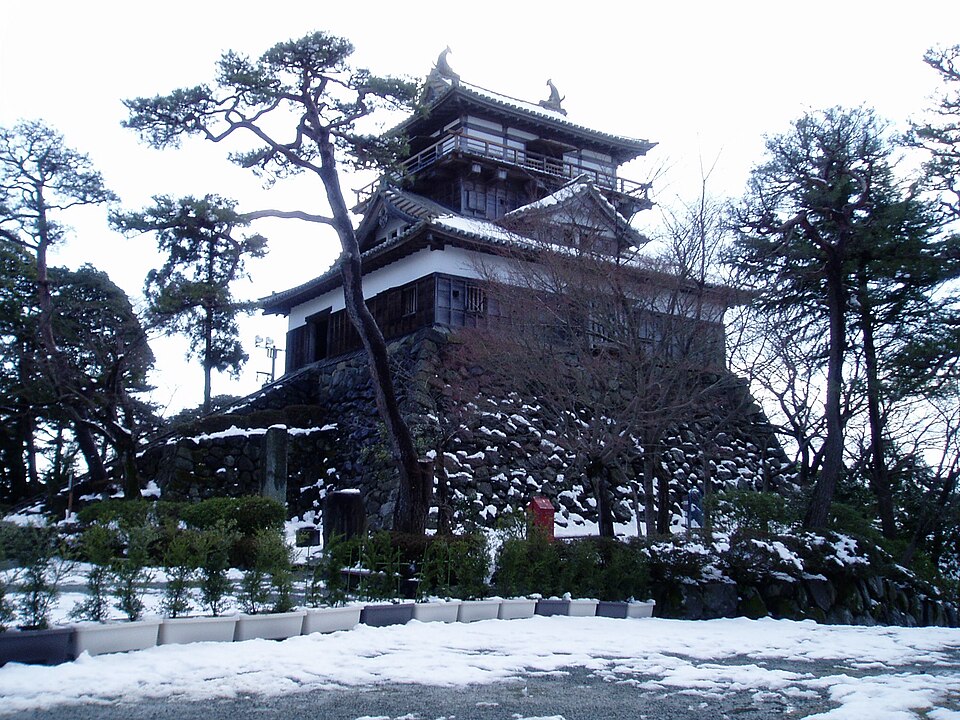
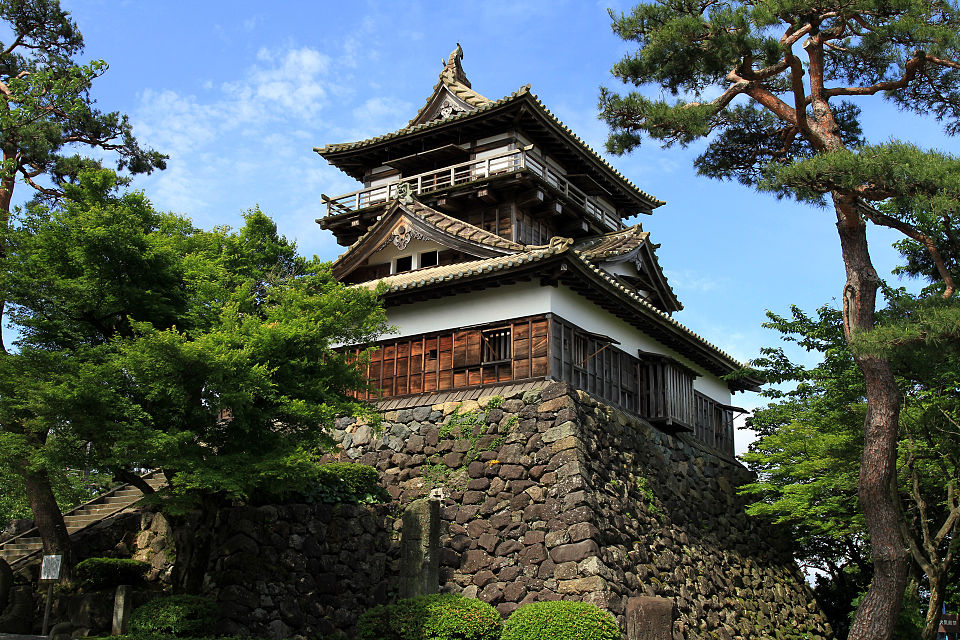
In the town of Maruoka, Sakai City, Fukui Prefecture, stands a quietly dignified ancient castle. Maruoka Castle is counted among just 12 surviving original castle towers (tenshu) in Japan, and its imposing stone-tiled tower combined with the surrounding rows of cherry blossom trees creates a landscape that deeply captivates all who visit. Its alternate name, “Kasumigajo” (Castle of Mist), derives from the dreamlike spring scene when the tower appears to float amid a veil of haze.
Maruoka Castle was built in 1576 (Tensho 4). It is said to have been constructed by the Sengoku-period warrior Shibata Katsutoyo to govern the Echizen region, and for nearly 450 years it has withstood the harsh winters of the Hokuriku region. The shakudani stone roof tiles, used to cope with Hokuriku’s heavy snowfall, are a distinctive feature found nowhere else in Japan, and when wet with rain they take on a uniquely bluish hue. When you approach the tower and look up, the orderly rows of stone tiles, layered like fish scales, will take your breath away.
This article provides everything you need to know for visiting Maruoka Castle, from its history and architectural features to highlights within the grounds, nearby tourist spots, and detailed access information. As a nationally designated Important Cultural Property and one of Japan’s 12 surviving original castle towers, we invite you to fully appreciate the charm of this remarkable castle. For those planning a tour of Japan’s surviving original towers, we also recommend reading our articles on Inuyama Castle and Bitchu Matsuyama Castle, which will help you appreciate the distinct character of each castle.
Overview of Maruoka Castle
Maruoka Castle is a hilltop castle (hirayamajiro) located at 1-59 Kasumi-cho, Maruoka-cho, Sakai City, Fukui Prefecture. The tower standing atop a small hill in Kasumigajo Park has a two-layer, three-story structure (two-tiered exterior, three interior levels). At approximately 11.7 meters tall, it is relatively compact among Japan’s surviving original towers, yet the combination of its imposing stone-tile exterior and steep stone walls gives it a distinctive and commanding presence. Designated as a national Important Cultural Property, it is highly valued as one of Hokuriku’s most significant historical structures.
| Official Name | Maruoka Castle (Maruoka-jo) |
|---|---|
| Alternate Name | Kasumigajo (Castle of Mist) |
| Location | 1-59 Kasumi-cho, Maruoka-cho, Sakai City, Fukui Prefecture |
| Castle Type | Hilltop castle (hirayamajiro) |
| Year Built | 1576 (Tensho 4) *some debate exists |
| Tower Structure | Two-tiered, three-story; independent watchtower style (dokuritsu-shiki borokei) |
| Cultural Property Designation | Nationally Designated Important Cultural Property (1934) |
| Opening Hours | 8:30 – 17:00 (last entry 16:30) |
| Admission | Adults: 450 yen, Junior high school students and younger: 150 yen |
| Closed | Open year-round |
| Phone | 0776-66-0303 |
The most distinctive feature of Maruoka Castle is the shakudani stone roof tiles covering the tower. Shakudani stone is a blue-gray tuff quarried near Mount Asuwa in Fukui City. While soft and easy to work, it takes on a bluish tint when wet. Located in Echizen, one of Japan’s heaviest snowfall regions, Maruoka Castle uses these heavy stone tiles instead of conventional clay tiles to withstand the weight of snow. This stone tile roofing is a one-of-a-kind feature found only at Maruoka Castle among all surviving original towers, and the way the tiles shimmer with a moist bluish glow after rain or snowfall is a sight you cannot see at any other castle.
The tower is classified as an independent watchtower type (dokuritsu-shiki borokei), one of the oldest architectural forms for castle towers. This ancient style features a watchtower placed atop a hip-and-gable roof on the first floor, strongly preserving the castle architecture styles from the Momoyama to early Edo periods. The extremely steep interior staircases are very narrow with a severe incline, requiring visitors to grip ropes to pull themselves up. This too is a remnant of the original rugged functional beauty that has been lost in castles renovated in later periods. The castle welcomes approximately 150,000 visitors per year, making it one of Fukui Prefecture’s premier tourist destinations.
History of Maruoka Castle
Background of Construction: Shibata Katsutoyo and the Rule of Echizen
Maruoka Castle was built in 1576 (Tensho 4). Its builder was Shibata Katsutoyo, a nephew of the Sengoku warrior Shibata Katsuie. After pacifying the Echizen Ikko Ikki uprising under orders from Oda Nobunaga, Shibata Katsuie divided Echizen into five districts and assigned family members and retainers to each in order to stabilize his control of the region. As part of this strategy, Katsutoyo, the nephew of Katsuie who was based in Kitanosho (present-day Fukui City), was given the Maruoka territory and ordered to build a castle.
At the time, Echizen had long been ravaged by the Ikko Ikki, an uprising led by followers of Jodo Shinshu (True Pure Land Buddhism). After Nobunaga thoroughly suppressed the uprising in 1574, fortifying key positions in the Hokuriku region became an urgent priority for Katsuie, who had been entrusted with governing Echizen. Maruoka was strategically important, located in northern Echizen and crucial for defending against incursions from Kaga (present-day Ishikawa Prefecture). The small hill known as Kasumigajo commanded a panoramic view of the surrounding plains, functioning as a natural observation point for early detection of enemy movements.
Shibata Katsutoyo built the castle complex including the tower here, but his tenure as lord of Maruoka Castle was brief, and he was soon transferred to Nagahama Castle (in present-day Shiga Prefecture). After him, Shibata Katsuyasu, a nephew of Katsuie, became castle lord. However, when Shibata Katsuie was defeated by Hashiba Hideyoshi (Toyotomi Hideyoshi) at the Battle of Shizugatake in 1583 and took his own life, Maruoka Castle came under Hideyoshi’s sphere of influence. Subsequently, several lords including the Aoyama and Imamura clans maintained the castle, but the tower itself is believed to have survived largely unchanged from its original construction.
Whether the current tower dates from its original 1576 construction has been the subject of ongoing debate from an architectural history perspective. Recent investigations have included dendrochronological analysis of building materials, and research continues. Regardless, many experts agree that Maruoka Castle’s tower is a valuable surviving structure preserving Japan’s oldest architectural style.
Prosperity in the Edo Period: The Honda Clan’s Rule
After the Battle of Sekigahara (1600) brought the Tokugawa family to national supremacy, new lords were appointed to Maruoka Castle. The family that governed this domain longest throughout the Edo period was the Honda clan. In 1624 (Kan’ei 1), the first lord Honda Narishige took up his post, and the Honda family continued to rule Maruoka as lords of a 50,000-koku domain. Honda Narishige was a grandson of Honda Masanobu, a close advisor to Tokugawa Ieyasu, and he stabilized domain governance through the Honda family’s strong ties with the Tokugawa shogunate.
Under Honda rule, the castle town was steadily developed. A castle town formed along the Hokurikudo highway, commerce and industry flourished, and Maruoka established itself as the political and economic center of northern Echizen. Great care was also taken to maintain and repair the castle structures, and the tower was preserved throughout the Edo period under the Honda family’s patronage. Domain records from the period contain descriptions of repeated repair works, showing that successive lords placed great importance on maintaining the castle.
The Honda family was particularly notable for stabilizing domain governance and promoting agriculture. While Echizen was known as one of the Hokuriku region’s rice-producing areas, the Maruoka domain also encouraged the development of new rice paddies, increasing agricultural productivity. The Honda family also invested in education, establishing domain schools and promoting scholarship to cultivate the learning of their samurai retainers. This foundation is said to have helped the domain adapt relatively flexibly to the social upheaval following the Meiji Restoration.
Throughout the Edo period, Maruoka Castle’s tower remained a symbol of the region as the castle with the oldest surviving architectural style among all original towers. For the samurai and townspeople of the time, the tower was both a symbol of domain prestige and a familiar presence in their daily lives. Records show that in spring, cherry blossoms bloomed profusely around the castle and people enjoyed hanami (cherry blossom viewing), indicating that Maruoka Castle was already cherished as a famous cherry blossom viewing spot during the Edo period.
The Abolition Order and the Trials of the Meiji Era
With the dawn of the Meiji era, Maruoka Castle faced severe trials. After the Meiji Restoration, the abolition of domains and establishment of prefectures (haihan chiken) was carried out in 1871 (Meiji 4), abolishing all feudal domains nationwide. The Maruoka domain was dissolved, and the castle was transferred from the former lord to government control. Then in 1873 (Meiji 6), the “Castle Abolition Order” (haijyorei) was issued, leading to the demolition or sale of many castles deemed militarily unnecessary.
While the Castle Abolition Order forced the demolition of numerous castles across the country, Maruoka Castle’s tower narrowly escaped this fate. Although it was designated for military disposal, it is said that strong local demands for preservation, combined with the building’s unsuitability for military repurposing, saved it from demolition. However, maintenance of castle sites under government control was insufficient, and many of the castle’s facilities fell into disrepair. From the Meiji through Taisho periods, while the tower itself remained standing, the surrounding grounds reportedly deteriorated to near wasteland overgrown with grass.
In 1889 (Meiji 22), the Maruoka Castle tower came under the jurisdiction of the Imperial Japanese Army. Under military management, no active preservation efforts were undertaken, and the tower’s deterioration became severe. Some stone roof tiles had shifted and fallen, rain leaked inside, and timber decay advanced. Alarmed by these conditions, local intellectuals launched preservation campaigns, and several repair attempts were made from the Taisho to early Showa periods, but none amounted to a fundamental solution.
Despite these hardships, Maruoka Castle’s tower received designation as a national Important Cultural Property in 1934 (Showa 9). This was a landmark event that officially recognized the castle’s historical and cultural value at the national level, and represented the fruit of local residents’ tireless preservation efforts. However, shortly thereafter, an unimaginable disaster was about to strike the castle.
The Fukui Earthquake: Collapse and Restoration
On June 28, 1948 (Showa 23), at 4:13 PM, an unprecedented earthquake struck Fukui Prefecture. The Fukui Earthquake (magnitude 7.1) inflicted catastrophic damage across the Fukui Plain, resulting in a total of 3,769 dead and missing (some estimates exceed 4,000), making it the worst natural disaster in Fukui Prefecture’s history. This earthquake completely toppled the Maruoka Castle tower, which had only recently been designated an Important Cultural Property.
The tower’s collapse brought a profound sense of loss to local residents. The original tower that generations of lords and townspeople had protected was reduced to a pile of rubble in mere seconds. Yet even amid this catastrophe, the local people did not give up. The collapsed tower’s building materials were carefully collected and stored, and the strong determination to rebuild was passed down through the community.
After post-earthquake reconstruction had settled in the 1950s, full-scale efforts to restore Maruoka Castle began. Under the Cultural Properties Protection Act (enacted in 1950), the restoration was carried out as a “repair” project that maximized the reuse of original materials. The tower’s restoration was completed in 1955 (Showa 30). Approximately 80% of the stone tiles and timber recovered from the collapse were reportedly reused in this restoration, which is one of the key reasons Maruoka Castle continues to be recognized as a “surviving original tower.”
The restored tower regained an appearance and structure identical to its pre-earthquake form. The steep interior staircases, the stone-tile roof, and the watchtower-style architecture were all faithfully recreated to match the pre-disaster appearance. The existence of detailed pre-earthquake survey records and photographs was a major factor in enabling this accurate restoration. When visiting the current tower, keeping in mind that it was reborn through this restoration effort deepens one’s appreciation for the almost obsessive passion the local community invested in its preservation.
Why Maruoka Castle Has Been Preserved as an Original Surviving Tower
Multiple factors have contributed to Maruoka Castle being preserved to this day as one of Japan’s “12 Surviving Original Castle Towers.” First, there were geographic and social factors that helped it survive the Castle Abolition era. Maruoka Castle was a low priority for military repurposing by the Meiji government, and local leaders launched early preservation campaigns, which are considered key reasons it escaped demolition.
Second, the thorough preservation and reuse of original materials during the post-earthquake restoration was critical. While many original towers were completely destroyed by war or fire, Maruoka Castle collapsed in an earthquake but its key materials, including stone tiles and timber, remained at the site. By storing and reusing these materials, architectural historical continuity was maintained, satisfying the conditions for classification as a “surviving original tower.”
Third, the community’s continuous preservation consciousness has been essential. The Honda family’s patronage during the Edo period, local volunteers’ preservation campaigns after the castle was abolished, restoration efforts after the earthquake, and ongoing maintenance up to the present day all represent an unbroken chain of local commitment to preserving Maruoka Castle for future generations. In 2015, improvements to Kasumigajo Park were carried out, enhancing the area as a tourism hub. Additionally, annual events such as the “National Elementary and Junior High School Haiku Contest” held each autumn demonstrate the continued connection between the castle and regional culture.
In 2015, the “Campaign to Make Surviving Towers National Treasures” intensified, with a nationwide petition campaign seeking National Treasure designation for all 12 surviving original castle towers. Maruoka Castle is considered to hold value equal to the five National Treasure castles (Matsumoto, Hikone, Inuyama, Himeji), and petitions for its National Treasure designation continue. This campaign has served as an opportunity to raise public awareness of the value of surviving original towers, further increasing attention on Maruoka Castle.
Highlights & Recommended Spots
Here is a curated selection of must-see spots when visiting Maruoka Castle. From the interior of the tower to the park’s seasonal scenery and unique cultural facilities, the Maruoka Castle area is filled with diverse attractions.
The Surviving Original Tower
The heart of Maruoka Castle is, without question, the surviving original tower itself. While the exterior appears as two tiers, the interior is divided into three levels, and the staircases connecting each floor rank among the steepest of any surviving original tower in Japan. The incline reaches approximately 65 degrees, requiring visitors to grip ropes and pull themselves up. This steepness is not a theatrical tourist feature but rather a practical military design intended to slow enemy advance in case of attack. While it does place strain on your legs, the sense of achievement upon reaching the top is exceptional, as reaching the uppermost floor reveals a suddenly expansive panoramic view across the Sakai Plain.
The interior is minimally lit, and the thick beams, pillars, and board walls retaining their original scars and knots convey the spirit of the Sengoku era. The dry scent of aged wood and the creaking of ancient floorboards beneath each step allow you to experience history not just visually but through smell and sound as well. Exhibition panels about the castle’s structural features are installed on the walls, enabling even first-time visitors to understand the architectural characteristics as they tour the tower.
On the exterior, take time to appreciate the stone tiles from various angles. On clear days, the blue-gray shakudani stone stands out beautifully against the blue sky, while on rainy days the wet tiles transform into deep, rich tones. The nozurazumi (rough-stacked) stone walls surrounding the tower are also not to be missed. These walls, built by stacking uncut natural stones, preserve the original construction techniques from Maruoka Castle’s founding era, with grass growing from between the stones evoking the long passage of time.
- Extremely steep interior staircases (approx. 65-degree incline): Climb using ropes
- Shakudani stone roof tiles: Uniquely beautiful blue tint on rainy days
- Nozurazumi stone walls: Precious surviving structures preserving original construction techniques
- Panoramic view from the top floor: Overlooks the Sakai Plain and Takeda River basin
Kasumigajo Park
Kasumigajo Park, surrounding Maruoka Castle, covers approximately 60,000 square meters and is designed as a strolling-style park centered on the castle. The park retains stone wall and inner moat remnants around the tower, along with maintained lawns, walking paths, and observation decks, allowing visitors to enjoy both historical exploration and nature walks simultaneously. Popular photo spots for Instagram and social media are scattered throughout the park, and you will see many tourists enjoying photography combining the tower with seasonal flowers.
One of the park’s signature features is its nationally renowned avenue of Yoshino cherry trees. Approximately 400 cherry trees are planted throughout the park, and their simultaneous bloom in early April each year has earned the park a place on “Japan’s Top 100 Cherry Blossom Viewing Spots.” During the blooming season, the “Maruoka Castle Cherry Blossom Festival” is held, complete with evening illuminations. The sight of the tower silhouetted against the night sky under warm light, accompanied by cherry blossoms in full bloom, is nothing short of magical.
Walking paths throughout the park allow visitors to make a complete circuit of the castle hill, taking about 30 to 40 minutes at a leisurely pace. From the east, you can see the full frontal view of the tower; from the north, the combination of stone walls and tower; and from the west, the reflection of the tower in Kasumigaike Pond. Each angle reveals an entirely different expression. Benches are placed throughout the park, providing comfortable spots to relax while gazing at the tower.
The park also features a “Fukui Earthquake Memorial Monument.” An inscription records the memory of Maruoka Castle’s collapse in the 1948 Fukui Earthquake and the subsequent journey toward restoration. You may see visitors quietly paying their respects. More than just a place for learning history, Kasumigajo Park is beloved by local residents as a healing space where nature and history harmonize.
The “Ippitsu Keijo” Stone Monument
In one corner of Kasumigajo Park stands a stone monument that is modest in size but carries undeniable presence. “Ippitsu keijo, hi no yojin, Osen nakasu na, uma koyase” (A brief note: beware of fire, don’t make Osen cry, keep the horse well-fed) — this is the text of what is known throughout Japan as “the shortest letter in Japan.” This letter is said to have been written by Honda Shigetsugi, the first lord of Maruoka Castle, to his wife from the battlefield, and its concise yet affectionate message has been passed down through the generations.
Honda Shigetsugi was a warrior who participated in numerous battles as a key retainer of Tokugawa Ieyasu, becoming lord of Maruoka Castle in 1590 (Tensho 18). Known by the fearsome nickname “Oni Sakuza” (Demon Sakuza) for his stern demeanor, he also possessed a human warmth that led him to worry about his family even from the battlefield. The “Ippitsu Keijo” letter is frequently cited in Japanese language textbooks and introductions to Japanese culture as a famous historical composition that encapsulates this more personal side of the formidable warrior.
“Osen” refers to Senchiyo, the childhood name of Shigetsugi’s son (later Honda Narishige). Thus the letter reads: “(Dear wife, I am writing you a letter.) Be careful of fire. Don’t make Senchiyo cry. Keep the horse well-fed.” — conveying three essential matters of household safety, childcare, and war preparation with ultimate simplicity. Even today, it is cited as a model of “brief and precise” communication, and is sometimes discussed in the context of business communication.
Tourists constantly line up to photograph the monument, making it one of the classic photo spots when visiting Maruoka Castle. The full text of the letter is carved on the stone, and knowing the historical episode behind it makes the words, written over 400 years ago, feel all the more vivid. Visiting the adjacent “Museum of Japan’s Shortest Letters” (described below) will help you discover the deeper appeal of this cultural heritage.
Museum of Japan’s Shortest Letters
Near Kasumigajo Park stands the “Museum of Japan’s Shortest Letters” (Ippitsu Keijo Chaya). Here, visitors can view the winning entries from the “Japan’s Shortest Letter Contest,” which was inspired by Honda Shigetsugi’s “Ippitsu Keijo” and has been held since 1993. The contest receives tens of thousands of entries each year from across the country, with participants ranging from children to senior citizens, making it a beloved cultural event with broad appeal.
Inside the museum, past contest winners are displayed on the walls. From humorous entries to deeply moving ones, the diverse collection of “short letter” masterpieces is so captivating that you may lose track of time. Themes vary each year, with universal topics like “Father,” “Mother,” “Friend,” “Love,” and “Dreams” drawing short compositions from across Japan. Some winning letters have gained even wider recognition after being featured in television commercials or published in books.
The facility includes a rest area where visitors can leisurely enjoy the exhibits during breaks from sightseeing. The gift shop sells original goods themed around “Ippitsu Keijo,” famous Echizen confections, and Maruoka Castle souvenirs, adding the pleasure of choosing visit mementos. The building’s exterior is designed in a Japanese architectural style that harmonizes with Maruoka Castle and the overall park landscape. Opening hours vary by season, so we recommend checking the official Sakai City website before your visit.
As this facility demonstrates, Maruoka Castle is more than just a historical building tourist site. It is a place that has generated a unique cultural content centered on “short letters.” Through activities promoting letter-writing culture, Maruoka Castle’s name has reached not only castle enthusiasts but a broad audience interested in language and expression. We invite you to experience one facet of Maruoka Castle’s multifaceted charm, where history and culture converge, right here at this museum.
Spring Cherry Blossoms and Maruoka Castle
No discussion of Maruoka Castle’s highlights is complete without mentioning the spectacular combination of spring cherry blossoms and the castle. Every year from early to mid-April, approximately 400 Yoshino cherry trees surrounding Kasumigajo Park burst into bloom simultaneously. The sight of pale pink petals enveloping the entire castle is the quintessential Japanese spring landscape, producing stunning photographs regardless of the photographer’s skill level. The cherry blossoms of Maruoka Castle, selected as one of “Japan’s Top 100 Cherry Blossom Viewing Spots,” are particularly renowned for being photogenic even among Japan’s many famous cherry blossom destinations, drawing visitors from afar during the blooming season.
During the blooming period, the “Maruoka Castle Cherry Blossom Festival” is held, featuring special evening illumination of the tower. At night, the tower emerges against the night sky bathed in warm light, creating a magical atmosphere entirely different from daytime when paired with cherry blossoms in full bloom. The cheers of visitors enjoying the evening cherry blossoms, the sound of petals dancing in the wind, and the aromas from food stalls enveloping the entire park make this festival one of Maruoka Castle’s signature spring traditions.
The peak blooming period varies by year but generally falls around April 5-15. Blooming updates are regularly posted on the Sakai City Tourism Association’s official website and social media accounts, so we recommend checking the latest information when planning your visit. Since the cherry blossom season draws concentrated crowds, we recommend visiting early in the morning (around 8:00 AM). The tower and cherry blossoms bathed in quiet morning light possess a serene beauty quite different from the daytime scene, making early visits especially popular among photography enthusiasts.
Kasumigajo Park is beautiful in seasons beyond cherry blossom time as well. From late spring through summer, refreshing landscapes of lush green trees abound; in autumn, ginkgo and colorful foliage paint the park in vibrant hues. In winter, a snow-covered tower can be seen when snowfall occurs, and each season at Maruoka Castle brings new discoveries with every visit. While Hokuriku winters are harsh, the tower standing resolutely amid snow possesses its own exceptional beauty.
Nearby Tourist Spots
The area around Maruoka Castle is dotted with some of Hokuriku’s most prominent tourist destinations. Here are spots well worth combining with your Maruoka Castle visit. All are located within an hour’s drive of the castle, making them easily accessible even on a day trip.
Eiheiji Temple
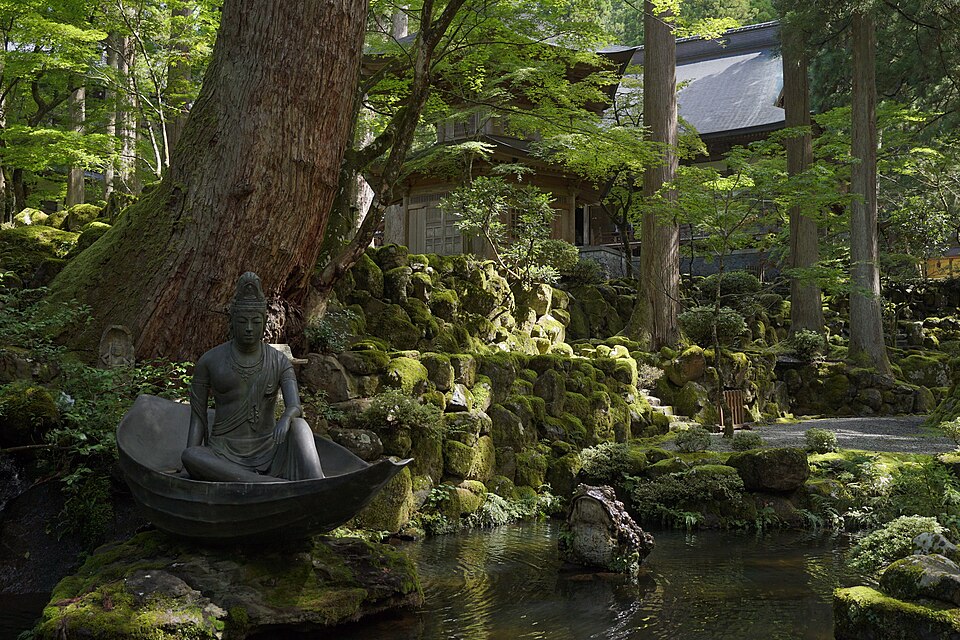
Located approximately 30 minutes by car (about 20 kilometers) southeast of Maruoka Castle, Eiheiji Temple is the head temple of Soto Zen Buddhism, founded in 1244 (Kangen 2) by Zen Master Dogen. Nestled quietly amid deep cedar groves in Eiheiji-cho, Yoshida District, Fukui Prefecture, this temple is an active training monastery where over 200 monks continue rigorous practice to this day, creating a special space where historic buildings and living religious culture coexist.
The temple grounds contain over 70 buildings including the Seven Main Halls (Hatto, Butsuden, Sodo, Kuin, Sanmon, Tosu, and Yokushitsu), connected by corridors across a vast precinct that cleverly utilizes the mountain slope in a three-dimensional layout. Walking along the moss-covered stone paths, overwhelmed by towering cedar trees reaching toward the sky, Eiheiji’s approach road transports visitors to another world far from everyday bustle. Reading our shrine visit guide alongside your visit will deepen your understanding of the diversity of Japanese religious culture. With approximately 900,000 annual visitors, it is the most celebrated temple in the Hokuriku region, drawing visitors from Japan and abroad. Combining Maruoka Castle and Eiheiji Temple for a “history and Zen journey” is a classic Fukui sightseeing course.
Tojinbo Cliffs
Located approximately 25 minutes by car (about 18 kilometers) northwest of Maruoka Castle, Tojinbo is a spectacular scenic spot known for its sheer cliffs facing the Sea of Japan. The columnar jointed rock walls stretching approximately one kilometer possess a geological structure so remarkable that they are designated as a national Natural Monument and Special Natural Monument. Called one of the world’s three great cliff formations, these precipices exceed 25 meters at their highest point, and the sight of rough waves crashing against them is absolutely thrilling.
The name Tojinbo derives from a legend in which a monk named Tojinbo from Heisenji Temple (in present-day Katsuyama City), who was notorious for his misconduct during the Heian period, was pushed off the cliff. The grand panorama of the Sea of Japan viewed while walking along the rocks expands on clear days, sometimes offering views of Oshima Island offshore and even the distant Noto Peninsula. Sightseeing boat tours viewing the cliffs from the sea are also popular, revealing caves and rock formations invisible from land. The Tojinbo shopping street also offers the area’s famous crab and seafood dishes, making it a popular driving route combined with Maruoka Castle sightseeing for a meal-inclusive excursion.
Fukui City & the Dinosaur Museum Area
Located approximately 30 minutes by car (about 25 kilometers) south of Maruoka Castle, Fukui City and the Fukui Prefectural Dinosaur Museum further south in Katsuyama City are especially popular spots for families. Known as “Japan’s Dinosaur Kingdom,” Fukui Prefecture boasts the country’s largest number of dinosaur fossil discoveries, and the museum presents these research findings through world-class exhibits. Inside the dome-shaped building, the world of dinosaurs captivates visitors of all ages with its impressive scale and comprehensive displays.
In Fukui City, the Fukui Castle Ruins (where the Fukui Prefectural Government office is located) in the castle park, and the Ichijodani Asakura Clan Ruins built during the Tensho era are must-see spots for history enthusiasts. Ichijodani is the excavated and partially restored castle town site of the Asakura clan, who ruled Echizen during the Sengoku period, allowing visitors to vividly experience what a castle town looked like in those times. Combining Maruoka Castle (surviving original tower) with the Asakura clan ruins (castle town archaeological site) provides a more three-dimensional understanding of Echizen’s history. Reading about the history of Osaka Castle will further deepen your knowledge of the development of early modern Japanese castles.
Access Information
Maruoka Castle is located in Sakai City, Fukui Prefecture, approximately 18 kilometers north of Fukui City. With the opening of the Hokuriku Shinkansen (March 2024), access from the Tokyo and Nagoya areas has significantly improved. Below is a summary of access methods by various transportation options.
By Train & Bus
When using the Hokuriku Shinkansen, the journey from Tokyo Station to Fukui Station takes approximately 2 hours 30 minutes to 3 hours via the “Kagayaki” or “Hakutaka” services. From the Nagoya area, the Limited Express “Shirasagi” reaches Fukui Station in approximately 1 hour 30 minutes. From Fukui Station, transfer to the JR Hokuriku Main Line to Maruoka Station (or Awara Onsen Station), which takes approximately 15-20 minutes. From Maruoka Station, take the Keifuku Bus “Maruoka Castle Line” and get off at the “Maruoka Castle” bus stop, then walk approximately 5 minutes. Note that bus frequency is limited to about 1-2 buses per hour, so we recommend checking the timetable in advance.
By Car & Parking
The castle is conveniently located just about 5 minutes from the “Maruoka IC” exit on the Hokuriku Expressway, making car travel the most convenient option. From the Osaka/Nagoya area, take the Meishin Expressway and Hokuriku Expressway. From the Tokyo/Kanto area, use the Kanetsu and Hokuriku Expressways. The “Kasumigajo Park Parking Lot” (free, approximately 150 car spaces) is available near the castle, and outside of peak tourist seasons, finding parking is not a problem. Temporary parking lots are set up during the Cherry Blossom Festival, but they can get crowded, so arriving early is recommended.
- Hokuriku Shinkansen: Tokyo Station to Fukui Station, approx. 2.5-3 hours
- Limited Express Shirasagi: Nagoya Station to Fukui Station, approx. 1.5 hours
- JR Hokuriku Main Line: Fukui Station to Maruoka Station, approx. 15-20 minutes
- Keifuku Bus: Maruoka Station to Maruoka Castle, approx. 10 minutes (ride time)
- By car: Approx. 5 minutes from Maruoka IC on the Hokuriku Expressway
Nearby Accommodation
In addition to business hotels in the Maruoka town area near the castle, numerous ryokan (traditional inns) and hotels are located in nearby Awara Onsen (Awara Hot Springs). Awara Onsen is a renowned hot spring known as “Hokuriku’s Inner Parlor,” located about 20 minutes by car from Maruoka Castle. An itinerary combining Maruoka Castle sightseeing with a stay at an onsen ryokan is an ideal plan for an Echizen getaway. For those interested in Japan’s ryokan culture, please also refer to our ryokan guide.
Conclusion
Maruoka Castle is a premier castle of the Hokuriku region, with nearly 450 years of history as one of Japan’s 12 surviving original castle towers. The distinctive tower with its beautiful shakudani stone tiles, the visceral sense of history evoked by its steep interior staircases, Kasumigajo Park adorned by 400 cherry trees in spring, and the cultural heritage of “Ippitsu Keijo,” Japan’s shortest letter — these many charms layer upon one another, offering new discoveries with every visit.
Though toppled by the Fukui Earthquake, this tower was restored through the passion of the local community. Though it speaks no words, it teaches us about the sincere way the Japanese engage with their history. For those planning a tour of Japan’s 12 surviving original castle towers, Maruoka Castle absolutely deserves a place on your itinerary. Comparative visits with other surviving original towers such as Inuyama Castle and Bitchu Matsuyama Castle are also highly rewarding for understanding the diversity of Japanese castle architecture. Additionally, for a journey steeped in historical gravitas, we recommend visiting historical castles across the country such as Shuri Castle.