- Introduction
- Overview of Ujigami Shrine
- History of Ujigami Shrine
- 1. Ancient Period (4th-5th Century): Prince Uji no Wakiiratsuko and the Divine Presence in Uji
- 2. Heian Period (10th-12th Century): Patronage of the Fujiwara Regents and Construction of the Oldest Surviving Shrine Buildings
- 3. Kamakura to Muromachi Period: The Shrine’s Survival Under Warrior Rule and Construction of the Worship Hall
- 4. Edo to Meiji Period: Separation from Uji Shrine and the Wave of Shrine Reform
- 5. Modern Era: World Heritage Registration and Reappraisal as Japan’s Oldest Architecture
- Highlights & Recommended Spots
- Main Hall (National Treasure): Secrets of Japan’s Oldest Shrine Building
- Worship Hall (National Treasure): A Masterpiece of Shrine Architecture with Shinden-zukuri Design
- Kirihara Spring Water and the Sacred Garden
- Uji Shrine and Uji Bridge: Access from the Opposite Bank and Uji’s Historic Landscape
- The Four Seasons at Ujigami Shrine
- Nearby Tourist Attractions
- Access
Introduction
Nestled quietly among deep groves of trees along the Uji River in Uji City, Kyoto Prefecture, Ujigami Shrine is a mysterious small shrine known worldwide as the oldest surviving shrine building in Japan. Cross the Uji River from the bustling Byodoin Phoenix Hall, walk along the tranquil approach path, and through a dense forest of evergreen trees, the main hall emerges — a structure that has borne witness to over a thousand years of history. In that moment, a stillness descends as if time itself has stopped. This is the first impression of Ujigami Shrine.
The main hall (honden) of Ujigami Shrine is believed to have been constructed in the late Heian period (late 11th century) and is designated as a National Treasure as the oldest surviving shrine building in Japan. This wooden structure, having endured nearly 1,000 years while retaining its form, holds a special place in the history of Japanese architecture. The worship hall (haiden) also dates from the late Heian to early Kamakura period (late 12th to early 13th century) and is likewise designated as a National Treasure. This small shrine, housing two National Treasure buildings, is registered in its entirety as part of the UNESCO World Heritage Site “Historic Monuments of Ancient Kyoto,” making it unparalleled in Japan in terms of its density of cultural properties.
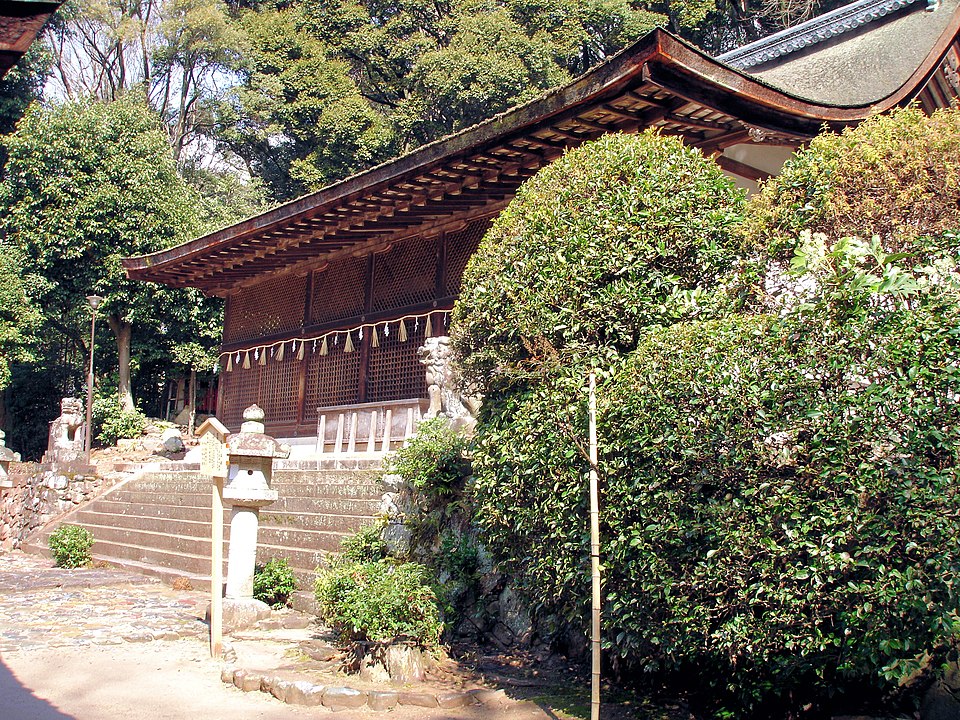
Ujigami Shrine enshrines the deities who protect the land of Uji. The three inner sanctuaries of the main hall respectively enshrine Emperor Ojin (the 15th emperor), his son Emperor Nintoku (the 16th emperor), and Prince Uji no Wakiiratsuko. Prince Uji no Wakiiratsuko is a tragic prince who, despite being designated by his father Emperor Ojin as heir to the throne, is said to have taken his own life so that his elder brother Emperor Nintoku could ascend instead. He is also traditionally credited as the origin of the place name “Uji.”
This article provides a detailed guide covering Ujigami Shrine’s history from its founding to the present day, must-see highlights, nearby tourist attractions, and how to explore the town of Uji. Please read on to discover the allure of this small sanctuary where a millennium of history is concentrated.

Overview of Ujigami Shrine
Ujigami Shrine is located at 59 Ujiyamada, Uji City, Kyoto Prefecture. It is a Shikinaisha (a prestigious shrine listed in the Engishiki Jimmyocho). Its official name is simply “Ujigami Jinja.” Across the Uji River on the opposite bank stands Uji Shrine, and the two shrines are believed to have originally formed a single shrine known as “Uji Rikyu Myojin.”
| Official Name | Ujigami Shrine |
|---|---|
| Address | 59 Ujiyamada, Uji City, Kyoto Prefecture |
| Principal Deities | Prince Uji no Wakiiratsuko, Emperor Ojin, Emperor Nintoku |
| Shrine Rank | Shikinaisha / Former Prefectural Shrine |
| Founded | Unknown (traditionally: Emperor Ojin era to Heian period) |
| Main Hall Built | Late Heian period (late 11th century) |
| Worship Hall Built | Late Heian to early Kamakura period (12th-13th century) |
| Visiting Hours | 9:00 – 16:30 |
| Admission | Free |
| Closed | Open year-round |
| Phone | 0774-21-4634 |
*Please check the official Ujigami Shrine website for the latest visiting hours.
The most distinctive feature of Ujigami Shrine is its exceptional value as a cultural property. The main hall (National Treasure) was built in the late Heian period and is considered the oldest surviving shrine building in Japan. The worship hall (National Treasure) dates from the late Heian to early Kamakura period and is likewise an extremely precious historic structure. Although the shrine grounds cover only about 1,800 square meters, the cultural density of containing two National Treasure buildings is unmatched among Japanese shrines.
In 1994, Ujigami Shrine was registered as a UNESCO World Cultural Heritage Site as one of the 17 properties constituting the “Historic Monuments of Ancient Kyoto.” Byodoin Temple, also registered as a World Heritage Site, is located on the opposite bank of the Uji River, making Uji a notable “cluster of World Heritage Sites.” Within the shrine grounds, there is a natural spring called “Kirihara no Mizu,” one of the Seven Famous Waters of Uji, which still flows with crystal-clear water to this day.
History of Ujigami Shrine
1. Ancient Period (4th-5th Century): Prince Uji no Wakiiratsuko and the Divine Presence in Uji
To tell the history of Ujigami Shrine, one must first understand the origin of the place name “Uji” and the tragic prince deeply connected to this land — Prince Uji no Wakiiratsuko. The prince was born as a son of Emperor Ojin (the 15th emperor) and was personally designated by his father as heir to the throne. After Emperor Ojin’s death (traditionally dated to the late 4th to early 5th century), a curious exchange of deference over the imperial succession unfolded between the prince and his elder brother, Prince Osazaki (later Emperor Nintoku).
The two brothers each insisted that the other should take the throne, and according to the Nihon Shoki (Chronicles of Japan), this mutual refusal continued for three years. Ultimately, to ensure his elder brother’s ascension to the throne, Prince Uji no Wakiiratsuko took his own life in the land of Uji. The place where the prince established his palace is traditionally said to be the origin of the name “Uji” (anciently written with characters meaning “rabbit path”), and Uji has been a sacred land deeply connected to the imperial lineage since antiquity.
The worship that preceded Ujigami Shrine is said to have begun after the prince’s death, as a means of consoling his spirit. Prince Uji no Wakiiratsuko came to be revered as the “guardian deity of Uji,” and his father Emperor Ojin and elder brother Emperor Nintoku were also enshrined alongside him. Emperor Ojin is widely worshipped throughout Japan as the deity Hachiman, and through this connection, Ujigami Shrine also came to be known as “Rikyu Hachiman” and “Uji Rikyu Myojin.”
The oldest surviving written record of Ujigami Shrine appears in the Jimmyocho (Register of Deities) of the Engishiki, compiled in 927 CE. It is recorded there as “Uji Shrine, two seats, Uji District, Yamashiro Province,” indicating that the present-day Ujigami Shrine and Uji Shrine functioned as a single shrine at that time. Being listed in the Engishiki is evidence of a shrine’s high prestige, confirming that Ujigami Shrine was an important shrine during the Heian period.
2. Heian Period (10th-12th Century): Patronage of the Fujiwara Regents and Construction of the Oldest Surviving Shrine Buildings
The most important period in Ujigami Shrine’s history was the era of patronage by the Fujiwara regent clan from the mid to late Heian period. Uji was a strategic transportation hub where the Nara Highway and the Uji River waterway intersected, south of Kyoto, and many Fujiwara clan villas (betsugyo) were established in the area. In particular, Byodoin Temple, which Fujiwara no Yorimichi (992-1074) converted from his father Michinaga’s villa, was completed in 1052 and cemented Uji’s position as the center of Heian aristocratic worship.
The surviving main hall of Ujigami Shrine is estimated to have been built in the late 11th century, close to the time of Byodoin’s construction. Dendrochronological analysis has revealed that the timber used in the main hall was felled around 1060, placing it in nearly the same era as Byodoin’s founding (1052). This strongly suggests that Ujigami Shrine’s main hall was constructed by Fujiwara no Yorimichi or his successors.
The surviving main hall is built in the “sangensha nagare-zukuri” (three-bay flowing style), featuring a rare structure in which three inner sanctuaries are housed side by side within a single protective enclosure (oiya). The central sanctuary enshrines Prince Uji no Wakiiratsuko, the left sanctuary (to the viewer’s right) enshrines Emperor Ojin, and the right sanctuary (to the viewer’s left) enshrines Emperor Nintoku. Each inner sanctuary was built at slightly different times, with the oldest left sanctuary dating to the late Heian period (1070s-1080s), while the central and right sanctuaries were constructed somewhat later.
During this era, Uji also played an important role as the setting for The Tale of Genji. The final chapters known as the “Uji Chapters” (Uji Jujo) of this great novel, written by Murasaki Shikibu in the early 11th century, unfold precisely in Uji. The area around Ujigami Shrine served as the backdrop for key scenes in the “Uji Chapters,” and a memorial stone marker still stands at the western end of Uji Bridge today. A visit to Ujigami Shrine can be seen as an immersive experience in the world of Heian literature from a thousand years ago.
3. Kamakura to Muromachi Period: The Shrine’s Survival Under Warrior Rule and Construction of the Worship Hall
From the late Heian period into the Kamakura period, the worship hall that survives at Ujigami Shrine today was constructed. Its construction date is estimated to be from the late Heian to early Kamakura period (late 12th to early 13th century), and like the main hall, it is designated as a National Treasure. The worship hall is built in the “wari-haiden” (split worship hall) style, characterized by an open passageway running through the center of the building. It incorporates design elements from “shinden-zukuri,” the architectural style of Heian aristocratic residences, making it a uniquely precious example in the history of shrine architecture.
After the Kamakura period, as the political center shifted from Kyoto to Kamakura, Uji gradually lost its former prosperity. However, Ujigami Shrine continued to attract worshippers as the “guardian deity of Uji” and was carefully maintained by the local community. Even after losing the patronage of the Fujiwara clan, the faith of Uji’s residents sustained the shrine’s existence. During the Muromachi period, Uji regained attention as a tea-producing region, but records of Ujigami Shrine itself from this period are relatively scarce, suggesting it quietly endured as a local guardian shrine.
The Onin War (1467-1477) brought the flames of conflict to Uji as well, but Ujigami Shrine, situated on the far side of the Uji River, suffered relatively minor damage compared to temples and shrines in Shimadaigo or central Kyoto. Both the main hall and worship hall escaped fire, which is why they have preserved their original appearance to this day. This “fortunate survival from war” is one of the primary reasons why Ujigami Shrine’s buildings have endured for nearly 1,000 years.
In the late Sengoku period, Toyotomi Hideyoshi took a deep interest in Uji and promoted Uji tea production. While Hideyoshi also worked on maintaining Uji Bridge and developing the town of Uji, there are few records of his direct involvement with Ujigami Shrine, and the shrine is believed to have continued quietly serving as a place of local worship during this era.
4. Edo to Meiji Period: Separation from Uji Shrine and the Wave of Shrine Reform
During the Edo period, Uji was administered as a direct domain (tenryo) of the Tokugawa shogunate and was particularly valued as a tea-producing region. Ujigami Shrine, together with Uji Shrine, continued to function as the collective guardian shrine of Uji under the name “Uji Rikyu Myojin.” Although detailed records of Ujigami Shrine from this period are scarce, gazetteers and shrine precinct maps produced from the mid-Edo period onward depict the shrine grounds in a configuration largely unchanged from today.
A pivotal turning point in the modern history of Ujigami Shrine came with the Shinbutsu Bunri decree (separation of Shinto and Buddhism) issued in 1868. During the era of syncretic Shinto-Buddhist worship, the shrine had been maintained as “Uji Rikyu Myojin” with intermingled religious elements, but the decree led to the removal of Buddhist elements and the shrine’s reorganization as a purely Shinto institution. The relationship with Uji Shrine was also formalized, and the two shrines, previously managed as a single entity, were officially separated into independent shrines.
During the Meiji period, a modern shrine ranking system was established, and Ujigami Shrine was classified as a “Fusha” (Prefectural Shrine). While its rank within the state-managed shrine hierarchy was defined, the Meiji government prioritized large shrines that enjoyed the patronage of imperial and warrior families, so the small-scale Ujigami Shrine did not necessarily attract major attention. However, from the Taisho through the Showa era, architectural historians began to recognize the antiquity and rarity of its buildings, and through ongoing research, its value as “the oldest surviving shrine architecture” gradually came to light.
5. Modern Era: World Heritage Registration and Reappraisal as Japan’s Oldest Architecture
Following cultural property protection legislation enacted in 1945, the main hall and worship hall of Ujigami Shrine were designated as National Treasures in 1952. This was the moment when Ujigami Shrine, long revered by local people simply as “an old shrine,” was officially recognized as one of the nation’s highest-ranking cultural properties. After the National Treasure designation, many architectural historians and cultural property specialists visited the shrine and marveled at the excellent state of preservation of this wooden structure with nearly 1,000 years of history.
From the Showa through Heisei eras, academic research on Ujigami Shrine’s main hall advanced significantly. Dendrochronological analysis scientifically confirmed that the timber used in the main hall was felled in the 1060s, establishing its status as “the oldest surviving shrine building” on an academic basis. Further investigation revealed that the three inner sanctuaries housed within the protective enclosure were each constructed at slightly different dates, yielding important findings for architectural history research.
In 1994, Ujigami Shrine was registered as a UNESCO World Cultural Heritage Site as one of the 17 properties constituting the “Historic Monuments of Ancient Kyoto.” With Byodoin Temple, also a World Heritage Site, located just across the Uji River, Uji gained international attention as a rare place where “one small town contains two World Heritage Sites.” Today, numerous domestic and international visitors come to Ujigami Shrine throughout the year, and this ancient shrine continues to quietly fulfill its role as a precious witness to the history of Japanese architecture and as the guardian deity of Uji.
Highlights & Recommended Spots
Although the shrine grounds are small, the highlights are concentrated. The key to fully enjoying Ujigami Shrine is to carefully appreciate the architectural details where the phrase “Japan’s oldest” becomes tangible reality.
Main Hall (National Treasure): Secrets of Japan’s Oldest Shrine Building
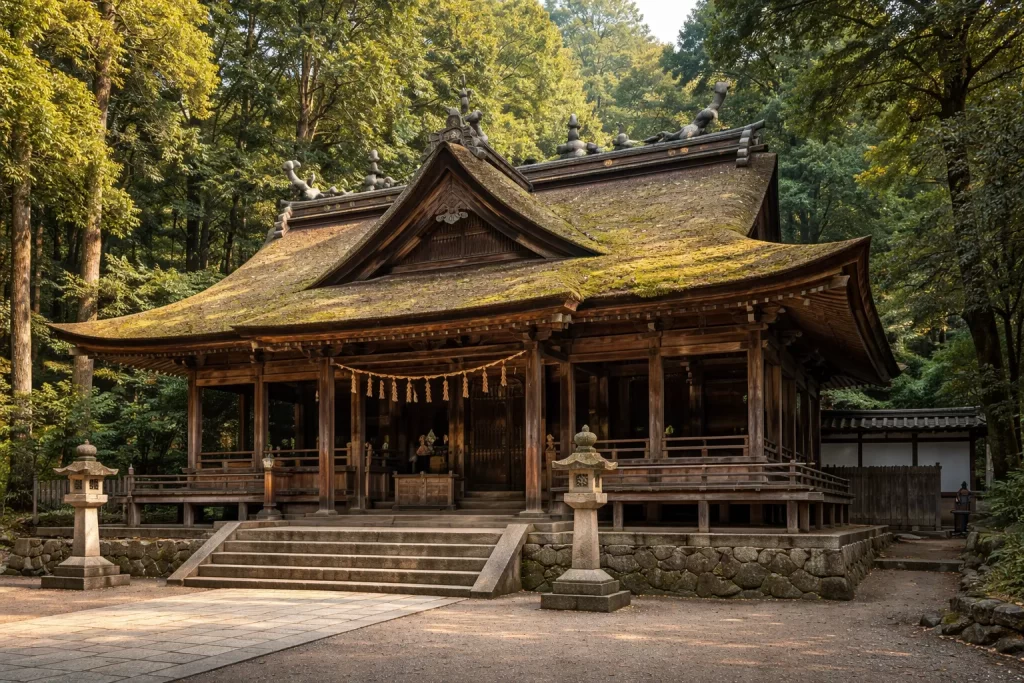
The main hall of Ujigami Shrine, built in the late Heian period (late 11th century), is the oldest surviving shrine building in Japan. Designated as a National Treasure, the structure appears at first glance to be a relatively small protective enclosure (oiya), but it contains three inner sanctuaries within — a rare architectural configuration. Of the three inner sanctuaries hidden beneath the enclosure’s roof, the left sanctuary (to the viewer’s right) is the oldest, estimated to date from the late 11th century (1070s-1080s).
The main hall’s architectural style is called “sangensha nagare-zukuri” (three-bay flowing style), with a frontage of three bays (approximately 5.4 meters) and a roof that curves gracefully forward in the “nagare-zukuri” (flowing style) form. While this is the most common style in Japanese shrine architecture, Ujigami Shrine’s main hall holds a special place in the history of shrine architecture as the oldest surviving example.
Traces of vermillion pigment called “ni” (tan) remain on the outer walls and columns of the inner sanctuaries, indicating that the structure was once painted in a vivid red that expressed its sacred nature. Over time, the color has faded to the natural hue of the wood, and this weathered beauty is itself one of the charms of the main hall today. While the interior is not normally open for direct viewing, the appearance of the protective enclosure glimpsed through gaps in the worship hall conveys the gravity of a structure that has witnessed centuries upon centuries of time.
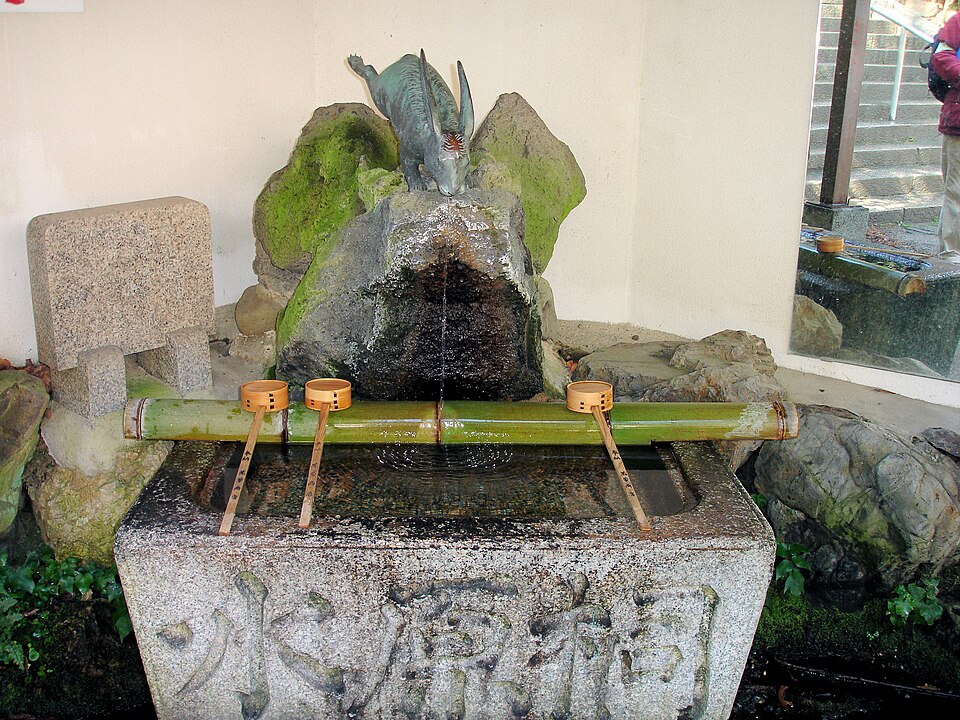
In front of the main hall lies a natural spring called “Kirihara no Mizu.” Known as one of the Seven Famous Waters of Uji (Nana Meisui), this clear spring still pools in a corner of the shrine grounds, its gentle sound echoing through the silence of the precinct. This water was traditionally prized as the finest water for brewing tea in Uji, Japan’s premier tea-producing region, and it continues to embody the deep connection between Uji’s culture and nature.
Worship Hall (National Treasure): A Masterpiece of Shrine Architecture with Shinden-zukuri Design
Standing in front of the main hall, the worship hall was built from the late Heian to early Kamakura period (late 12th to early 13th century) and is also designated as a National Treasure. The worship hall is constructed in the “wari-haiden” (split worship hall) style, characterized by an open passageway through the center of the building. This design served the dual practical purpose of providing a space for worshippers to pray and a passage along the approach path.
The worship hall’s most notable feature is its incorporation of “shinden-zukuri” design elements — the architectural style of Heian aristocratic residences — into shrine architecture. The influence of shinden-zukuri is clearly visible in the roof form, column placement, and joinery details, illustrating how shrine architecture and aristocratic residential architecture influenced each other during this period. While the building is relatively modest in scale, with a frontage of approximately 17.3 meters and a depth of about 5.6 meters, its presence exudes a dignity accumulated over a thousand years.
The worship hall’s roof is a “kokera-buki” (shingled) roof made from thin wooden boards (kokera-ita) layered upon one another. While the current shingles are from later restorations, much of the structural framework dates from the late Heian to early Kamakura period. The beautiful slope of the roof and the horizontal expansiveness of the overall structure give the worship hall a distinctive, elegant beauty. Viewing the worship hall from the front against the backdrop of the green grove creates a profound sense of encountering the essence of Heian and Kamakura-period shrine architecture.
The interior of the worship hall is normally not accessible, but visitors can catch a glimpse of the inside through the central open passageway. The ceiling features flat wooden paneling (kagami tenjo), where the deep color of aged wood conveys depth and dignity. When offering prayers through the worship hall toward the main hall beyond, one can contemplate the deities across a span of a thousand years — this is the profound allure of Ujigami Shrine.
Kirihara Spring Water and the Sacred Garden
Within the grounds of Ujigami Shrine is a natural spring known as “Kirihara no Mizu.” Celebrated since ancient times as one of the Seven Famous Waters of Uji (Nana Meisui), this spring is the only one of the seven that still flows today. The sacred water in a corner of the grounds purifies the precinct and the hearts of visiting worshippers.
Kirihara no Mizu has long been prized as “the most delicious water in Uji, Japan’s premier tea region.” Uji is one of Japan’s foremost tea-producing areas, and the cultivation of tea seeds brought back from Song Dynasty China by the monk Eisai during the Kamakura period is considered the origin of Uji tea. High-quality tea leaves complemented by crystal-clear water — Ujigami Shrine’s Kirihara spring is deeply connected to Uji’s tea culture.
Although compact, the shrine grounds include a maintained sacred garden (shin’en) shaded by evergreen trees. The foliage is particularly beautiful during the fresh green of spring and the autumn foliage season, deepening the atmosphere of this ancient shrine. Throughout the grounds, you will find ema (votive tablets) and omamori (charms) featuring rabbit motifs. This is because the character for “u” in “Ujido” (the ancient name of Uji written in the name of the enshrined Prince Uji no Wakiiratsuko) means “rabbit,” and rabbit designs can be spotted throughout the precinct. The adorable rabbit charms are a popular souvenir among visitors to Ujigami Shrine.
Near the entrance of the grounds is the shrine office, where goshuin (shrine seal stamps) are available. The goshuin of Ujigami Shrine is simple yet distinguished, and is sought after by many goshuin collectors as a memento of visiting “Japan’s oldest shrine building.” Admission to the grounds is free, but a separate offering is required for goshuin.
Uji Shrine and Uji Bridge: Access from the Opposite Bank and Uji’s Historic Landscape
When visiting Ujigami Shrine, we recommend also exploring Uji Shrine and Uji Bridge on the opposite bank of the Uji River. Uji Shrine is a companion ancient shrine to Ujigami Shrine, and the two formerly constituted the unified “Uji Rikyu Myojin.” Within Uji Shrine’s grounds stands a statue of the “Mikaeri Usagi” (the looking-back rabbit), whose backward-gazing pose is popular with visitors.
Uji Bridge, though various theories exist, is traditionally said to have been first built in 646 CE by a monk named Doto, making it one of the oldest bridges in Japan. The current bridge is a modern reconstruction, but as a bridge with nearly 1,400 years of history, it forms the heart of Uji’s historic landscape. The view of the Uji River flowing beneath the bridge and the mountains on the opposite bank is serene and beautiful, and many travelers pause to take in the scenery.
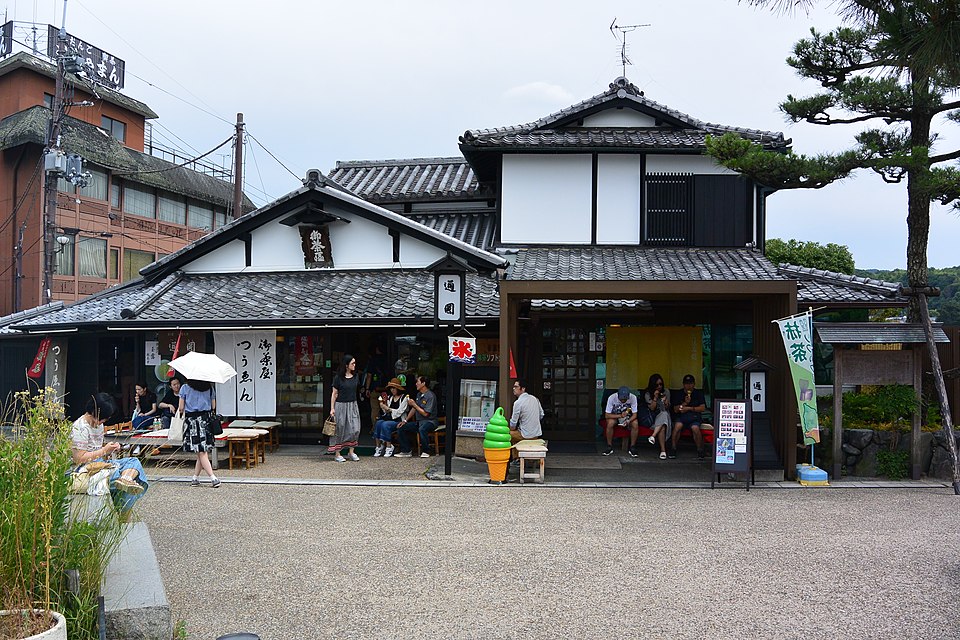
At the western end of Uji Bridge stand the “Uji Jujo Stone Monument” and a statue of Murasaki Shikibu, commemorating this very location as the setting for the “Uji Chapters” of The Tale of Genji. After visiting Ujigami Shrine, crossing Uji Bridge and pausing before the statue of Murasaki Shikibu to reflect on the literary world of a thousand years ago — this is one of the deeper pleasures of traveling in Uji. Strolling along the riverside promenade and stopping for a rest at a tea house is another quintessentially Uji way to spend your time.
The Four Seasons at Ujigami Shrine
The grounds of Ujigami Shrine offer natural beauty throughout all four seasons. The deep groves surrounding the precinct are composed mainly of evergreen broadleaf trees, enveloping the shrine buildings in deep green year-round. This atmosphere, quintessential of an ancient shrine, is the core of Ujigami Shrine’s appeal, setting it apart from flashier tourist destinations.
In spring (late March to mid-April), cherry blossoms begin to bloom within the grounds. While the cherry blossoms at Ujigami Shrine are not as famous as those at Byodoin, enjoying them amid the serene atmosphere of this ancient shrine offers a special elegance. Since Byodoin’s cherry blossoms reach their peak around the same time, the entire Uji area draws many visitors as a cherry blossom destination.
Summer (June to August) is when the fresh greenery is at its deepest and most beautiful. Shaded by the tree canopy, the grounds remain relatively cool even during Kyoto’s summer heat, and simply spending a moment in front of the worship hall allows you to feel the natural coolness. Early morning visits are especially quiet, with few other visitors, offering a chance to leisurely appreciate this space where a thousand years of history are condensed.
The autumn foliage season (mid-October to late November) is when all of Uji is at its most beautiful. The trees within Ujigami Shrine’s grounds also turn color, adding gradients of red and gold to the ancient buildings. The scenery, combined with the autumn foliage along the Uji River, offers a beauty unique to this season. Winter (December to February) brings fewer visitors and a deep silence, making it arguably the best season to experience the “authentic” Ujigami Shrine, where one can contemplate a millennium of history in solitude.
Nearby Tourist Attractions
Byodoin Phoenix Hall (approx. 15-minute walk from Ujigami Shrine)
Located across the Uji River, about a 15-minute walk over Uji Bridge, Byodoin Phoenix Hall is Uji’s premier tourist attraction and, together with Ujigami Shrine, a constituent part of the “Historic Monuments of Ancient Kyoto” World Heritage Site. Built in 1052 by the regent Fujiwara no Yorimichi, the Amida Hall is a National Treasure nationally recognized for its appearance on the 10-yen coin and 10,000-yen banknote. The sight of Phoenix Hall, with its phoenix-shaped roof ornaments, reflected in the Aji Pond represents the pinnacle of Heian aristocratic aesthetics in their attempt to recreate the Pure Land paradise on earth. With construction dates very close to Ujigami Shrine (both from the 11th century), this pairing offers an opportunity to experience the zenith of mid-Heian Japanese culture, and visiting both together is highly recommended.
Daigoji Temple (approx. 9 km northwest of Ujigami Shrine)
About a 20-minute JR train ride northwest of Uji, Daigoji Temple is the head temple of the Shingon Daigo school and a World Heritage-registered temple in southern Kyoto. With over 1,100 years of history since its Heian-period founding, highlights include the weeping cherry trees beloved by Toyotomi Hideyoshi, Kyoto’s oldest five-story pagoda (National Treasure), and the famous garden of Sanbo-in, designed with Hideyoshi’s personal involvement. As a World Heritage Site that, like Ujigami Shrine, preserves Heian-period architectural culture, combining it with a Uji visit deepens one’s understanding of Heian culture.
Kosho-ji Temple and the Uji River Riverside Walk
Heading upstream along the Uji River from Ujigami Shrine, you will reach Kosho-ji Temple, a Zen temple founded by Zen Master Dogen. The approach path known as “Koto-zaka” (Harp Slope), with a small stream running alongside, is particularly famous for its autumn foliage and has been selected as one of Japan’s 100 Most Beautiful Roads. About a 10-minute walk from Ujigami Shrine, this path becomes covered with brilliant red maple leaves in autumn, creating the experience of walking through a tunnel of foliage. A riverside promenade runs along the Uji River, allowing for a leisurely stroll from Ujigami Shrine to Kosho-ji while enjoying views of the river. Take a break at one of the tea houses or cafes along the road lined with tea merchants and enjoy the peaceful scenery unique to Uji. A World Heritage tour of the Nara-Uji area, including Kofukuji Temple (Nara), is also recommended as a day trip from Uji.
Access
The most convenient way to reach Ujigami Shrine is by train and bus from central Kyoto.
Via JR Nara Line (direct from Kyoto Station)
From JR Kyoto Station, take the JR Nara Line “Miyakoji Rapid” or “Local” train and alight at “JR Uji Station.” The journey takes approximately 17-24 minutes (about 17 minutes by rapid service, about 24 minutes by local). From JR Uji Station, it is about a 20-minute walk along the Uji River to Ujigami Shrine. The route passing through the main approach to Byodoin Phoenix Hall is a particularly enjoyable course for sightseeing.
Via Kintetsu Kyoto Line
From Kintetsu Kyoto Station, you can take the Kintetsu Kyoto Line “Express” or “Local” train, transfer at “Kintetsu Okubo Station,” and transfer again at “Kintetsu Shin-Tanabe Station,” but using the JR Nara Line is more convenient as it requires no transfers.
Via Keihan Railway
From Keihan Sanjo Station or Chushojima Station, take the Keihan Uji Line and alight at “Keihan Uji Station.” It is about a 10-minute walk from Keihan Uji Station to Ujigami Shrine, closer than from JR Uji Station. This route is convenient when coming from the eastern side of Kyoto (Sanjo/Gion area).
By Car / Parking
From the Meishin Expressway, exit at “Kyoto Minami IC” or “Kyoto Higashi IC” and take the prefectural road to Uji. There is no dedicated parking lot at Ujigami Shrine, but paid parking lots are available nearby. When visiting both Byodoin and Ujigami Shrine, the paid parking lots near Uji Bridge are convenient. Weekends and holidays tend to be crowded, so please use public transportation whenever possible.
Summary
Ujigami Shrine, as its title of “the oldest surviving shrine building in Japan” suggests, holds irreplaceable value in the history of Japanese architecture and culture. The grounds are small and there are no flashy presentations, but when standing before a National Treasure that has retained its original form for nearly 1,000 years, its quiet presence resonates deeply within the heart.
Registered as a World Heritage Site alongside Byodoin Phoenix Hall, Ujigami Shrine is a living witness that conveys the essence of Heian-period Japanese culture to the present day. Walk through the old streets where the aroma of Uji tea lingers, listen to the flow of the Uji River, and visit this small sanctuary that has watched over a thousand years of history. It will surely become an unforgettable page in your travels.