- Introduction
- Overview of Zojo-ji
- History of Zojo-ji
- Period 1: Muromachi Era (1393) — Founding as a Center of Pure Land Buddhism
- Period 2: Early Edo Period (1598–) — The Encounter with Tokugawa Ieyasu and Rapid Expansion
- Period 3: End of Edo to Meiji (1868–) — Anti-Buddhist Movement and Reduction of Grounds
- Period 4: Taisho to Showa (1923–1945) — Trials of the Great Kanto Earthquake and War
- Period 5: Late Showa to Present — Restoration and Transformation into a “Photogenic Sacred Spot”
- Highlights and Recommended Spots
- 1. Sangedatsu-mon Gate — A Nationally Important Cultural Property and the Oldest Surviving Structure
- 2. Ankokuden Hall (Black Buddha) — The Hidden Statue of Amida Nyorai
- 3. Tokugawa Shogunal Mausoleum — A Serene Sacred Ground Where Six Shoguns Rest
- 4. Daiden (Main Hall) — A Modern Main Hall Rebuilt in Reinforced Concrete
- 5. Bell Tower and Great Temple Bell — New Year’s Eve Bell Echoing Across Tokyo’s Sky
- Nearby Attractions
- How to Get There
Introduction
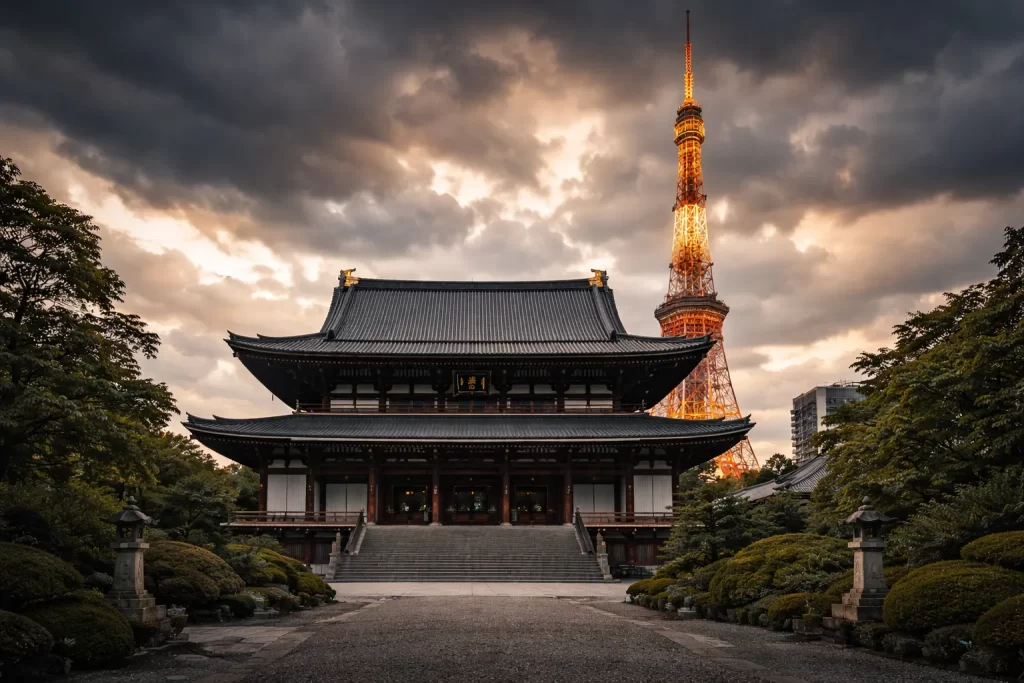
Step into the green temple grounds that spread beneath Tokyo Tower, and the urban bustle fades away, replaced by a quiet, solemn atmosphere. This is Zojo-ji, a temple that has served as the family temple of the Tokugawa shoguns for approximately 400 years. Looking across the grounds from the vivid vermilion Sangedatsu-mon Gate at the front entrance, Tokyo Tower glows red in the background — this striking contrast has captivated travelers from around the world as one of Tokyo’s most iconic views.
Zojo-ji is one of the seven head temples of Jodo-shu (Pure Land Buddhism) and a sacred site where six of the fifteen Tokugawa shoguns rest in eternal peace. The temple attracts approximately two million visitors annually, and nearly all of Shiba Park was once part of Zojo-ji’s grounds. At its peak, the temple compound covered roughly 250,000 tsubo (approximately 830,000 square meters), but it was reduced to its current size following the Meiji Restoration and World War II. Even so, the current grounds still span about 25,000 square meters, offering a tranquil oasis that seems worlds apart from central Tokyo.
Overview of Zojo-ji
Zojo-ji is the head temple of Jodo-shu Buddhism located in Shiba Park, Minato City, Tokyo. Its formal name is “Sanenzankoudo-in Zojo-ji.” The principal image of worship is Amida Nyorai (the Black Buddha), a hidden Buddhist statue that can only be viewed on special opening days.
| Official Name | Sanenzankoudo-in Zojo-ji |
|---|---|
| Address | 4-7-35 Shiba-koen, Minato-ku, Tokyo |
| Buddhist Sect | Jodo-shu (one of seven head temples) |
| Principal Image | Amida Nyorai (Black Buddha) |
| Founded | 1393 (Meitoku 4) |
| Founder | Yuyo Shoso Shonin |
| Visiting Hours | Grounds open freely (Ankokuden 6:00–17:30) |
| Admission | Free (Tokugawa Mausoleum: 500 yen for adults) |
| Closed | Open year-round |
| Phone | 03-3432-1431 |
*Please check the official Zojo-ji website for the latest visiting hours and fees.
Zojo-ji’s most distinctive feature is its deep connection to the Tokugawa shogunal family. After Tokugawa Ieyasu designated Zojo-ji as the prayer and family temple of the Edo shogunate in 1598, the temple expanded explosively under shogunal patronage. At its zenith, Zojo-ji formed a vast temple city stretching from present-day Hibiya Park in the north to Shiba Daijingu Shrine in the south, with over 100 sub-temples and 48 seminary halls.
The Sangedatsu-mon Gate, designated as a nationally Important Cultural Property, still stands in the temple grounds, preserving the magnificence of the Edo period as a structure built during that era. The Tokugawa Shogunal Mausoleum houses the tombs of six shoguns — the 2nd (Hidetada), 6th (Ienobu), 7th (Ietsugu), 9th (Ieshige), 12th (Iyeyoshi), and 14th (Iemochi) — along with their wives, concubines, and children. Welcoming approximately two million visitors per year, this temple is cherished both for its historical significance and as a place of tranquility within the city.
History of Zojo-ji
Period 1: Muromachi Era (1393) — Founding as a Center of Pure Land Buddhism
Zojo-ji traces its origins to 1393 (Meitoku 4).
Jodo-shu is a Buddhist sect founded by Honen Shonin at the end of the Heian period, teaching that anyone can attain rebirth in the Pure Land by chanting “Namu Amida Butsu.” It is easy to imagine how this sect, which attracted believers from samurai to commoners, resonated with people seeking peace and salvation in an age of civil war.
In its early years, Zojo-ji was merely a modest temple of one sect, smaller in scale and situated at a different location from today.
Period 2: Early Edo Period (1598–) — The Encounter with Tokugawa Ieyasu and Rapid Expansion
The turning point that dramatically altered Zojo-ji’s history arrived in 1598 (Keicho 3).
By Ieyasu’s order, Zojo-ji was relocated to its present site in Shiba in 1598.
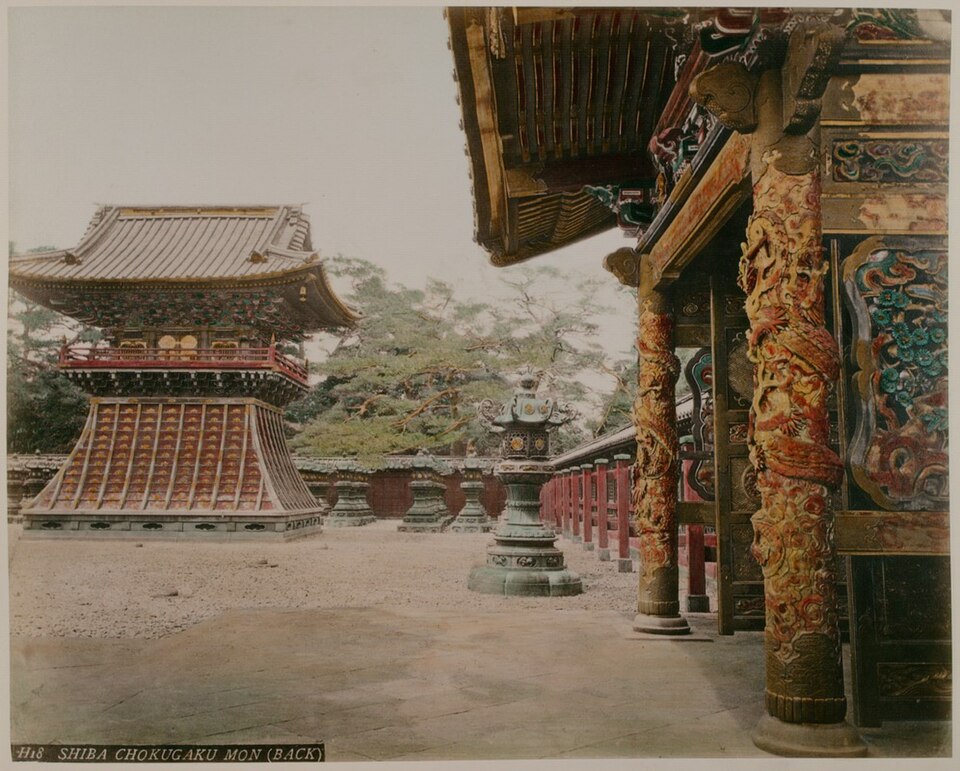
Throughout the Edo period, Zojo-ji flourished as one of “Edo’s great temples.” Its grounds grew to encompass what is now Shiba Park, Tokyo Tower, and parts of Hibiya Park, becoming a vast religious city where over 3,000 monks studied and trained at any given time.
Period 3: End of Edo to Meiji (1868–) — Anti-Buddhist Movement and Reduction of Grounds
The Meiji Restoration dealt a devastating blow to Zojo-ji.
In 1873 (Meiji 6), the bulk of Zojo-ji’s grounds were designated as “Shiba Park,” one of Japan’s first Western-style parks, and most of the more than 100 sub-temples were forced into closure or merger.
Yet Zojo-ji never allowed its flame of faith to be extinguished.
Period 4: Taisho to Showa (1923–1945) — Trials of the Great Kanto Earthquake and War
Just as Zojo-ji was beginning to recover from the hardships of the anti-Buddhist movement, further trials arrived.
Just as recovery was getting back on track, World War II plunged Zojo-ji into yet another crisis.
When Tokyo Tower was constructed in 1958, Zojo-ji found itself making a fresh start alongside the very symbol of Japan’s rapid economic growth.
Period 5: Late Showa to Present — Restoration and Transformation into a “Photogenic Sacred Spot”
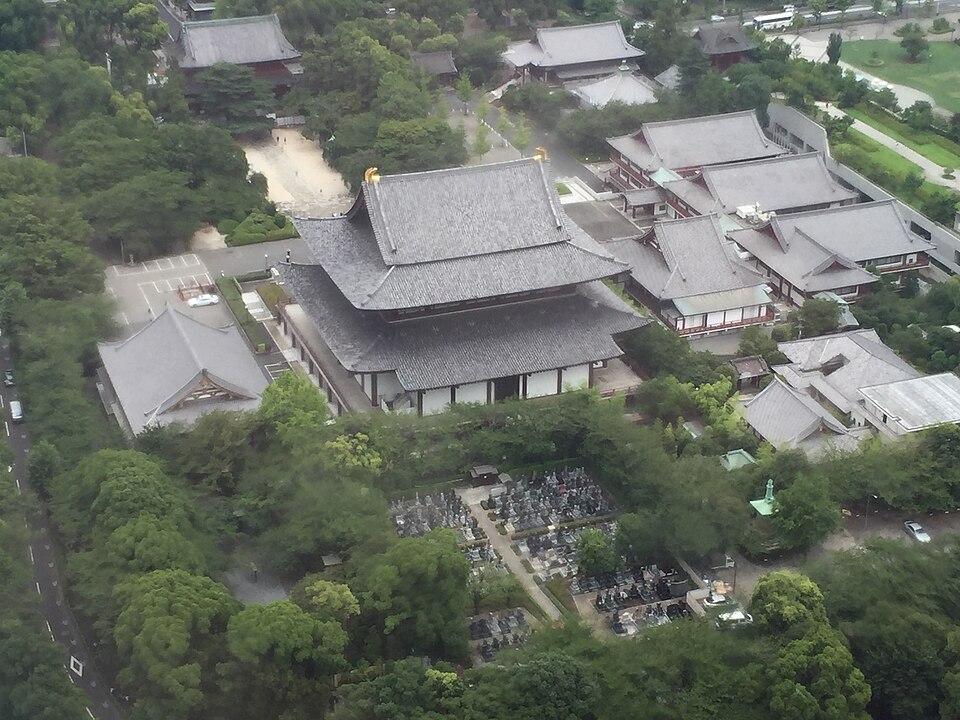
Zojo-ji’s full-scale restoration was finally completed with the reconstruction of the Daiden (Main Hall) in 1974.
From the Showa to Heisei eras, Zojo-ji has continuously adapted to the changing times.
Today, Zojo-ji continues its traditional religious activities while also growing significantly as a tourist destination.
Highlights and Recommended Spots
Zojo-ji’s grounds are dotted with diverse attractions, from architecturally significant structures steeped in history to seasonal scenic views.
1. Sangedatsu-mon Gate — A Nationally Important Cultural Property and the Oldest Surviving Structure
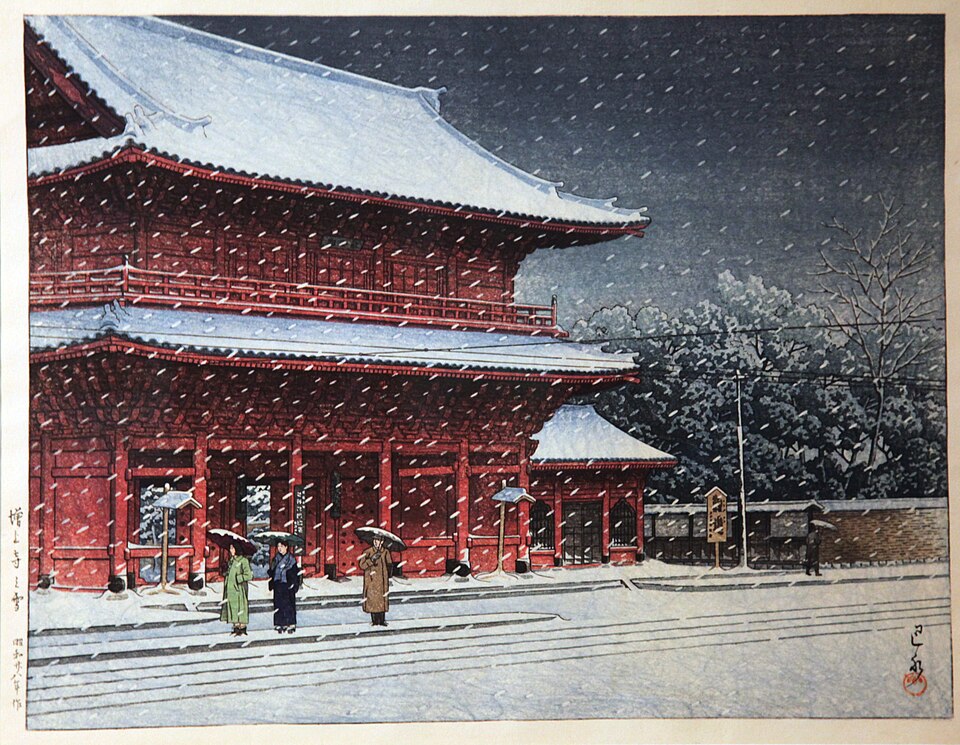
The Sangedatsu-mon Gate, the iconic face of Zojo-ji, is a two-story gate built in 1622 (Genna 8) and designated as a nationally Important Cultural Property.
The name “Sangedatsu-mon” derives from the Buddhist teaching that passing through this gate liberates one from the “three poisons” (greed, anger, and ignorance).
The greatest appeal of the Sangedatsu-mon Gate is the view it creates with Tokyo Tower rising behind it.
2. Ankokuden Hall (Black Buddha) — The Hidden Statue of Amida Nyorai
The most deeply revered object at Zojo-ji is the Amida Nyorai statue known as the “Kuro Honzon” (Black Buddha), enshrined in Ankokuden Hall.
The Black Buddha is known as a statue that Tokugawa Ieyasu revered deeply.
As a “hidden Buddha” (hibutsu), the Black Buddha is only revealed on the 1st and 15th of each month and on special festival days.
3. Tokugawa Shogunal Mausoleum — A Serene Sacred Ground Where Six Shoguns Rest
Located on the south side of Zojo-ji’s grounds, the Tokugawa Shogunal Mausoleum is a sacred space where six shoguns — the 2nd (Hidetada), 6th (Ienobu), 7th (Ietsugu), 9th (Ieshige), 12th (Ieyoshi), and 14th (Iemochi) — rest alongside their wives, concubines, and children.
Research on burial goods, some of which were dispersed to institutions such as the Tokyo National Museum, has revealed the splendid funerary culture of the Edo period.
Stone lanterns associated with the Tokugawa family line the approach to the mausoleum, and as you walk through the quiet grove, you may feel as though you are traveling back to the Edo period.
4. Daiden (Main Hall) — A Modern Main Hall Rebuilt in Reinforced Concrete
The current Daiden (Main Hall) was rebuilt in 1974 and is a modern structure with a total floor area of approximately 2,000 square meters.
Standing before the Daiden, you can see Tokyo Tower peeking out from behind it.
Inside the Daiden, morning prayers (chouka) are held daily at 6:00 AM, and visitors are welcome to participate freely.
5. Bell Tower and Great Temple Bell — New Year’s Eve Bell Echoing Across Tokyo’s Sky
Zojo-ji’s great temple bell (daibonsho) was cast in 1702 (Genroku 15) and is registered as a Tokyo Metropolitan Designated Tangible Cultural Property.
The great bell attracts the most attention during the New Year’s Eve “Joya no Kane” (bell-ringing) ceremony held every December 31st.
Beyond New Year’s Eve, the great bell is also rung during morning prayers and memorial services.
Nearby Attractions
The Shiba and Hamamatsucho area of Minato City, where Zojo-ji is located, is a zone rich with some of Tokyo’s most popular tourist spots.
1. Tokyo Tower — The Showa-Era Symbol Rising Right Next to Zojo-ji
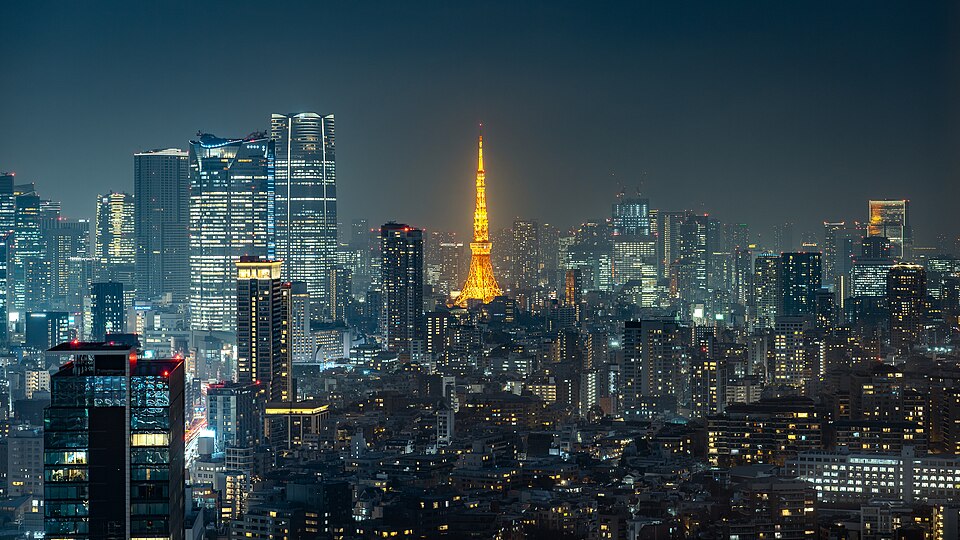
The attraction inseparably linked with Zojo-ji is Tokyo Tower, standing just a 5-minute walk away.
Tokyo Tower’s Main Deck (150 meters) and Top Deck (250 meters) offer a 360-degree Tokyo panorama that includes a view of Zojo-ji’s grounds.
2. Shiba Park — A Central Tokyo Oasis Surrounding Zojo-ji
Shiba Park, which wraps around Zojo-ji’s grounds, is a historic park established in 1873 as one of Japan’s first Western-style parks.
In spring, approximately 1,300 cherry trees burst into bloom, making it a famous spot for hanami (cherry blossom viewing).
3. Toranomon and Shimbashi Area — A City Stroll Filled with Gourmet Food and Culture
Within a 15–20 minute walk northeast of Zojo-ji, you will find the redeveloped Toranomon Hills and Shimbashi, known as the mecca of the Japanese salaryman.
The Imperial Palace and Hibiya Park are also within cycling or walking distance.
How to Get There
Public transportation is the most convenient way to reach Zojo-ji. Located in the heart of Tokyo, the temple is accessible from multiple train lines.
By Train
The closest route is a 3-minute walk from Shibakoen Station (Exit A4) on the Toei Mita Line. Alternatively, Daimon Station (Exit A6) on the Toei Asakusa and Oedo Lines is about a 5-minute walk. From Hamamatsucho Station (North Exit) on the JR Yamanote and Keihin-Tohoku Lines, it is approximately an 8–10 minute walk. The route from any station is flat and easy to walk.
By Bus
If using Toei buses, the nearest stop is “Shiba-Daimon.” Buses run from Shimbashi Station and Shinagawa Station areas.
By Car / Parking
From the Shuto Expressway, take the “Shiba-koen Exit” or “Ichinohashi Exit,” then drive approximately 5 minutes. There is no dedicated parking lot on the temple grounds, so please use nearby coin-operated parking lots. Multiple parking facilities are available around Shiba Park and the surrounding area. Parking is also available near Tokyo Tower, which is convenient if you plan to visit both.
As Part of a Sightseeing Route
Zojo-ji is a staple of west Tokyo sightseeing courses when combined with Tokyo Tower and the Imperial Palace. A recommended full-day itinerary is to visit Shiba Park, Zojo-ji, and Tokyo Tower in the morning, then head to Senso-ji Temple or Meiji Jingu Shrine in the afternoon.
Conclusion
Zojo-ji is a venerable temple with approximately 630 years of history — founded in the Muromachi period, it reigned at the center of Edo as the Tokugawa shoguns’ family temple, and endured the trials of the anti-Buddhist movement and wartime destruction to persist into the modern era. Its grounds are filled with attractions where you can feel history firsthand, including the Sangedatsu-mon Gate, the Black Buddha (Ankokuden Hall), and the Tokugawa Shogunal Mausoleum.
With Tokyo Tower rising behind it, Zojo-ji stands as a symbol of Tokyo’s defining landscape — where history and modernity coexist. From quiet worship to photography and historical exploration, this versatile destination is a place you should absolutely visit when sightseeing in Tokyo. Leave the hustle and bustle of the city behind and experience a moment of tranquility in this sacred space of prayer that transcends 600 years.