
🕓 2025/3/8
#Culture
A Detailed Guide to Ninja: History and Experiences
Table of Contents
What Are Ninja?
Ninja were warriors with specialized skills who played active roles throughout Japanese history. They were not merely fighters, but specialists primarily in “intelligence gathering (espionage),” “infiltration and reconnaissance,” “surprise attacks,” and “psychological warfare.” In modern terms, their role was similar to that of spies or special forces.

Ninja were most active during the Sengoku period (15th-16th centuries), hired by feudal lords to spy on enemy movements and secretly execute operations. While the popular image of ninja features black-clad figures throwing shuriken, actual ninja are believed to have frequently disguised themselves as ordinary farmers or merchants to carry out their activities inconspicuously.

They were also known by names such as “rappa,” “suppa,” “kusa,” and “dakkuchi,” and their activities were similar to those of modern spies and special forces. While their exact origins are unclear, their existence has been confirmed from the late Heian period through the Kamakura period (around the 12th century). During the Muromachi to Sengoku periods (14th-16th centuries), the need for espionage and surprise attacks increased amidst ongoing warfare, and ninja activities intensified.
■ Major Schools and Regions
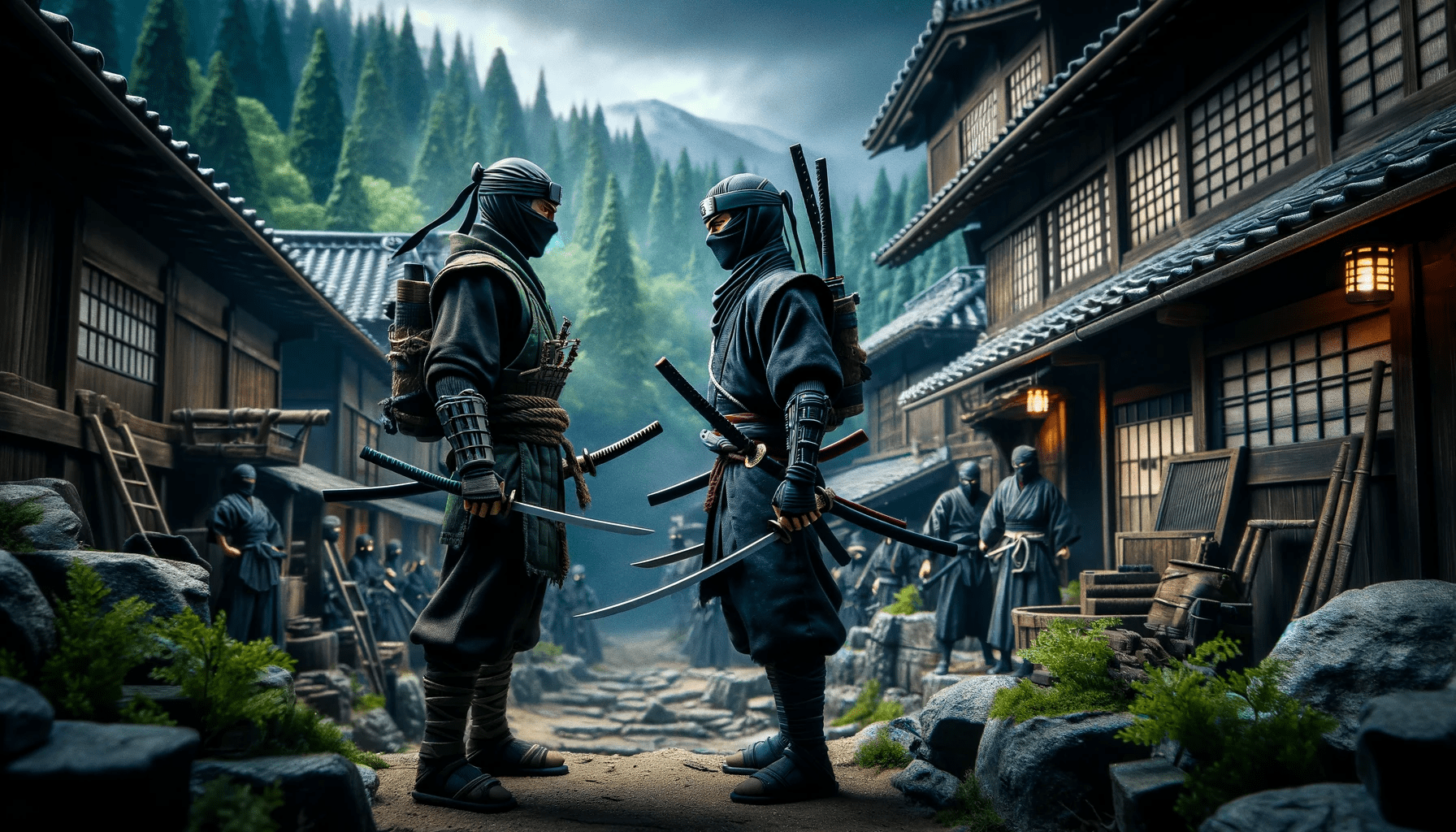
Among ninja, the Iga-ryu and Koga-ryu schools are the most famous. The Iga-ryu was based in the present-day Iga region of Mie Prefecture, while the Koga-ryu operated primarily in the Koka region of Shiga Prefecture. These areas are mountainous terrain that was difficult for outsiders to penetrate, fostering the development of unique cultures and techniques. Additionally, a ninja group called “Nokizaru” (Eaves Monkeys) served Uesugi Kenshin and were skilled in mountain intelligence operations.
■ Ninja Hierarchy
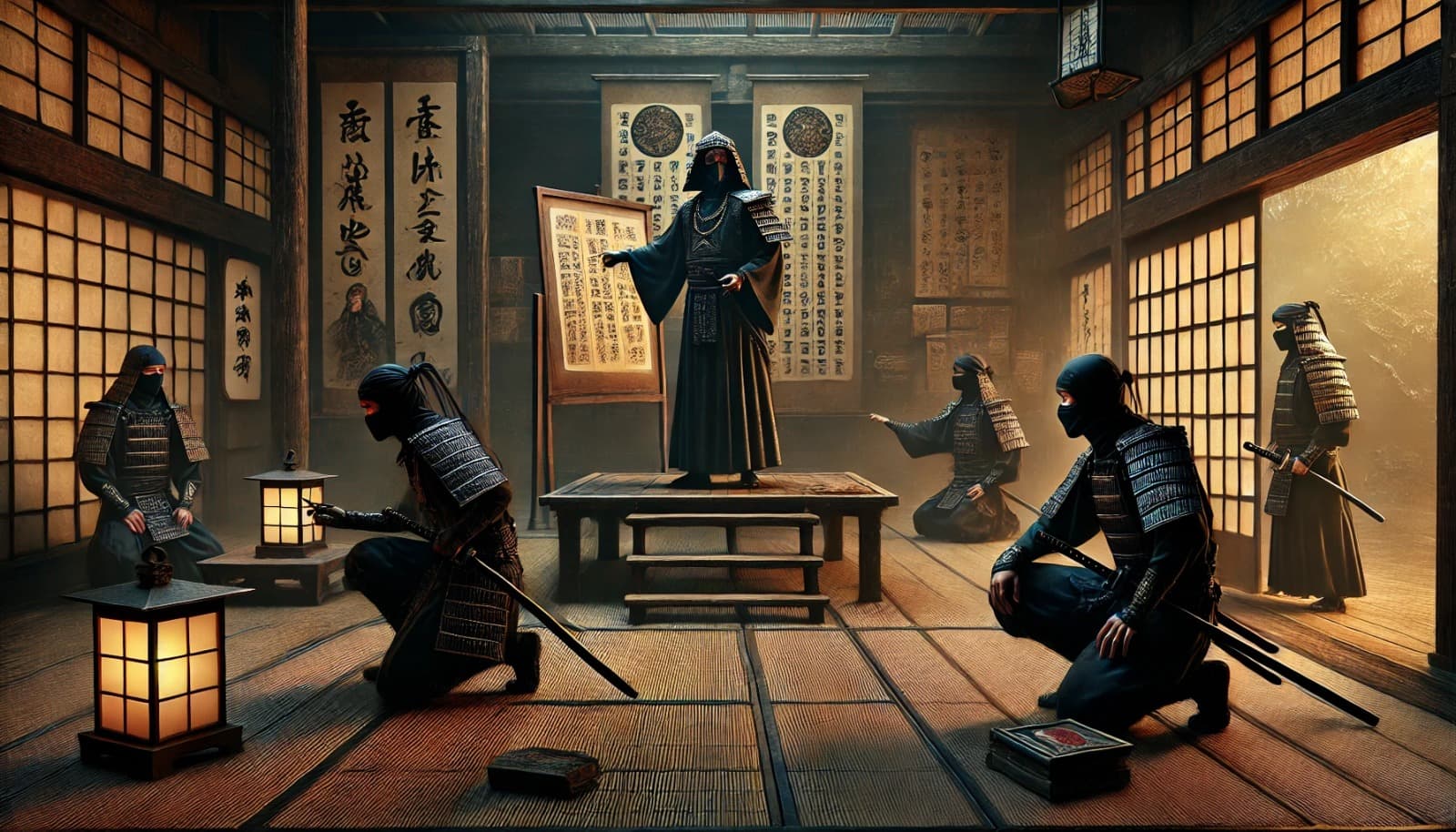
Ninja had a hierarchical structure based on their roles and skills. Jonin (upper ninja) were responsible for strategic planning and command, chunin (middle ninja) carried out missions under the direction of jonin, and genin (lower ninja) handled frontline tasks such as actual infiltration and combat. This organizational system enabled efficient and effective operations.
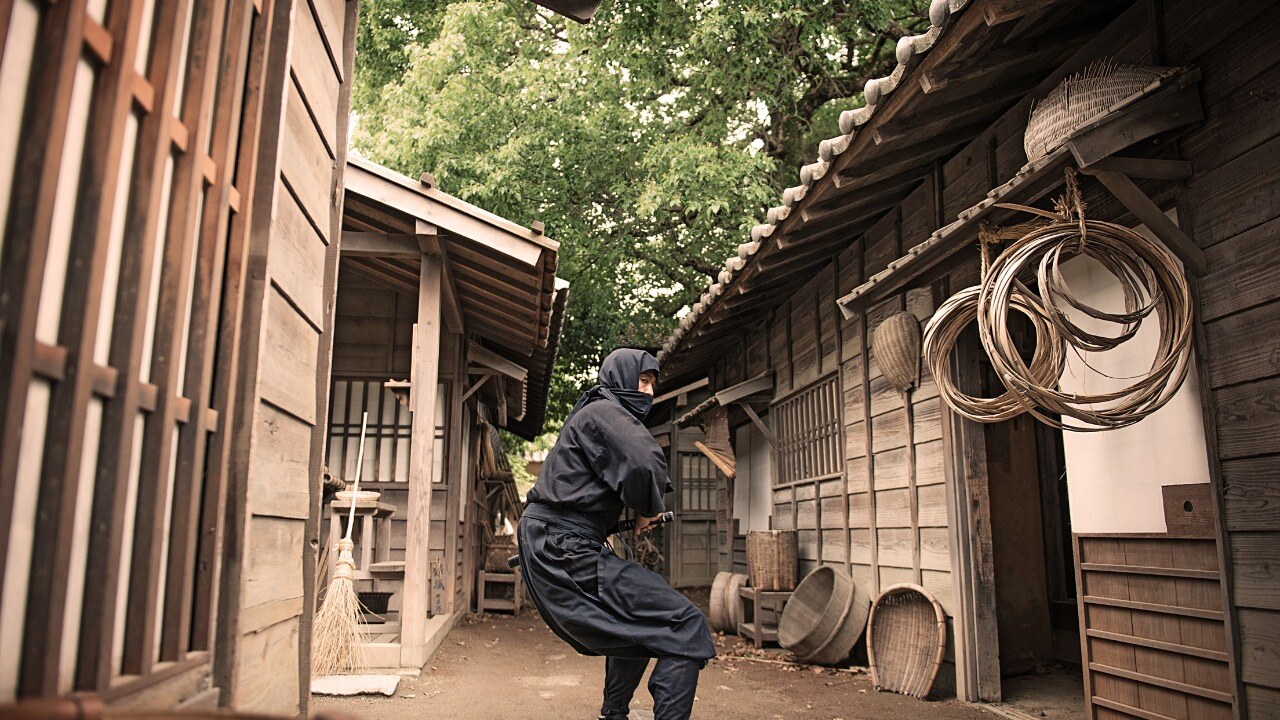
Due to their secretive nature, many legends and stories have emerged about ninja. Even today, ninja attract high levels of interest both domestically and internationally as symbols of Japanese culture. Ninja are deeply rooted in Japanese history and culture, and their true nature and legends continue to capture people’s imagination.
History of Ninja
1. Origins of Ninjutsu and Its Founders (up to the 14th Century)
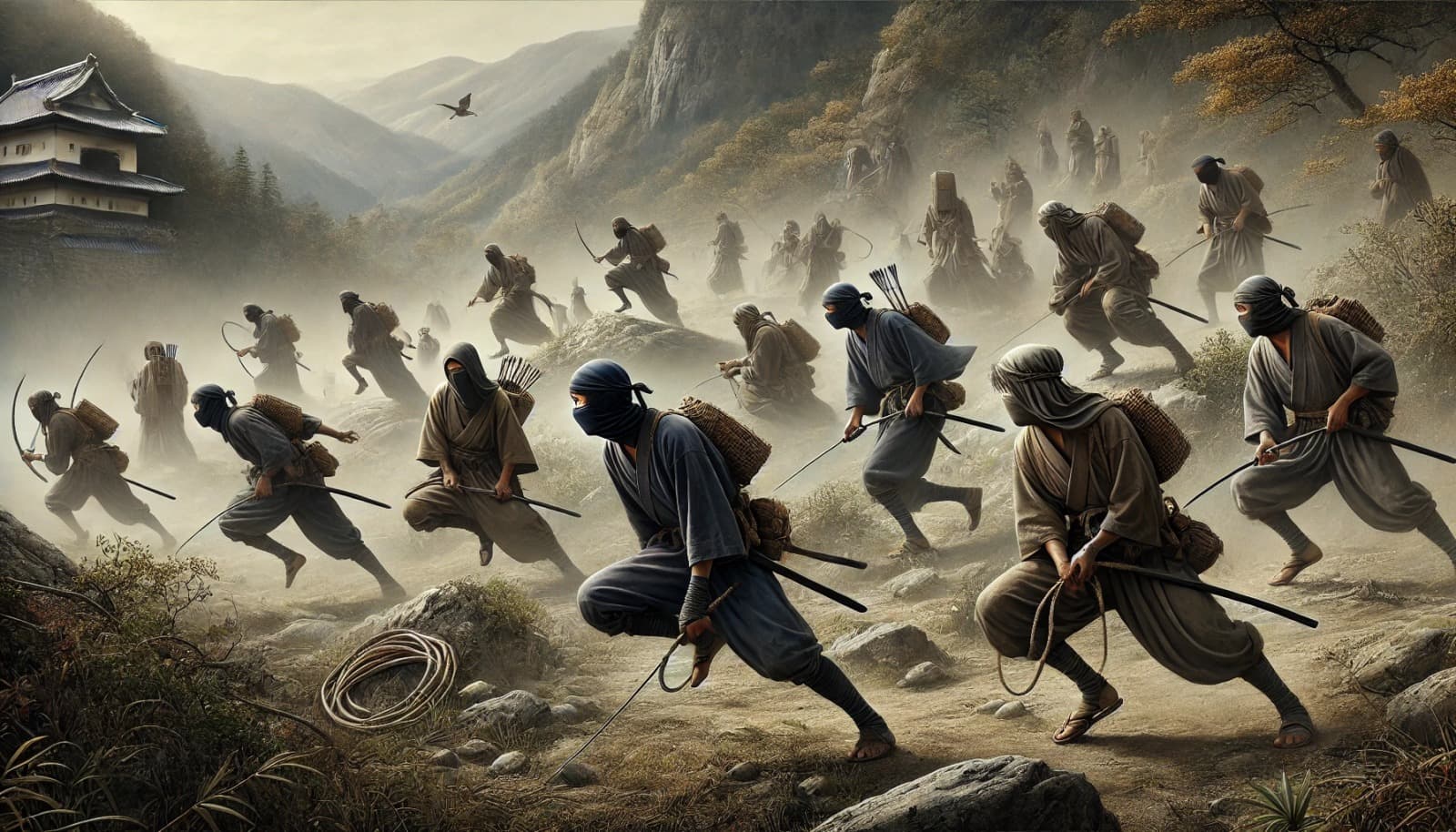
Ninja (shinobi) have no clear origin or founder, as they gradually formed from ancient through medieval Japan. Their roots are believed to be a fusion of spy techniques from the Chinese military treatise “The Art of War” by Sun Tzu, the knowledge of mountain ascetics, and the techniques of secret agents.
Particularly in the mountainous regions of Iga and Koga, ninjutsu developed as a unique means of self-defense. The first historical record of ninja appears in the mid-14th century work “Taiheiki,” which contains descriptions of Ko no Moronao using “shinobi.”
Ninjutsu was systematized as written documentation during the Edo period, and the representative “Bansenshukai” (1676) comprehensively compiled the ninjutsu knowledge and techniques of the time, serving as an important resource that conveys the ninja image to the present day.
2. Historical Background of Ninja Activities (14th-17th Centuries)
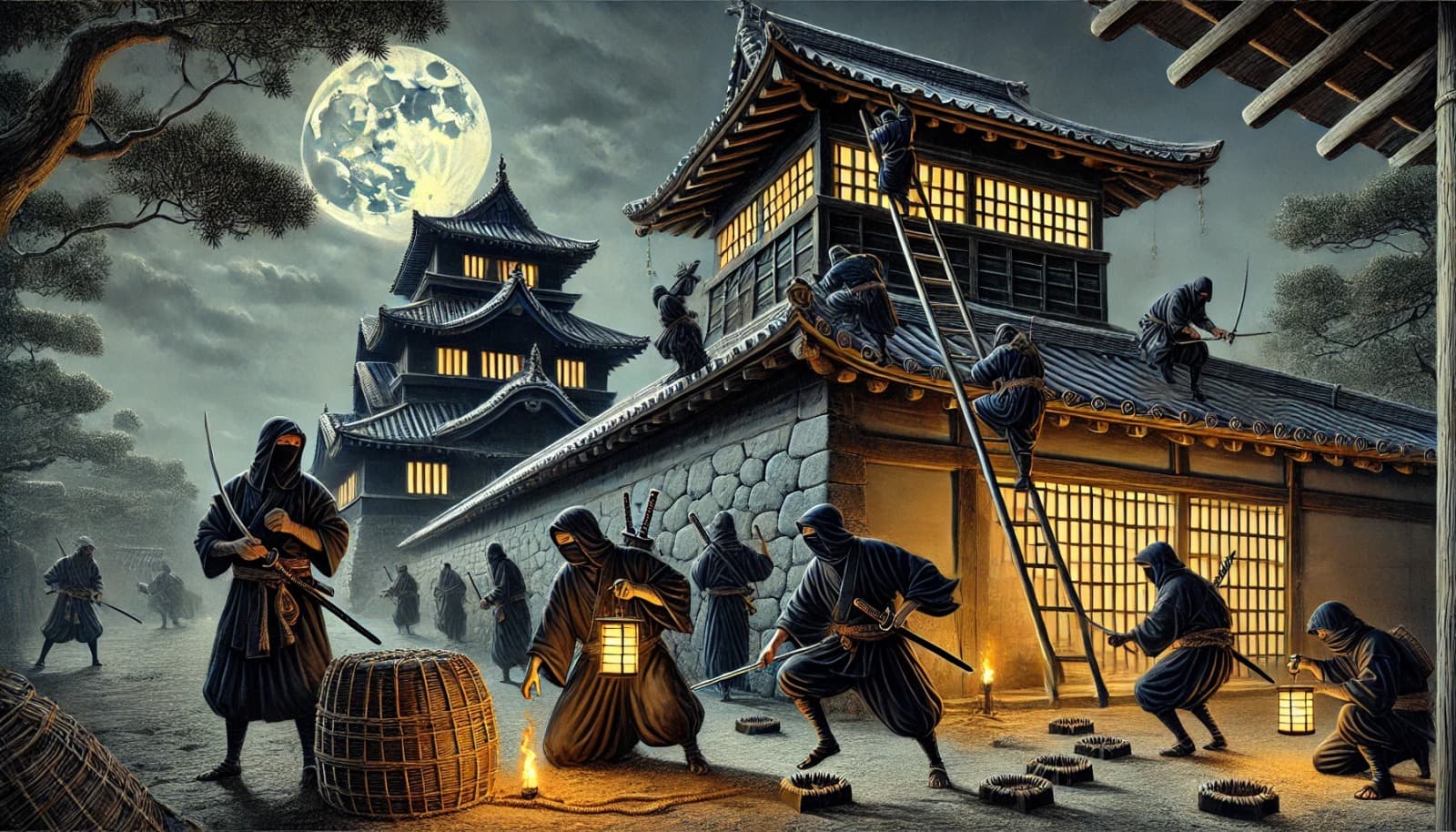
As warfare intensified from the Muromachi through the Sengoku periods, ninja came to serve various feudal lords in espionage and surprise attacks. Particularly in Iga and Koga, powerful ninja groups formed autonomous organizations, maintaining independence while rejecting outside interference, yet being hired by feudal lords across the country as needed.
Ninja missions ranged widely from disguised reconnaissance infiltrating enemy territory, spreading disinformation, nighttime castle infiltration and arson, assassination, and kidnapping. Sengoku-era ninja skillfully used weapons such as short swords (kodachi), chain-sickles (kusarigama), blowguns, and gunpowder bombs, while employing unique tactics and tools like rope ladders and grappling hooks to scale castle walls, and scattering caltrops (makibishi) to impede enemies.
3. Ninja in the Edo Period (17th-19th Centuries)
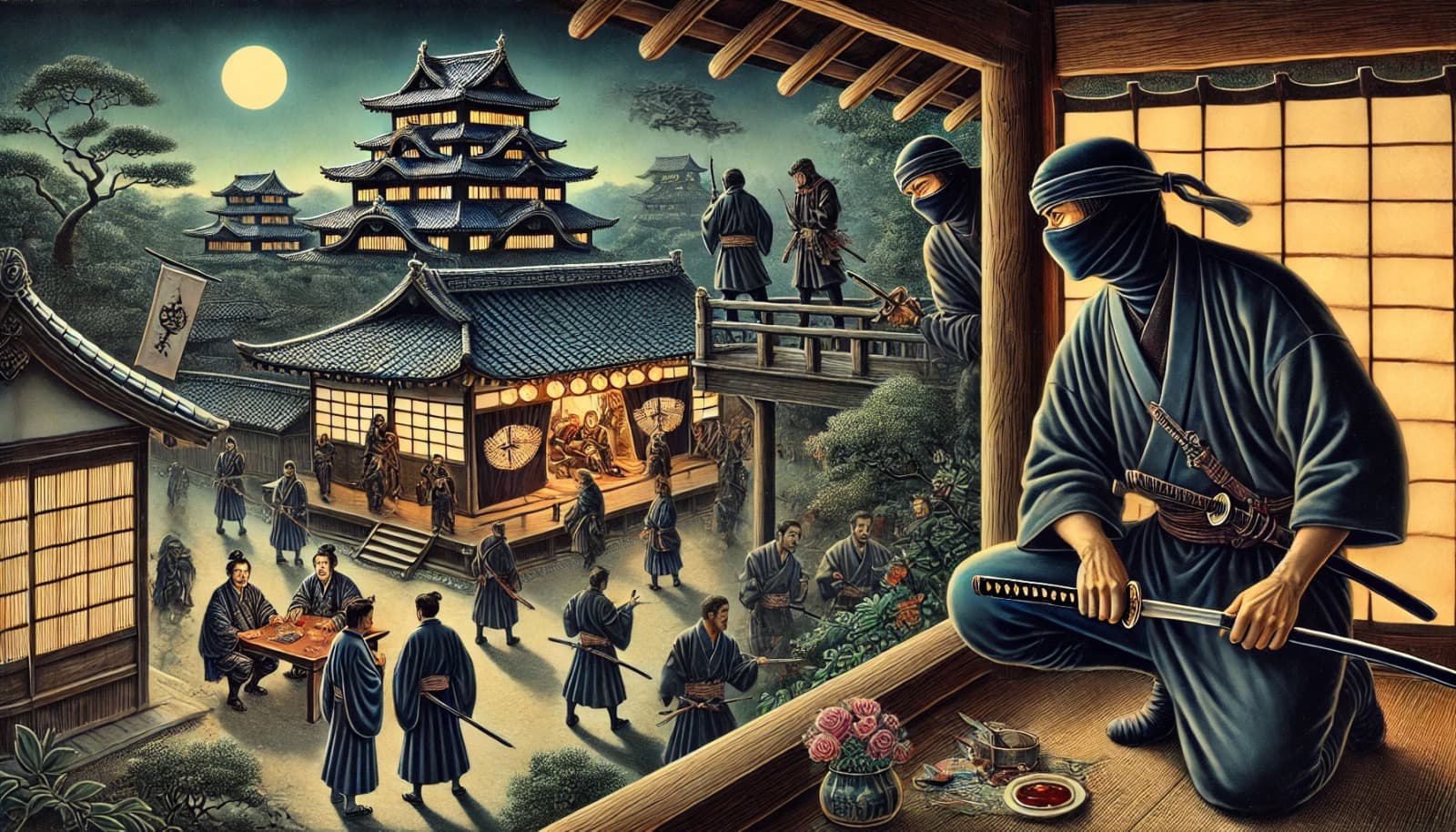
During the Edo period, peace arrived and the ninja’s role shifted primarily to intelligence gathering and security. Tokugawa Ieyasu recruited ninja from Iga and Koga into the shogunate, and figures like Hattori Hanzo were placed in charge of guarding Edo Castle and monitoring feudal lords. Subsequently, ninja served in covert organizations directly under the shogunate, such as the oniwaban (garden guards), carrying out intelligence gathering, though many came to live ordinary lives as rural samurai or officials.
From around the late 18th century, ninja began appearing in kabuki and novels, becoming widely known as legendary heroes such as Ishikawa Goemon and Sarutobi Sasuke.
4. The Changing Image of Ninja in the Modern Era (19th Century Onward)
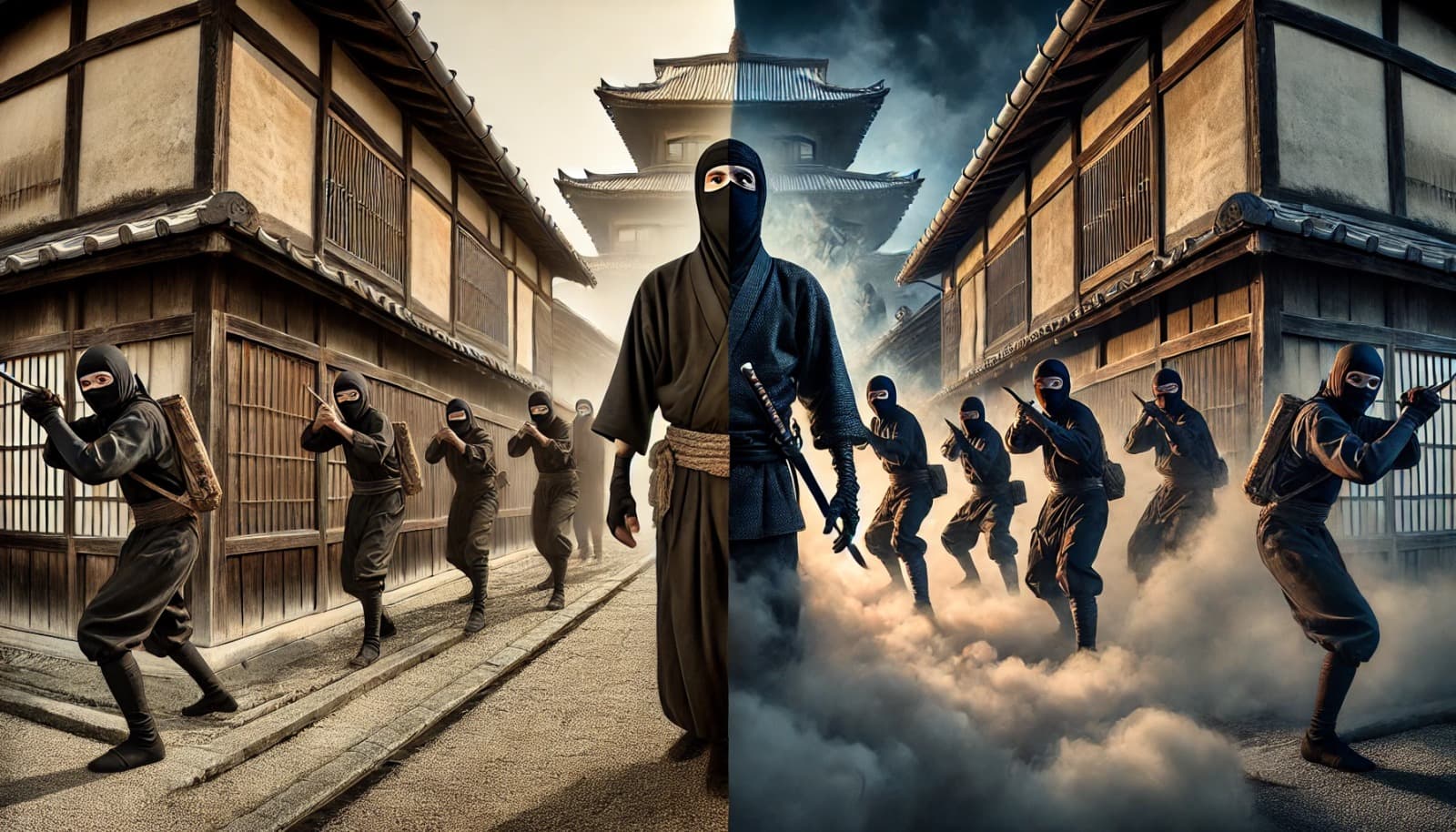
With the Meiji Restoration (1868), the samurai system was abolished, and ninja also lost their official roles and declined. However, in the late Meiji period, they attracted renewed attention through popular novels, with fictional ninja like Sarutobi Sasuke and Kirigakure Saizo gaining popularity. From the Taisho period onward, ninja were also depicted in films, and characteristic portrayals such as “disappearing in a puff of smoke” became widespread.
After World War II, in the 1950s and 60s, ninja novels like Yamada Futaro’s “The Kouga Ninja Scrolls” became massive hits, and films and television programs based on them were produced one after another. Subsequently, manga and anime such as “Kamui Gaiden” and “NARUTO” gained popularity both domestically and internationally, establishing the image of “ninja = cool Japanese culture.”
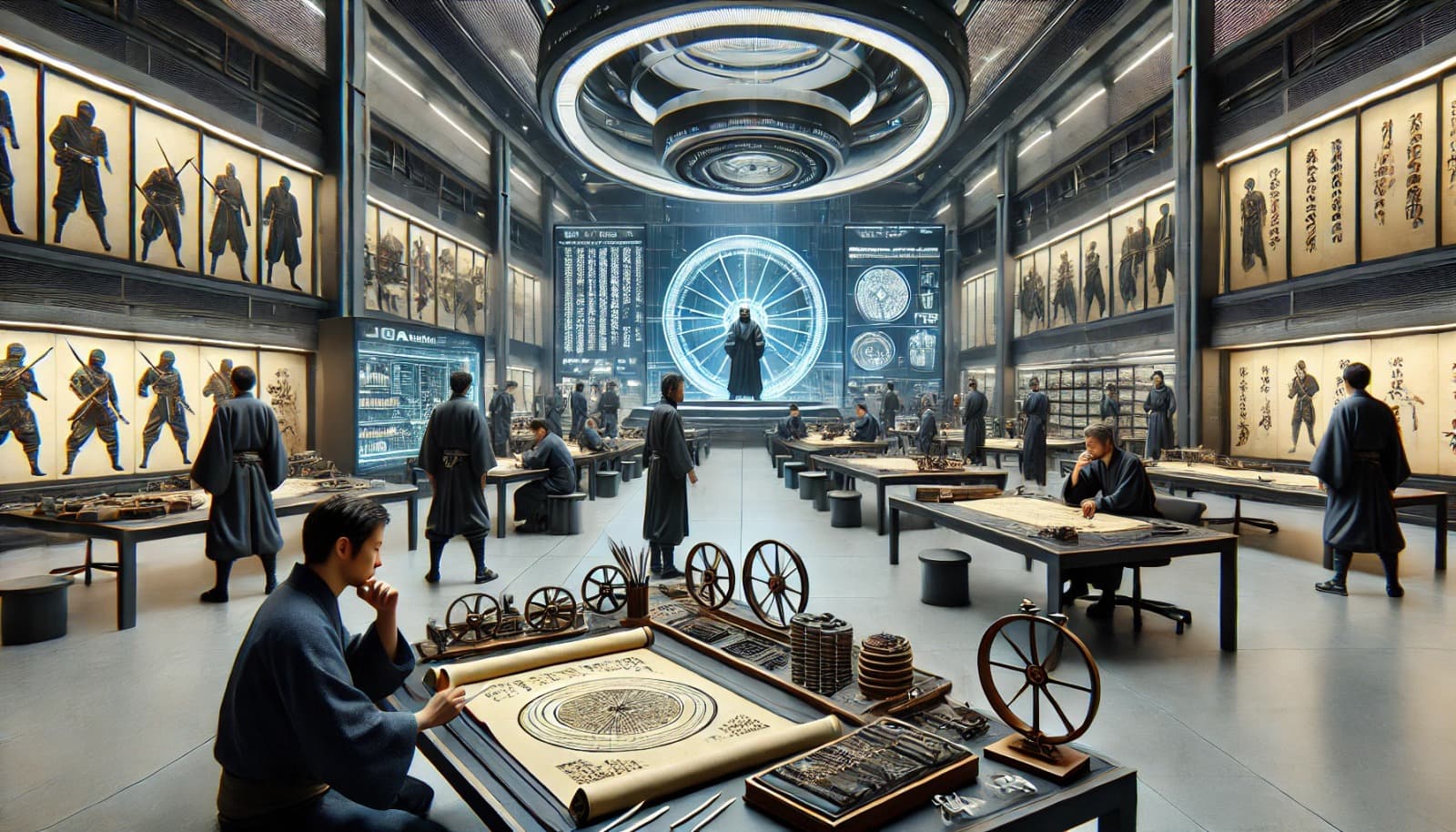
Today, ninjutsu research has also advanced, with the world’s first ninja research organization established at Mie University. The history and techniques of ninja are widely introduced at facilities such as the Iga-ryu Ninja Museum. Internationally, the ninja image has become firmly established through films and games, and ninja have become symbols of Japanese culture beloved around the world.
Ninja Equipment
Ninja were skilled in the use of a wide variety of weapons and tools. Their main equipment included the following:
・Kasha-ken (Fire Wheel Shuriken)
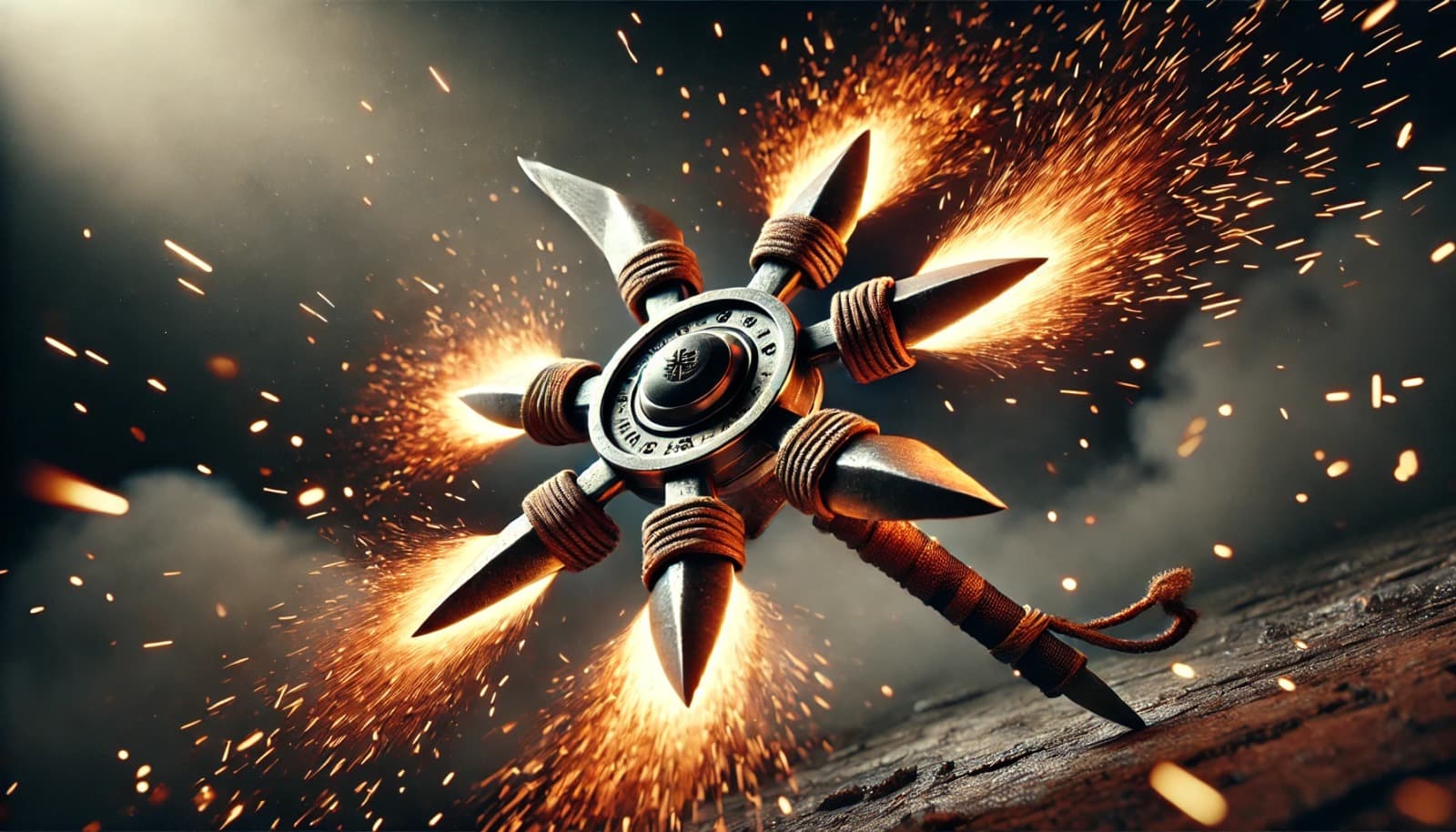
The kasha-ken was a specialized shuriken used by ninja, featuring a cross-shaped shuriken wrapped with a slow match fuse, with gunpowder concealed in its center. When the fuse was lit and the kasha-ken was thrown, it would ignite in mid-flight and was used for illumination and arson. This weapon was used not only to cause confusion among enemies but also to support covert operations.
There are few historical documents about the actual use of kasha-ken, and they are primarily mentioned in later works of fiction and legends. Therefore, the extent to which kasha-ken were actually used remains largely unknown and has not been established as definitive historical fact.
・Kusarigama (Chain Sickle)
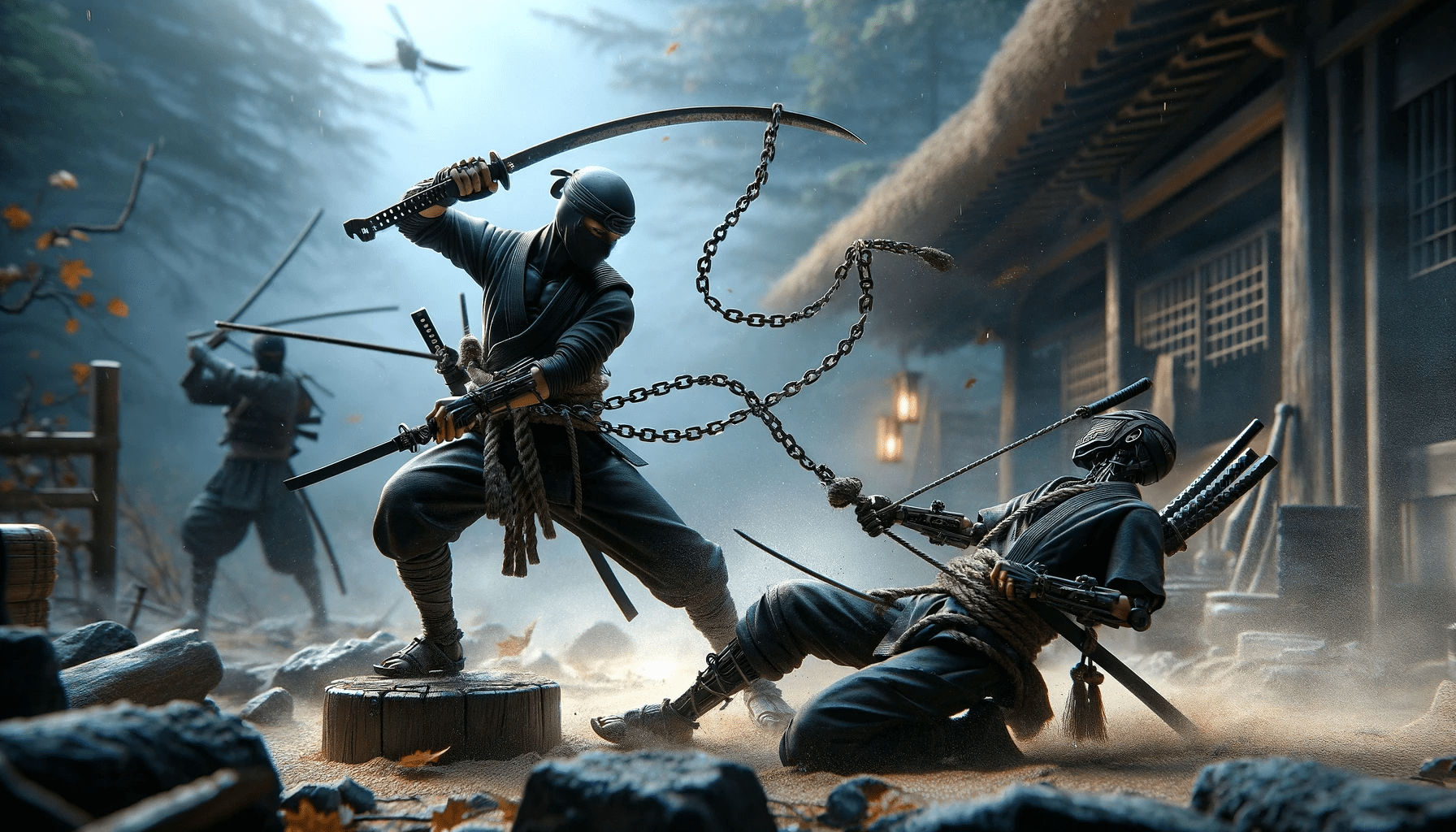
The kusarigama was a weapon said to have been used by ninja and warriors during the Sengoku period. This weapon consisted of a chain with a sickle on one end and a weighted ball on the other. The tactic involved first entangling the weighted chain around the enemy’s weapon or limbs to restrict their movement, then attacking with the sickle. The length of the chain and weight of the ball made it possible to pull in enemy weapons or strike down opponents.
While the kusarigama was said to have been used by ninja and some samurai, its use required advanced skill. Because it could be used for both offense and defense, it was an extremely effective weapon in the hands of a skilled user.
・Shinobigama (Stealth Sickle)
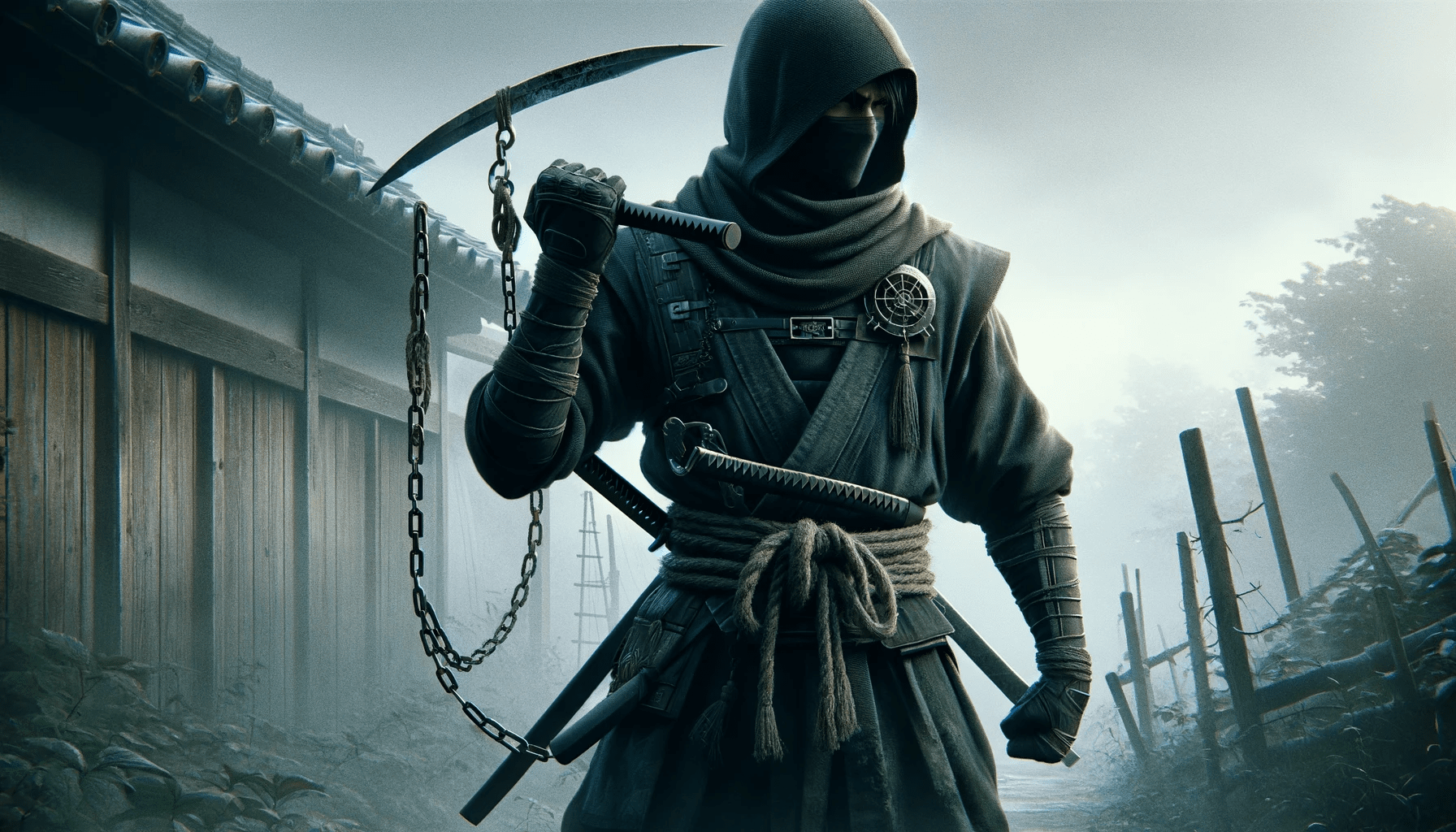
The shinobigama was a weapon disguised as an agricultural sickle, used by ninja during covert operations and surprise attacks. At first glance, it appeared to be an ordinary farming tool, but it could also function as a combat weapon. By attaching a chain, it could also be used as a kusarigama for long-range attacks or disarming enemies.
The shinobigama was particularly valued for nighttime operations and infiltration activities, used to approach enemies undetected and launch sudden attacks. As a versatile ninja weapon, its design was ingenious – appearing as everyday farm equipment while actually functioning as a combat tool.
・Manrikigusari (Weighted Chain)
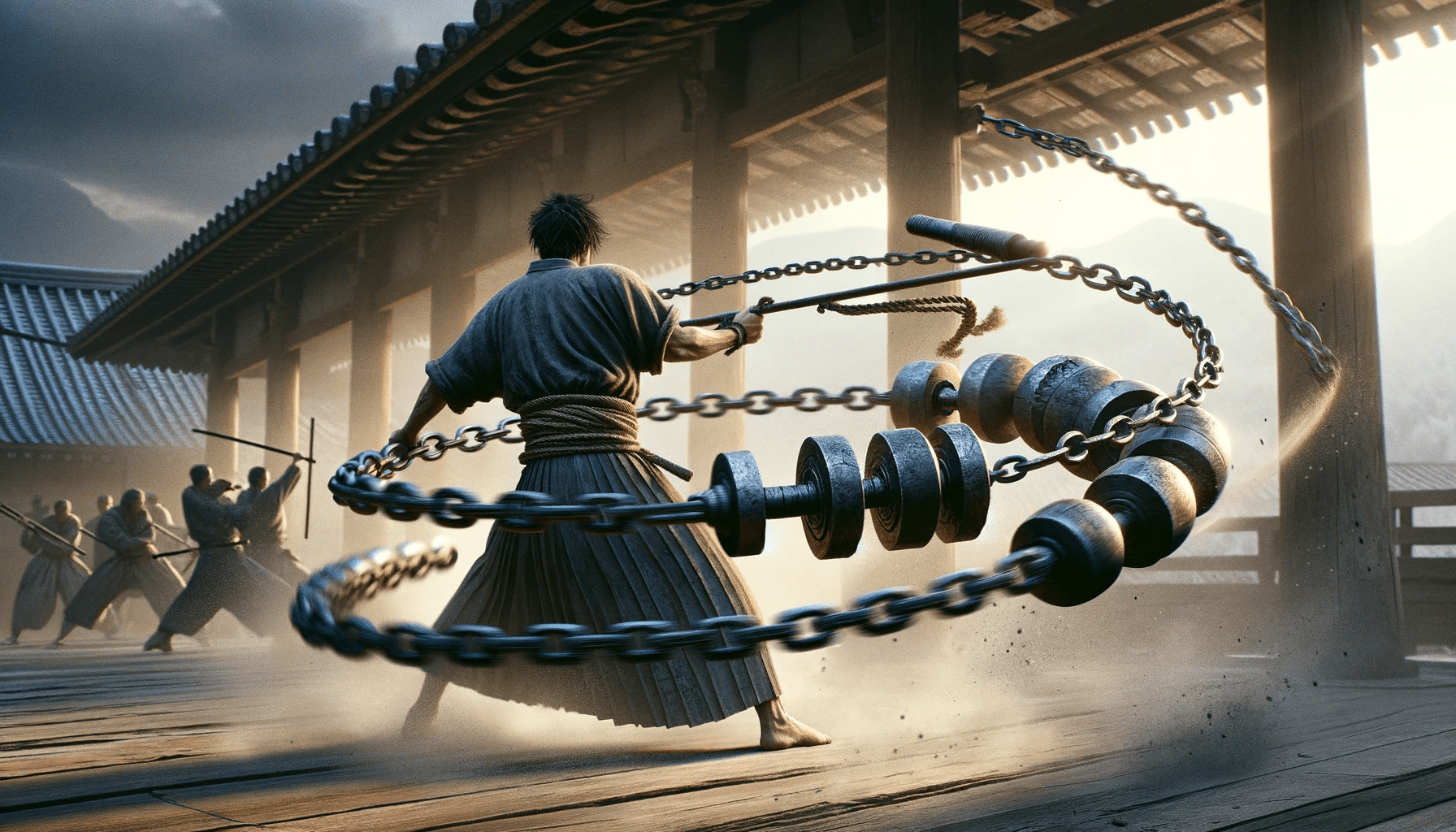
The manrikigusari was a weapon consisting of a chain with weights on both ends, used for attack and self-defense through centrifugal force. This weapon was primarily used for defensive purposes, swinging the weights using centrifugal force to deflect enemy attacks, strike opponents, or entangle and neutralize enemy weapons.
The manrikigusari was used as part of martial arts and ninjutsu techniques, requiring advanced skill. The striking power varied depending on the weight and chain length, enabling effective subdual of enemies. Used by ninja and some samurai, its versatility made it valuable for both self-defense and attack.
・Makibishi (Caltrops)
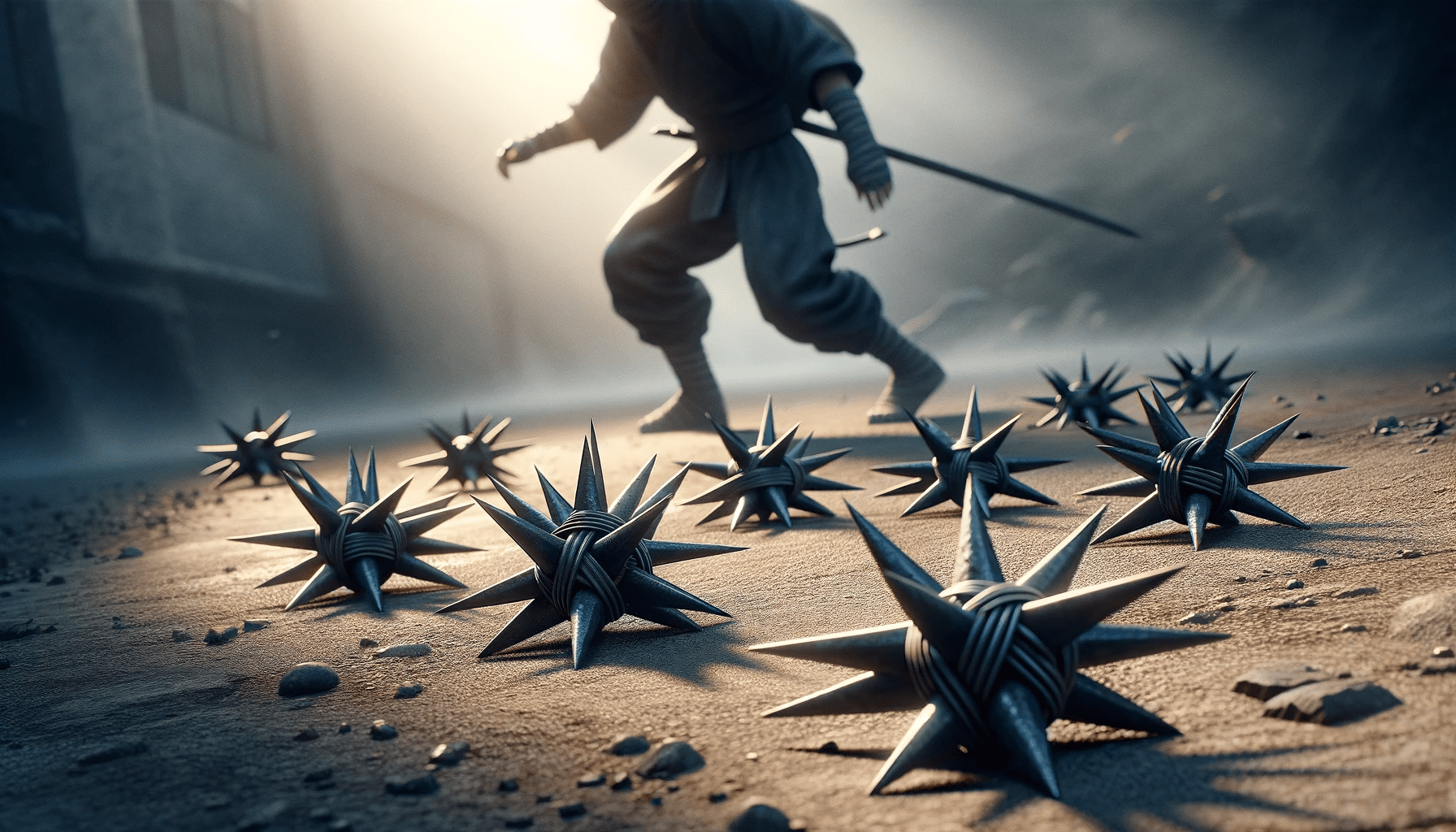
Makibishi were tools used by ninja to impede enemies, scattered on the ground to slow down enemy movement or restrict their actions. Made from metal or bamboo, these pointed implements were designed so that a sharp point would protrude upward no matter which face was on top. This meant that any enemy who stepped on them would feel pain in their feet and have their movement restricted.
Makibishi were frequently used when pursuing enemies or fleeing from pursuers. Their simple yet effective design makes them one of the ninja’s most iconic pieces of equipment. They were particularly suited for nighttime activities and use in dark places, proving highly effective at immobilizing enemies.
・Kakushi (Hidden Ring Weapon)
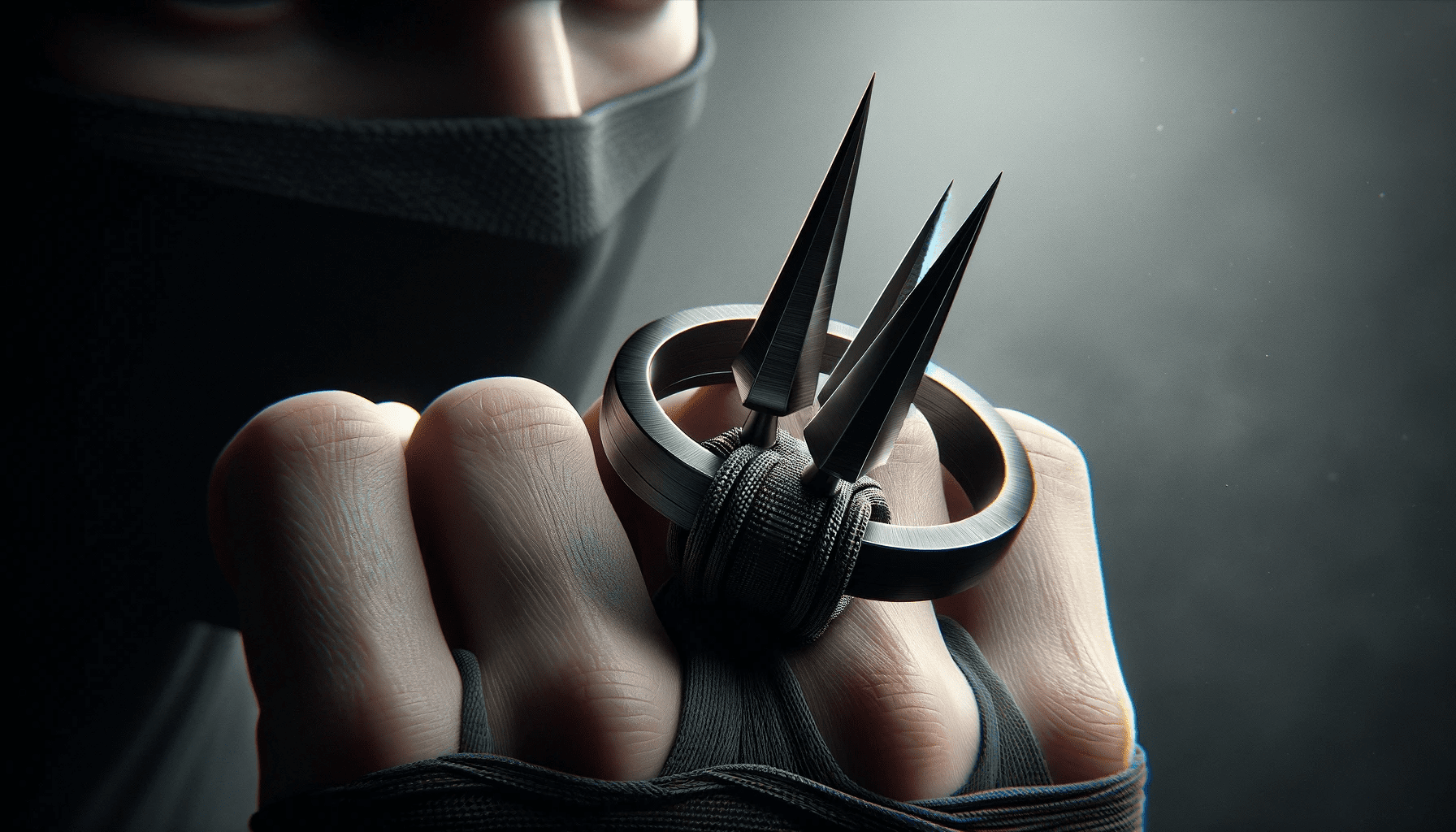
The kakushi was a close-combat weapon used by ninja, similar in shape to a modern brass knuckle. The kakushi was worn on the fingers like a ring and used to increase striking power. This enabled the user to inflict damage on enemies that would not be possible with bare hands.
The kakushi was often used for self-defense when encountering enemies during covert operations, and its compact, portable design was well-suited to ninja activities. Since it could be equipped without being noticed by enemies, it was effective in surprise attacks and sudden close-quarter combat.
・Horoku-biya (Incendiary Bomb)
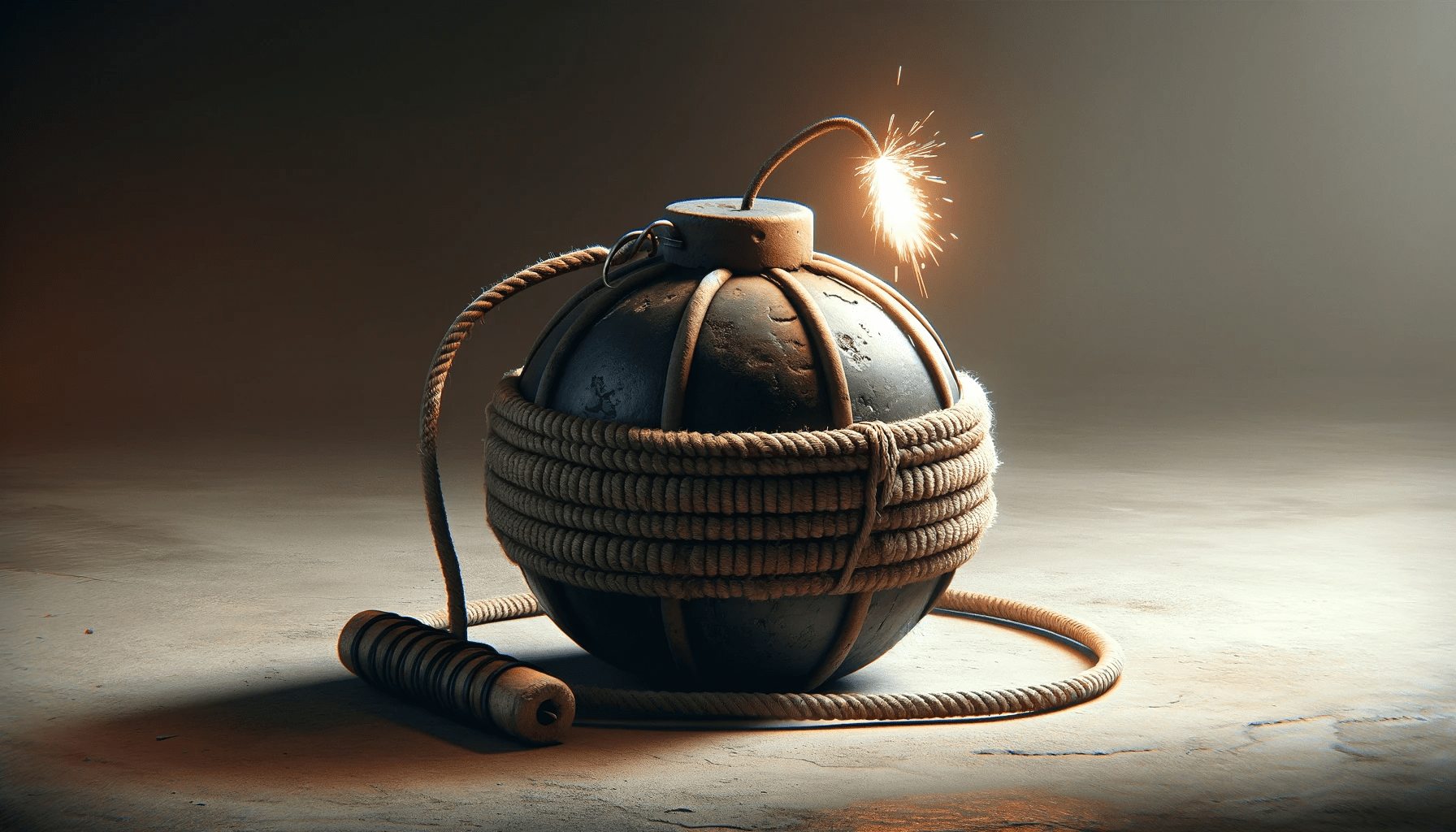
The horoku-biya was a weapon used by ninja as a small bomb, made by filling a horoku (earthenware vessel) with gunpowder. This weapon was used to attack enemy bases or cause confusion. By throwing it or shooting it as a fire arrow, explosive attacks were possible, making it a highly effective destructive weapon.
The horoku-biya was particularly used to set fire to enemy buildings and encampments, crushing enemy morale by causing fires. Due to its power and destructive capability, it was one of the ninja’s most important offensive tools.
・Tekko-kagi (Hand Claws)

The tekko-kagi was a rake-shaped weapon used by ninja, primarily for attack and defense. This weapon featured hooks (kagi) attached to tekko (hand and forearm guards), and was used for combat, assassination, and defensive purposes. The tekko-kagi was used to entangle enemy weapons or hook and strike opponents, and its unique shape made it versatile in many situations.
This weapon was highly effective in close combat, particularly suited for assassinations and surprise attacks where ninja approached enemies up close. The design of the tekko-kagi was visually intimidating, said to have a psychological effect of intimidating enemies.
・Kunai
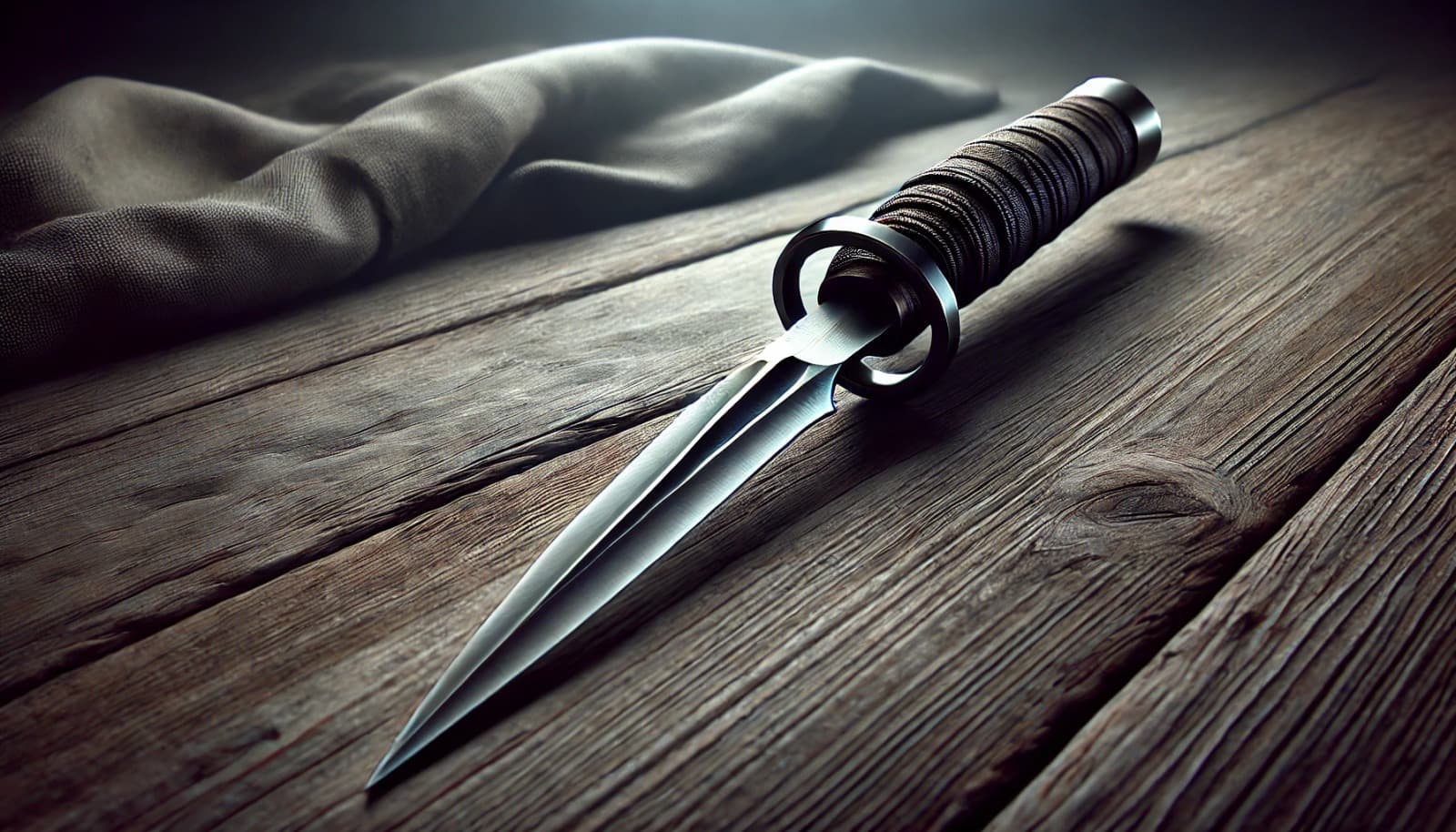
The kunai was a double-edged iron tool used by ninja for a wide variety of purposes. Beyond attacks, it was used for wall climbing, digging holes, and various other applications. It could be thrown like a shuriken and also used as a hand-held weapon. Its shape resembled a short dagger, and its sturdiness also made it useful in covert operations.
Beyond stabbing and cutting enemies in combat, kunai could be driven into walls to create footholds, or used as hooks to snag objects for movement. This high versatility made it one of the most important tools for ninja.
・Shuriken (Throwing Stars)
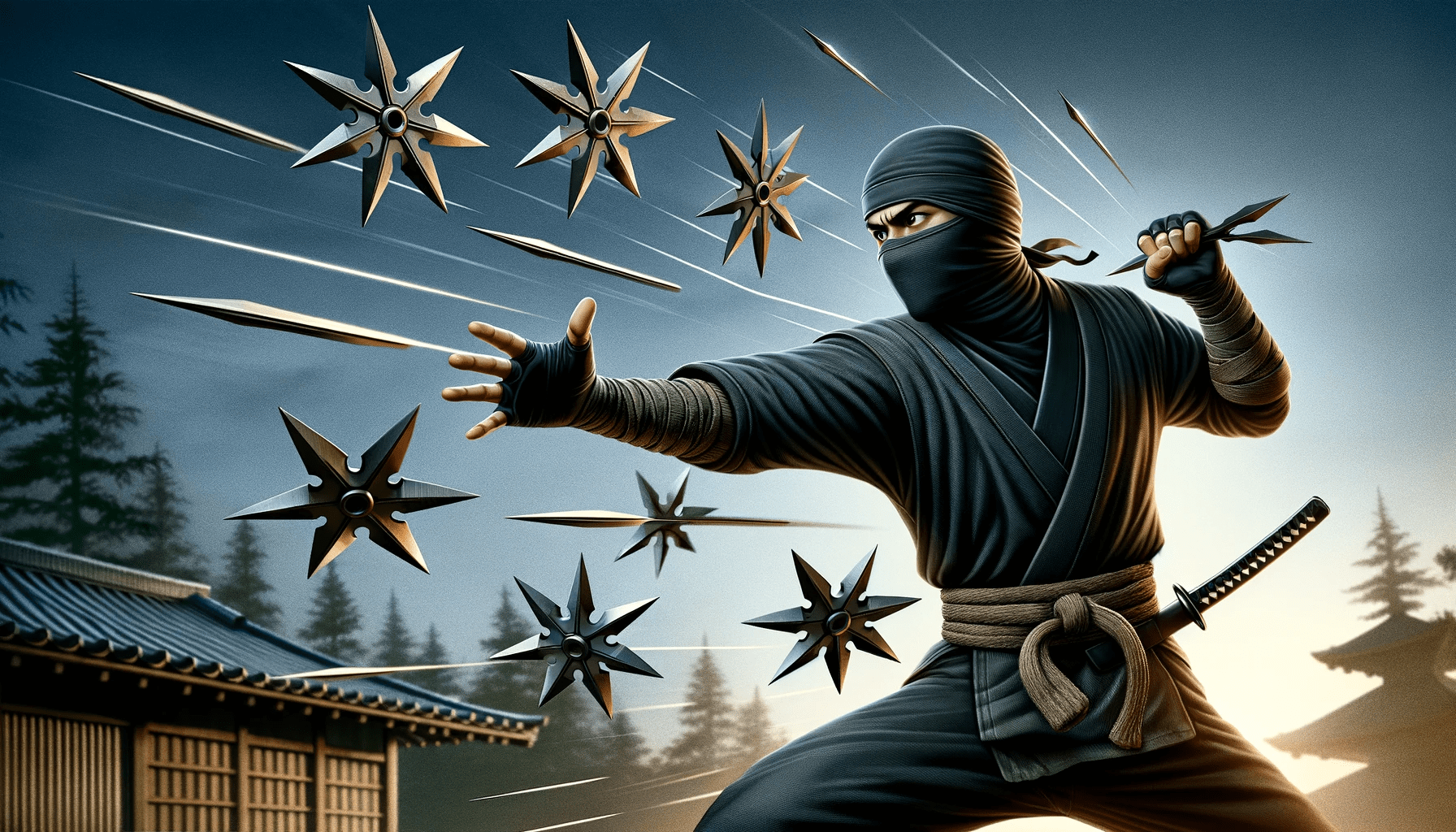
Shuriken were weapons shaped like small swords or needles, used to diminish enemy combat effectiveness. Thrown at enemies, shuriken possessed lethal capability while also serving the role of injuring opponents to reduce their fighting power. These weapons were easy to conceal and were frequently used by ninja during combat and surprise attacks.
Shuriken came in various shapes including cross-shaped, needle-shaped, and star-shaped, with each shape suited to different throwing methods and attack techniques. Shuriken were also used as tools to draw enemy attention, and despite their small size, their diverse applications made them highly valued by ninja.
Places to Experience Ninja Culture
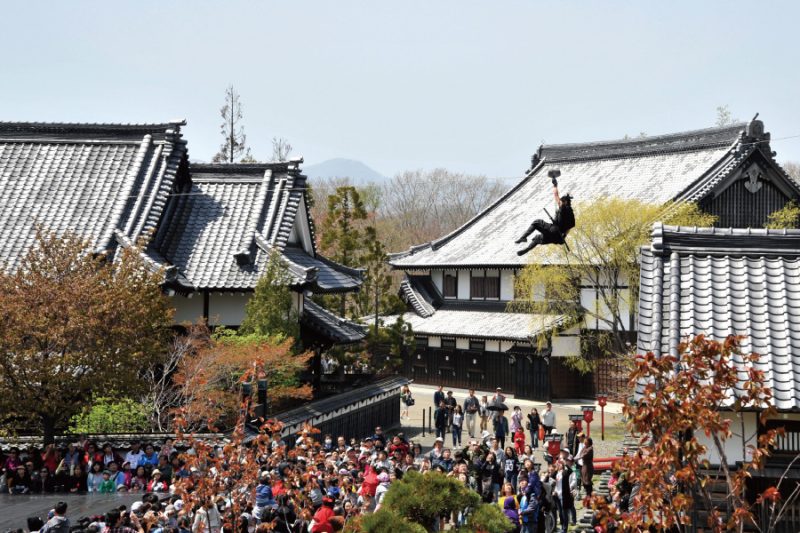
・Noboribetsu Date Jidaimura (Hokkaido):
A theme park recreating Edo-period streets where visitors can experience the lives of samurai and townspeople. Ninja shows are held featuring acrobatic martial arts demonstrations. Activities allowing hands-on experience of ninja skills include shuriken throwing, archery, and trick houses. Edo-style dining is also available at restaurants within the park.

・Yajin-ryu Ninjutsu “Ya-nin” (Tokyo):
A ninja experience held in the mountain village of Akiruno in Tokyo. Visitors can learn authentic ninjutsu, experiencing weapon techniques such as shuriken and blowguns, as well as stealth action and survival skills. Unlike conventional entertainment elements, it is known as a place to learn practical ninja techniques and spirituality.
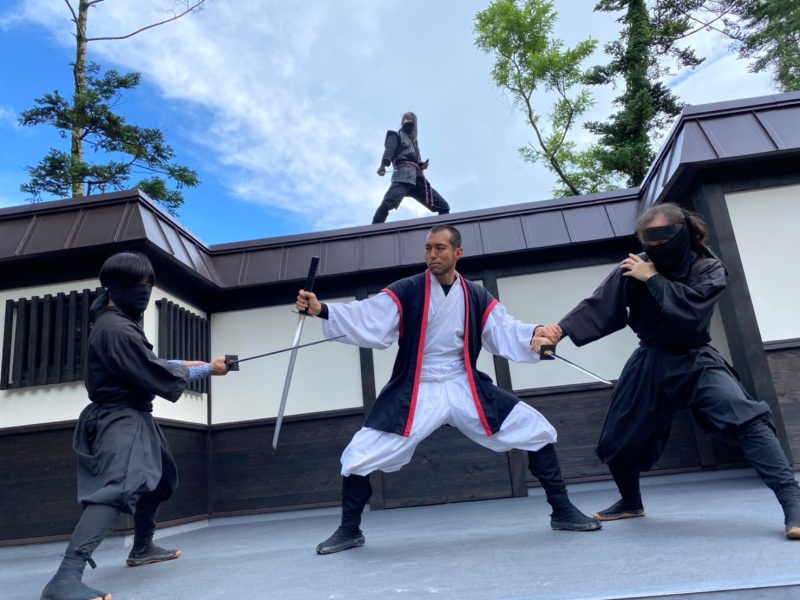
・Oshino Shinobi no Sato (Yamanashi Prefecture):
A ninja theme park at the foot of Mt. Fuji. In addition to hands-on shuriken, archery, and blowgun experiences, authentic ninja shows are performed. The grounds feature beautiful Japanese gardens, and visitors can dress in ninja costumes for photos. Ninja activities suitable for both adults and children are available.

・Togakushi Folk Museum & Togakure-ryu Ninja Museum (Nagano Prefecture):
A museum where you can learn about the history of Togakure-ryu ninja. The Ninja Treasure Hall displays actual ninja tools and secret manuscripts, while the trick house lets visitors experience hidden doors and mechanisms firsthand. Children’s ninja training athletic courses are also available, allowing visitors to enjoy the ninja world.
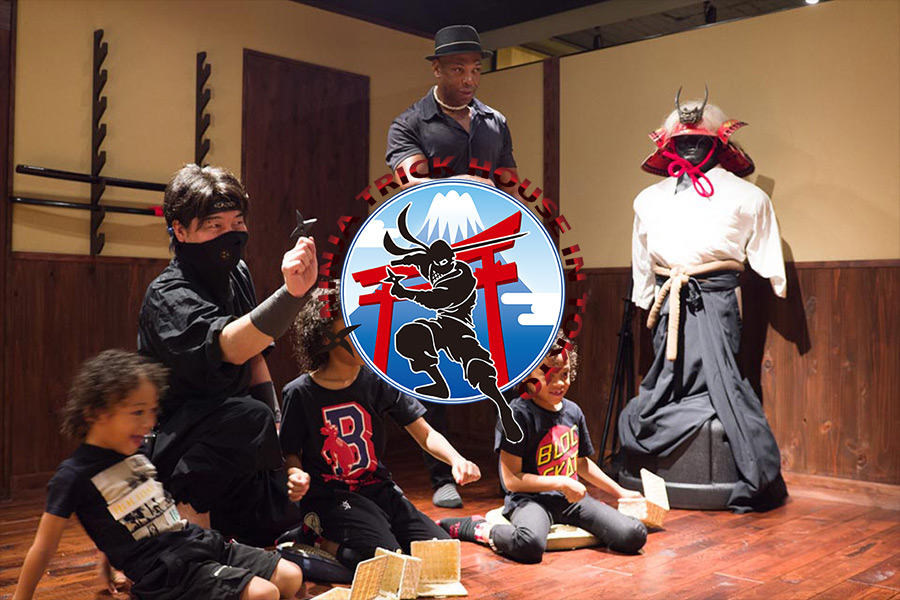
・Shuriken Dojo Shinjuku Ninja Trick House (Tokyo):
A ninja entertainment facility in Shinjuku. Visitors can enjoy “trick hunting” to find hidden rooms and mechanisms, as well as “shuriken experiences” throwing real iron shuriken. Sword techniques and makibishi tactical experiences are also available, making it a spot where you can casually practice ninja training in the city.